GST Rate Cuts Price Monitoring and Consumer Spending Growth
Source:The Hindu ↗
Why It Matters
It illustrates the real-world impact of indirect tax reforms on consumer behavior and the economy. It highlights the importance of government monitoring (akin to the anti-profiteering framework) to ensure tax benefits reach citizens, and connects recent trends in food deflation with broader economic growth dynamics.
Summary
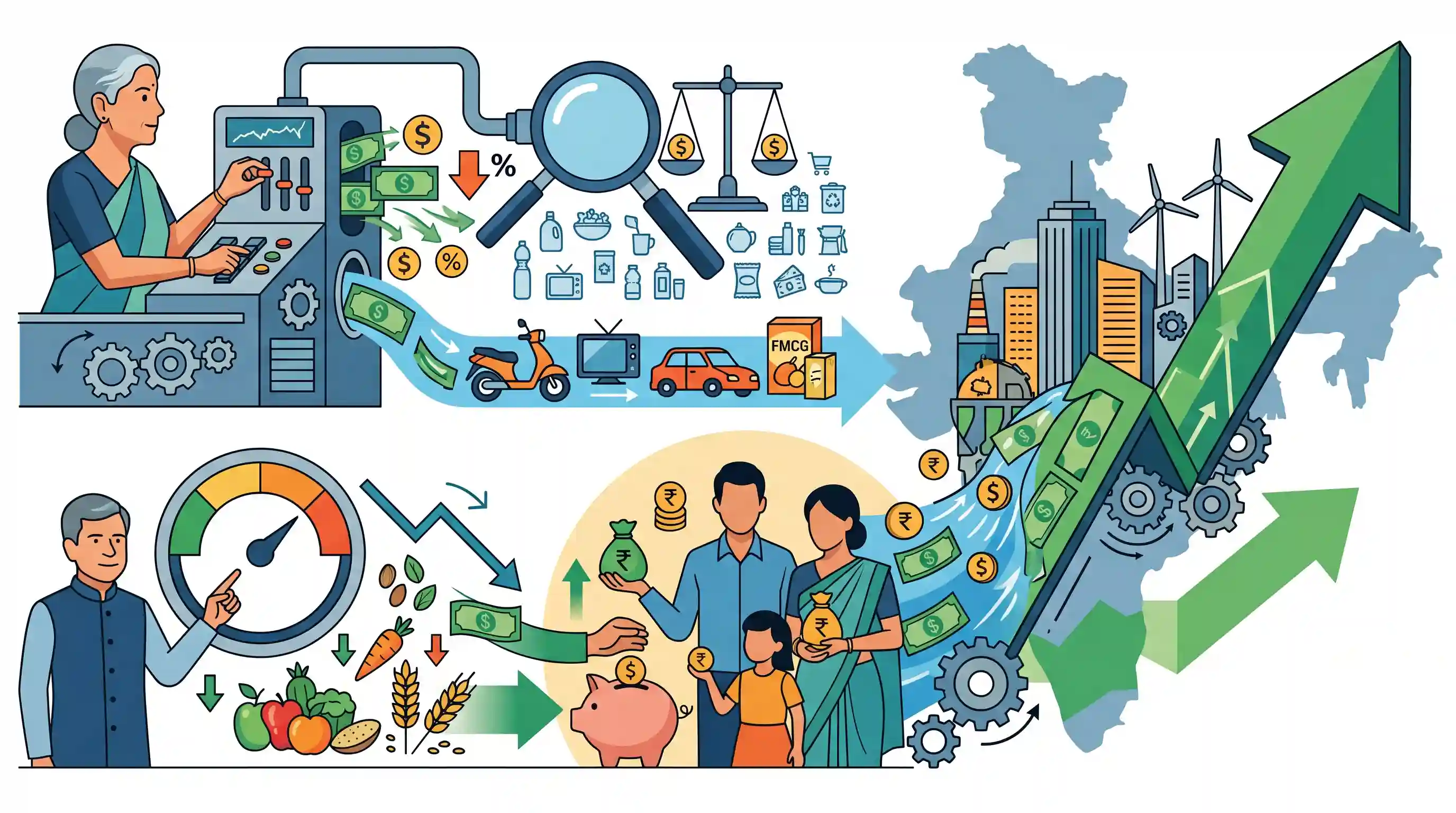
Finance Minister Nirmala Sitharaman has affirmed that the benefits of Goods and Services Tax (GST) rate cuts are successfully reaching consumers, a claim backed by government monitoring of 54 daily-use items including two-wheelers, cars, televisions, and FMCG products. These sectors are currently experiencing robust sales growth. Additionally, Information and Broadcasting Minister Ashwini Vaishnaw noted that India is witnessing a food deflation of about -2%. The combination of lower indirect taxes and falling food prices is expected to significantly boost household savings and drive domestic consumer expenditure, reinforcing overall economic growth.
Key Points
- The Indian government is monitoring retail prices of 54 essential and daily-use items to guarantee that GST rate cuts are fully passed on to consumers.
- Significant sales growth has been recorded in sectors directly benefiting from these tax rationalizations, including automobiles, tractors, televisions, and FMCG.
- India is currently experiencing food deflation of around -2%, which, combined with lower tax rates, is easing the burden on household budgets.
- These factors collectively contribute to a robust increase in consumer spending, thereby stimulating overall economic growth.
Important Terms
Goods and Services Tax (GST)

A comprehensive, destination-based indirect tax levied on the supply of goods and services, replacing multiple central and state taxes to create a unified national market.
UPSC context
GS Paper III (Economy); tests knowledge of tax reforms, fiscal federalism, and formalization of the economy.
Anti-profiteering Mechanism
A legal requirement under Section 171 of the CGST Act ensuring that businesses pass on benefits of tax rate reductions or input tax credits to consumers.
UPSC context
GS Paper III (Economy); relates to consumer protection, regulatory effectiveness, and GST implementation challenges.
Food Deflation
A sustained decrease in the general price level of food items, increasing consumer purchasing power but potentially impacting farmer incomes and agricultural production incentives.
UPSC context
GS Paper III (Economy); relevant to inflation targeting, agricultural economics, and macroeconomic stability.
FMCG (Fast-Moving Consumer Goods)
India's fourth-largest sector, consisting of low-cost products sold quickly with high turnover, including packaged foods, toiletries, and household essentials.
UPSC context
GS Paper III (Economy); tests understanding of industrial sectors, rural demand, and employment generation.
Indirect Tax
A tax collected by an intermediary (such as a retailer) from the person who bears the ultimate economic burden (the consumer) through spending.
UPSC context
GS Paper III (Economy); covers the basics of the Indian taxation system and price dynamics.
Prelims Trap
The National Anti-Profiteering Authority (NAA) is the apex statutory body responsible for monitoring if GST rate cuts reach consumers.
Aspirants often assume the NAA still exists. However, its tenure expired, and since December 2022, the Competition Commission of India (CCI) adjudicates all GST anti-profiteering complaints.
Static Concepts Connected
How does the GST anti-profiteering mechanism function under current laws?
- Statutory Mandate: Section 171 of the CGST Act mandates that any reduction in tax rates or benefit of input tax credit must be passed on to the consumer via price reduction.
- Enforcement Agency: Following the sunset of the National Anti-Profiteering Authority (NAA), the Competition Commission of India (CCI) is now the nodal agency handling these complaints.
- Penalties: Non-compliance can result in an order to reduce prices, return the profiteered amount with interest, or even cancellation of GST registration in extreme cases.
Why does food price volatility dominate India's retail inflation targeting?
- High CPI Weightage: Food and beverages carry a massive weightage of approximately 45.86% in the Consumer Price Index (CPI), dictating the headline inflation numbers tracked by the RBI.
- Supply-Side Driven: Food inflation is largely structural and driven by supply shocks (monsoons, logistics), limiting the effectiveness of the RBI's demand-side monetary policy tools in controlling it.
Cross-Topic Patterns
CCI's expanded mandate in tax compliance
The transition of GST anti-profiteering duties to the Competition Commission of India (CCI) bridges indirect tax law with market-competition regulation, making CCI a prime target for institutional questions.
Indirect tax relief and K-shaped recovery
Lowering indirect taxes (which are inherently regressive) alongside food deflation directly increases real disposable income at the bottom of the pyramid, acting as a counterweight to K-shaped economic disparities.

Expect a 2026 prelims multi-statement question combining CPI food weightage with the CCI’s statutory role in GST anti-profiteering.
Linked PYQs · 4
Linked PYQs · 4
- 2019MainsGS3
Enumerate the indirect taxes which have been subsumed in the Goods and Services Tax (GST) in India. Also, comment on the revenue implications of the GST introduced in India since July 2017.
- 2024MainsGS3
What are the causes of persistent high food inflation in India? Comment on the effectiveness of the monetary policy of the RBI to control this type of inflation.
- 2017PrelimsGS1
What is/are the most likely advantages of implementing 'Goods and Services Tax (GST)'? 1. It will replace multiple taxes collected by multiple authorities and will thus create a single market in India. 2. It will drastically reduce the 'Current Account Deficit' of India and will enable it to increase its foreign exchange reserves. 3. It will enormously increase the growth and size of economy of India and will enable it to overtake China in the near future. Select the correct answer using the code given below:
- 2011PrelimsGS1
Economic growth is usually coupled with
