GST Process Reforms Through Data Tech and Compliance
Source:Indian Express ↗
Why It Matters
Understanding GST process reforms is crucial for aspirants studying Indian taxation, resource mobilization, and the role of technology in governance and fiscal management under GS Paper III.
Summary
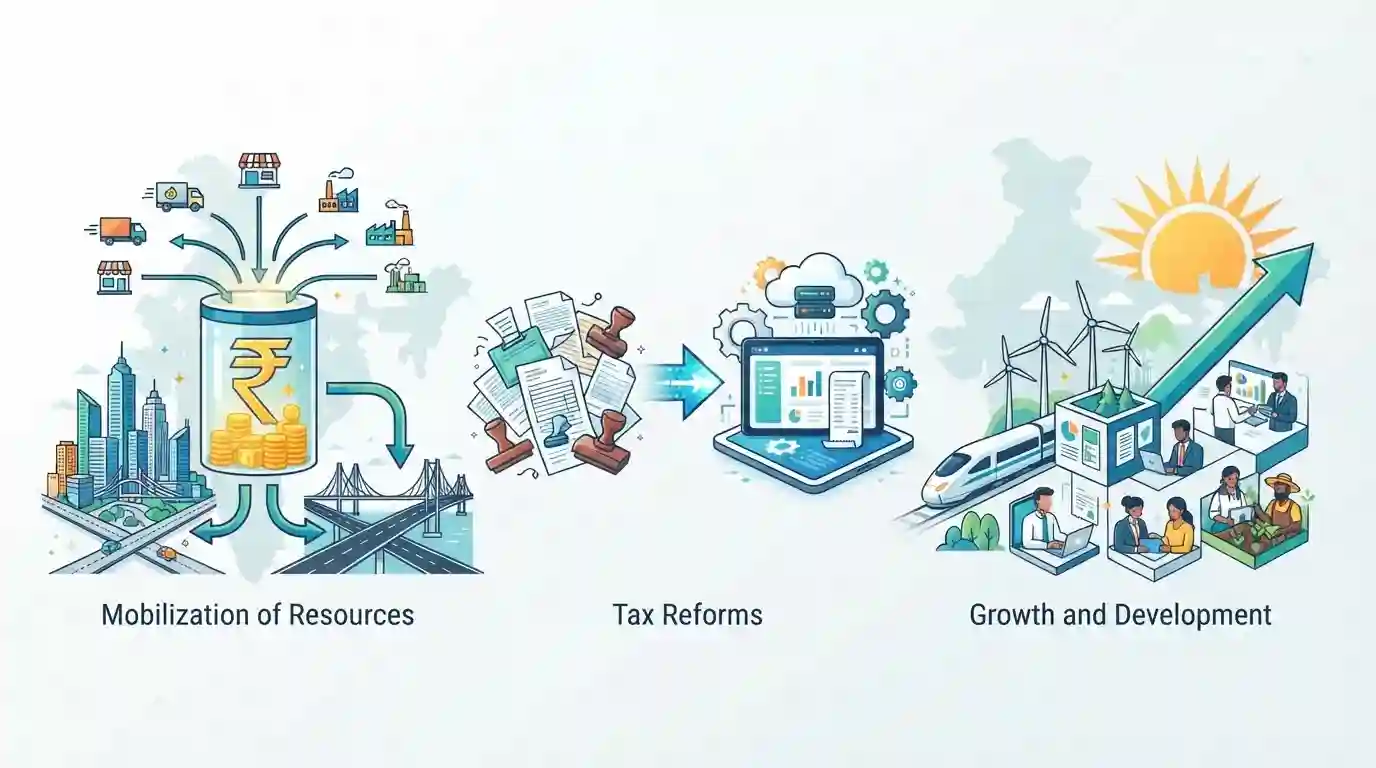
Recent reforms in the Goods and Services Tax (GST) framework leverage data analytics and technology to streamline compliance, minimize evasion, and strengthen tax administration in India.
Key Points
- GST process reforms focus heavily on data analytics, advanced technology, and streamlined compliance to reduce tax evasion.
- The integration of technology aims to ease the compliance burden for honest taxpayers while tightening checks on fraudulent practices.
- Efforts are directed towards optimizing the GST architecture to improve revenue mobilization and enhance federal fiscal transparency.
Important Terms
GST Council

A constitutional body established under Article 279A by the 101st Constitutional Amendment Act, responsible for making recommendations on tax rates, exemptions, and GST laws.
UPSC context
UPSC Prelims & Mains (GS Paper II/III): Important constitutional bodies, cooperative federalism, and tax reforms in India.
Goods and Services Tax Network
A not-for-profit public-private organization that provides the core IT infrastructure and services for taxpayer registration, return filing, and tax processing under the GST framework.
UPSC context
UPSC Mains GS Paper III: Growth, development, mobilization of resources, and technology-driven tax administration.
Goods and Services Tax Act
The legislative framework enacted in 2017 that replaced multiple indirect taxes with a unified national indirect taxation system.
UPSC context
UPSC Prelims & Mains (GS Paper III): Indian Economy, economic reforms, taxation structure, and fiscal federalism.
Prelims Trap
The GST Council functions as an advisory committee under the Department of Revenue, Ministry of Finance.
The GST Council is frequently misconstrued as a statutory body or an executive body of the Ministry of Finance, whereas it is a constitutional body established under Article 279A.
Static Concepts Connected
What is the constitutional basis and voting mechanism of the Goods and Services Tax (GST) Council?
- Article 279A: Constitutional status established under Article 279A, inserted by the 101st Constitutional Amendment Act, 2016.
- Composition: Chaired by the Union Finance Minister, with State Finance/Taxation Ministers as members.
- Voting Weight: Centre has a voting weight of one-third (1/3rd) and States combined have two-thirds (2/3rd) of total votes cast.
- Majority Rule: Decisions require a majority of not less than three-fourths (3/4th) of the weighted votes cast.
Cross-Topic Patterns
GST Reforms and Cooperative Federalism
GST Council decisions rely on cooperative federalism where states and Centre vote together, directly linking tax reform to constitutional federal design under Article 279A.
Tax Digitalization and Fiscal Deficit Management
The shift to digital invoice matching and e-invoicing mirrors global tax digitalization trends, impacting ease of doing business rankings and fiscal deficit management.

GST tech integration + DGARM risk-profiling will likely feature in a statement-based Prelims question on indirect tax reforms.
Linked PYQs · 1
Linked PYQs · 1
- 2019MainsGS3
Enumerate the indirect taxes which have been subsumed in the Goods and Services Tax (GST) in India. Also, comment on the revenue implications of the GST introduced in India since July 2017.
