GST Process Reforms and Technology-Driven Tax Compliance
Source:Indian Express ↗
આ શા માટે મહત્વનું છે
Understanding ongoing tax administration and technology-driven compliance reforms under GST is crucial for analyzing India's fiscal policy, revenue mobilization efforts, and ease of doing business initiatives.
સારાંશ
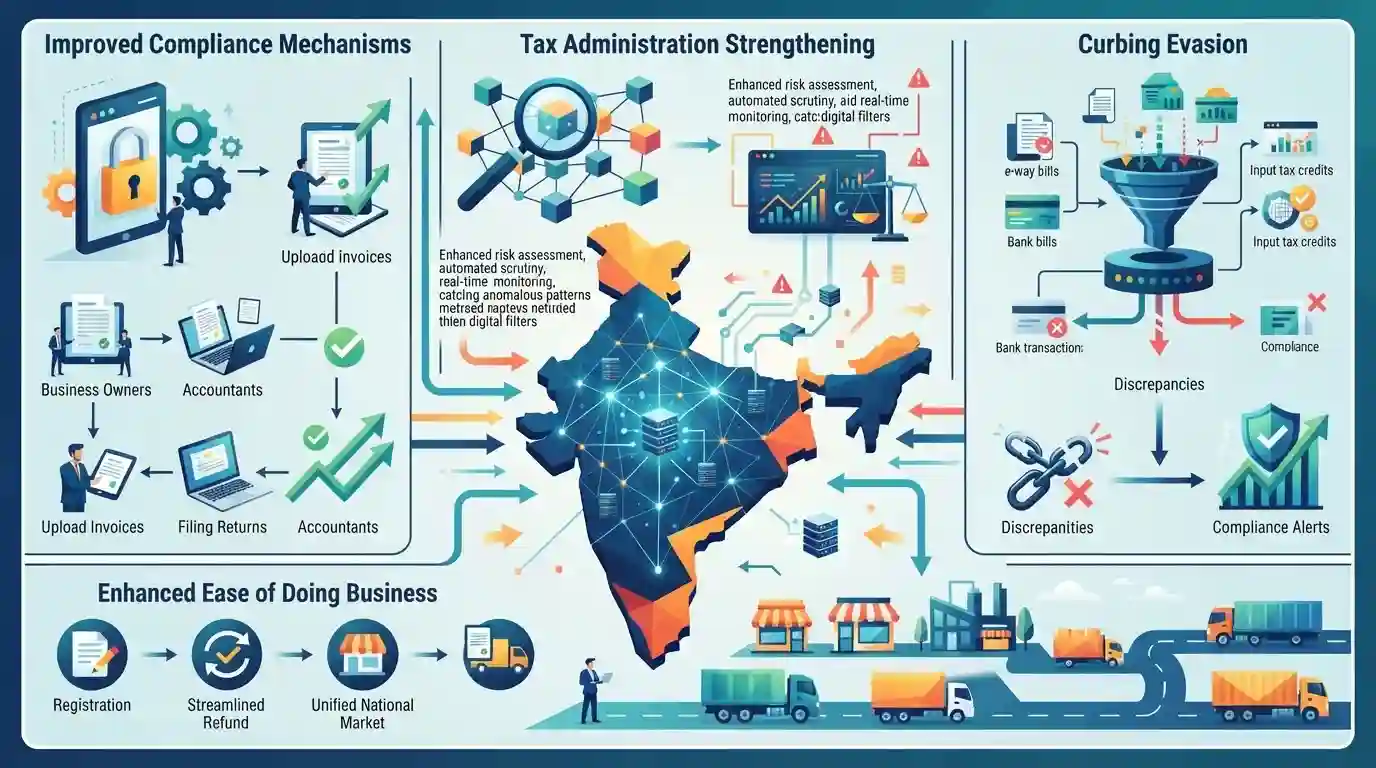
The article highlights recent and ongoing process reforms in the Goods and Services Tax (GST) regime, emphasizing the deployment of advanced technology, data analytics, and improved compliance mechanisms to strengthen tax administration, curb evasion, and enhance ease of doing business in India.
મુખ્ય મુદ્દા
- The government is focusing heavily on GST process reforms using data analytics and technology to streamline compliance.
- Technology integration aims to curb tax evasion, widen the tax base, and ease compliance burdens for honest taxpayers.
- Continuous refinement of the indirect tax architecture strengthens fiscal federalism and improves the overall ease of doing business in India.
મહત્વપૂર્ણ શબ્દો
Goods and Services Tax (GST) Act

A comprehensive indirect tax framework introduced in 2017 to replace multiple cascading central and state levies, creating a unified destination-based national market.
UPSC context
UPSC CSE Mains Paper III (Indian Economy - Government Budgeting and Tax Reforms). Tests understanding of indirect taxation, federal fiscal architecture, and resource mobilization.
GST Council
A constitutional body established under Article 279A comprising Union and State representatives to make recommendations on rates, exemptions, laws, and administrative procedures for GST.
UPSC context
UPSC CSE Mains Paper II (Polity - Cooperative Federalism & Constitutional Bodies) and Paper III. Tests cooperative federalism and decision-making in tax policy.
Goods and Services Tax Network
A non-profit organization serving as the digital backbone of the GST regime, providing shared IT infrastructure for registration, return filing, and invoice matching.
UPSC context
UPSC CSE Mains Paper III (Technology and Economic Development, Tax Reforms). Tests the role of digital infrastructure in curbing tax evasion and compliance.
પ્રિલિમ્સ ટ્રેપ
GSTN is a statutory body established directly under the provisions of the GST Act as a 100% government-owned entity.
Aspirants often assume the GSTN is a fully government-owned statutory body, whereas it is structured as a private limited company with majority non-government equity participation.
સંલગ્ન સ્થિર ખ્યાલો
What is the constitutional and institutional architecture of the Goods and Services Tax (GST) in India?
- Constitutional Amendment: Constitutional basis inserted via the 101st Constitutional Amendment Act, 2016, creating Article 246A for concurrent taxation powers.
- GST Council: Apex decision-making body comprising the Union Finance Minister and state finance ministers, ensuring cooperative fiscal federalism.
- GSTN Infrastructure: Non-profit, public-private partnership entity providing the IT backbone and digital infrastructure for return filing, e-invoicing, and matching.
આંતર-વિષય પેટર્ન
GST Data Tech + Fiscal Federalism + DPI
Advanced data analytics and automated real-time tracking in tax administration bridge the gap between financial inclusion, digital public infrastructure (India Stack), and fiscal deficit consolidation.

GSTN data analytics and e-invoicing architecture will likely be tested via a statement-based question on indirect tax compliance mechanisms.
સંલગ્ન PYQ · 2
સંલગ્ન PYQ · 2
- 2019MainsGS3
Enumerate the indirect taxes which have been subsumed in the Goods and Services Tax (GST) in India. Also, comment on the revenue implications of the GST introduced in India since July 2017.
- 2025PrelimsGS1
With reference to the Government of India, consider the following information: Organization Some of its functions It works under I. Directorate of Enforcement Enforcement of the Fugitive Economic Offenders Act, 2018 Internal Security Division-I, Ministry of Home Affairs II. Directorate of Revenue Intelligence Enforces the Provisions of the Customs Act, 1962 Department of Revenue, Ministry of Finance III. Directorate General of Systems and Data Management Carrying out big data analytics to assist tax officers for better policy and nabbing tax evaders Department of Revenue, Ministry of Finance In how many of the above rows is the information correctly matched?
