GST Council Indirect Tax Rate Overhaul and Dual Slab System
Source:The Hindu ↗
Why It Matters
The GST structure overhaul is one of the most significant fiscal reforms since the introduction of GST in 2017. It addresses long-standing criticisms regarding the complexity of the multi-slab system and classification disputes. For UPSC aspirants, this is critical for understanding indirect taxation, revenue mobilization (GS3), and the functioning of the GST Council as an instrument of fiscal federalism (GS2).
Summary
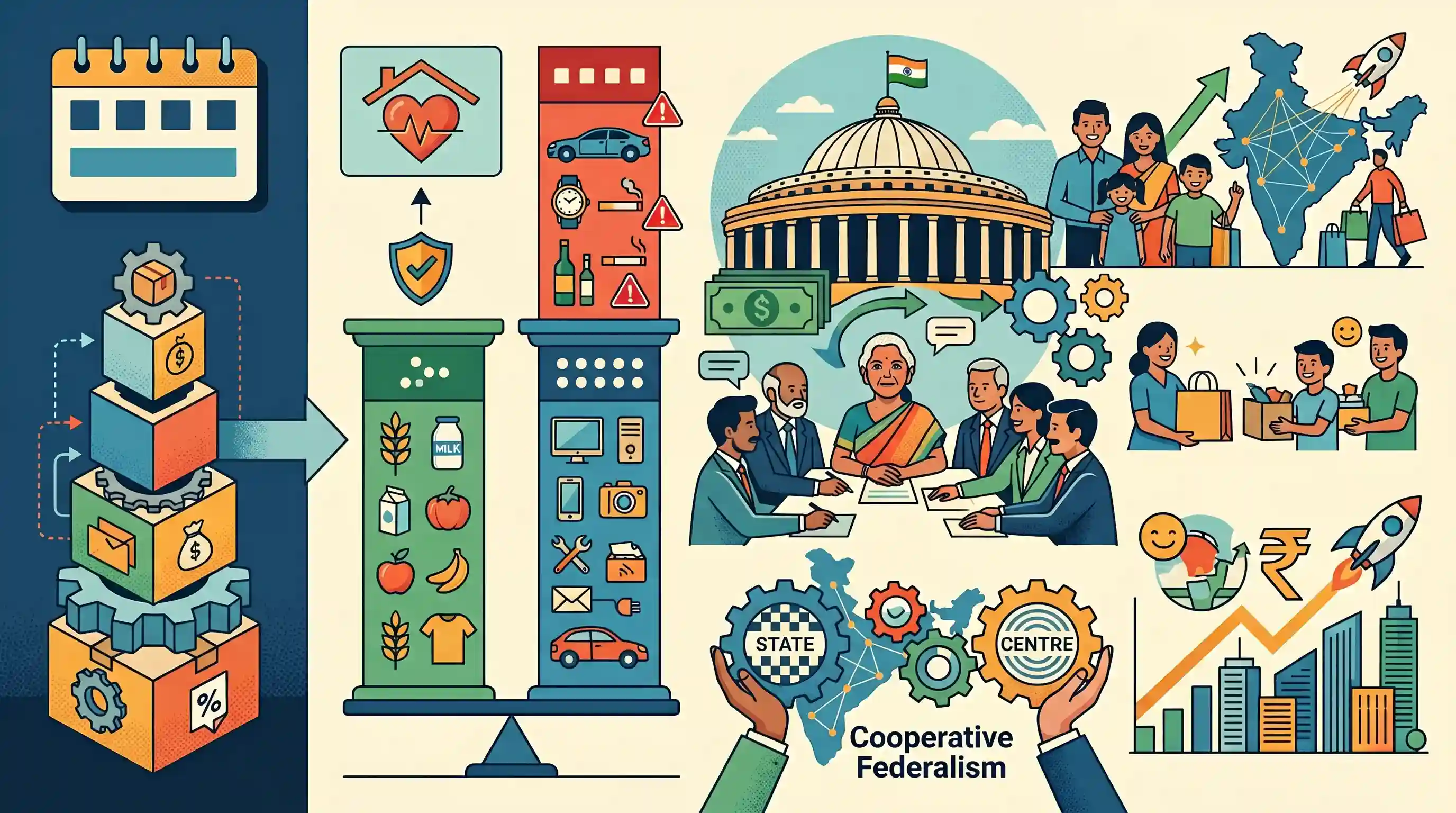
India is set to roll out "GST 2.0" on September 22, 2025, significantly simplifying its indirect tax regime. The 56th GST Council meeting, led by Finance Minister Nirmala Sitharaman, approved a transition from the existing four-tier structure to a dual-slab system with rates of 5% for essentials and 18% as the standard rate. Ultra-luxury and 'sin' items will attract a 40% tax, while health and life insurance premiums are exempted. This reform seeks to eliminate classification disputes, promote affordability, and stimulate consumer spending, marking a major milestone in India's fiscal policy and cooperative federalism.
Key Points
- India will implement the revamped 'GST 2.0' on September 22, 2025, replacing the current four-tier indirect tax system.
- The new structure features a simplified dual-slab system: 5% for essential goods and an 18% standard rate.
- A 40% 'sin tax' or de-merit rate will be applied to ultra-luxury goods, tobacco, and aerated beverages.
- Health and life insurance premiums have been exempted from GST to boost social security coverage.
- The sweeping changes were finalized during the 56th GST Council meeting chaired by Finance Minister Nirmala Sitharaman, aiming to end classification disputes and spur consumer spending.
Important Terms
Goods and Services Tax (GST)

A comprehensive indirect tax on the manufacture, sale, and consumption of goods and services, replacing multiple central and state taxes to create a unified national market.
UPSC context
GS Paper 3 (Indian Economy); essential for understanding indirect tax reforms and the "One Nation, One Tax" concept.
GST Council
A constitutional body (Article 279A) chaired by the Union Finance Minister that makes recommendations on GST rates, exemptions, and administrative rules through center-state consensus.
UPSC context
GS Paper 2 (Statutory/Constitutional Bodies); tests knowledge of fiscal federalism and joint decision-making mechanisms.
GST 2.0
An advanced phase of GST reform focused on simplifying the tax structure into fewer slabs (e.g., dual-rate system) to reduce classification disputes and improve compliance.
UPSC context
GS Paper 3 (Economy); relevant for questions on tax buoyancy, ease of doing business, and evolving fiscal policy.
Cooperative Federalism
A federal mechanism where the Center and States work together to solve common problems, exemplified by the GST Council's joint authority over indirect taxation.
UPSC context
GS Paper 2 (Polity); a core concept in Indian federalism and center-state financial relations.
Sin Tax
Higher taxes levied on goods deemed harmful to individuals or society (like tobacco and high-sugar items) to discourage consumption and fund social costs.
UPSC context
GS Paper 3 (Budgeting/Social Issues); tests understanding of demerit goods and corrective taxation.
Rate Rationalization
The process of simplifying multiple tax rates into fewer, more uniform slabs to eliminate anomalies like the "inverted duty structure" and reduce litigation.
UPSC context
GS Paper 3 (Economy); vital for discussing tax efficiency and structural economic reforms.
Prelims Trap
Decisions of the GST Council regarding the new GST 2.0 rates are legally binding on both the Centre and States.
The Supreme Court ruled in the 2022 Mohit Minerals case that GST Council recommendations are merely persuasive, not binding on Parliament or State legislatures.
Static Concepts Connected
What is the constitutional voting structure of the GST Council (Article 279A)?
- Union Weight: The Central government's vote has a weight of one-third of the total votes cast in the meeting.
- State Weight: The votes of all State governments combined have a weight of two-thirds of the total votes cast.
- Majority Required: Every decision of the GST Council requires a three-fourths (75%) majority of the weighted votes of members present and voting.
What is the rationale behind 'Sin Taxes' in public finance?
- Negative Externalities: They are Pigouvian taxes levied on de-merit goods with negative externalities (e.g., tobacco, aerated drinks) to discourage detrimental consumption.
- Revenue Generation: Because demand for addictive or luxury goods is often relatively inelastic, sin taxes provide a stable, high-yield revenue stream to fund state welfare.
Cross-Topic Patterns
GST Council and Cooperative Federalism
The consensus mechanism of the GST Council is frequently tested in Polity by comparing its structural mandate with other federal bodies like the Inter-State Council and the Finance Commission.
Insurance exemptions and Financial Inclusion
Exempting insurance premiums links indirect tax policy to India's low insurance penetration, addressing the broader socio-economic Mains topic of demographic vulnerability and universal social security.

GST 2.0’s dual-slab shift and the Supreme Court’s ruling on the non-binding nature of GST Council advice will likely merge in a 2026 MCQ.
Linked PYQs · 5
Linked PYQs · 5
- 2019MainsGS3
Enumerate the indirect taxes which have been subsumed in the Goods and Services Tax (GST) in India. Also, comment on the revenue implications of the GST introduced in India since July 2017.
- 2020MainsGS3
Explain the rationale behind the Goods and Services Tax (Compensation to States) Act of 2017. How has COVID-19 impacted the GST compensation fund and created new federal tensions?
- 2013MainsGS3
Discuss the rationale for introducing Goods and Services Tax (GST) in India. Bring out critically the reasons for the delay in roll out for its regime.
- 2017PrelimsGS1
What is/are the most likely advantages of implementing 'Goods and Services Tax (GST)'? 1. It will replace multiple taxes collected by multiple authorities and will thus create a single market in India. 2. It will drastically reduce the 'Current Account Deficit' of India and will enable it to increase its foreign exchange reserves. 3. It will enormously increase the growth and size of economy of India and will enable it to overtake China in the near future. Select the correct answer using the code given below:
- 2018PrelimsGS1
Consider the following items : 1. Cereal grains hulled 2. Chicken eggs cooked 3. Fish processed and canned 4. Newspapers containing advertising material Which of the above items is/are exempted under GST (Goods and Services Tax)?
