GST 2.0 Structural Reforms and Revised Indirect Tax Rates in India
Source:The Hindu ↗
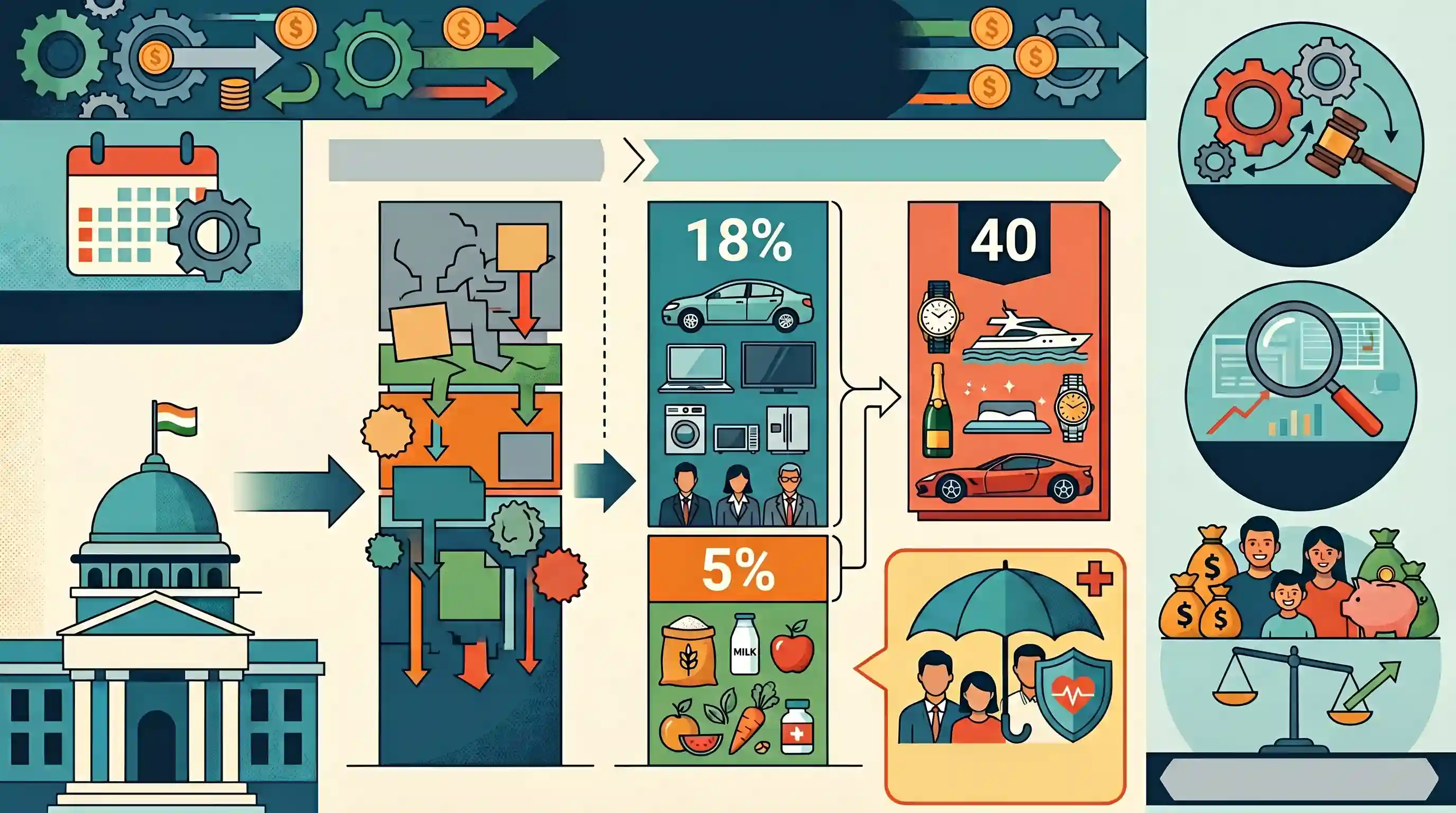
Why It Matters
GST is a cornerstone of India's indirect tax architecture and Centre-State financial relations. The transition to GST 2.0 represents a major macroeconomic reform, directly relevant to the GS Paper 3 syllabus on resource mobilization and taxation, as well as GS Paper 2 topics covering the GST Council and fiscal federalism. Questions on the rationale, benefits, and structural changes of GST are frequent in both Prelims and Mains.
Summary
The Union Government is set to roll out GST 2.0 on September 22, 2025, marking the most significant reform to India's indirect tax system since 2017. The transition will replace the existing four-tier structure with a simplified two-tier system of 5% (for essentials) and 18% (for standard goods and services). Additionally, a 40% de-merit rate will apply to luxury and sin goods. Finalized at the 56th GST Council meeting, the revamp is designed to minimize classification disputes, ensure greater tax transparency, and increase disposable income for the middle class by lowering taxes on mid-range items. Notably, individual health and life insurance are now completely exempted from GST.
Key Points
- India is set to implement GST 2.0 on September 22, 2025, moving from a four-tier tax structure (5%, 12%, 18%, 28%) to a simplified two-tier system of 5% and 18%.
- A new 40% de-merit rate has been introduced for 'sin' and ultra-luxury goods, including tobacco, aerated drinks, and premium vehicles.
- Essential items remain taxed at 5%, while individual health and life insurance have been completely exempted from GST.
- The structural reform aims to reduce classification disputes, improve tax compliance, and boost consumer spending by increasing disposable income.
- The decision was finalized during the 56th GST Council meeting chaired by Union Finance Minister Nirmala Sitharaman.
Important Terms
GST Council

A constitutional body (Article 279A) chaired by the Union Finance Minister, responsible for making recommendations to the Union and States on GST rates, exemptions, and administrative thresholds.
UPSC context
GS Paper II (Constitutional Bodies) and GS Paper III (Fiscal Federalism); tests understanding of Centre-State cooperative federalism.
Goods and Services Tax (GST)
A destination-based, comprehensive indirect tax on the supply of goods and services, replacing multiple central (Excise, Service Tax) and state (VAT, Entry Tax) levies to create a unified market.
UPSC context
GS Paper III (Indian Economy); focuses on resource mobilization, tax reforms, and elimination of the cascading effect.
GST 2.0
The 'next-generation' phase of India's GST regime, effective September 22, 2025, which simplifies the multi-tier structure into a two-tier system (5% and 18%) to reduce classification disputes.
UPSC context
GS Paper III (Taxation/Reforms); tests awareness of evolving indirect tax structures and ease of doing business.
Central GST (CGST)
A component of the dual GST model levied by the Central Government on intra-state supplies of goods and services, governed by the CGST Act, 2017.
UPSC context
GS Paper III (Economy); involves understanding the distribution of taxing powers between the Union and the States.
State GST (SGST)
The tax levied by individual State Governments on intra-state supplies, collected simultaneously with CGST to ensure states maintain their revenue autonomy within the unified tax framework.
UPSC context
GS Paper III (Fiscal Policy); tests knowledge of state-level revenue generation and compliance mechanisms.
Fiscal Federalism
The division of financial powers and responsibilities between the Centre and States. GST is the premier example of 'pooled sovereignty' in Indian fiscal relations.
UPSC context
GS Paper II (Federal Structure); crucial for essays and questions on Centre-State financial tensions and cooperation.
De-merit Goods
Goods considered socially undesirable (e.g., tobacco, luxury cars) subjected to the highest tax slab (40% in GST 2.0) to discourage consumption while generating high revenue.
UPSC context
GS Paper III (Economic Development); relates to taxation as a tool for social engineering and public health.
Input Tax Credit (ITC)
A mechanism allowing businesses to reduce the tax they have paid on inputs from the tax they owe on outputs, preventing the 'tax on tax' effect.
UPSC context
GS Paper III (Economy); tests technical understanding of tax efficiency and its impact on sectoral costs (e.g., insurance).
Prelims Trap
GST 2.0 caps the maximum possible tax rate at 18%, effectively eliminating all higher tax slabs across all product categories.
While the standard top tier is now 18% (replacing 28%), GST 2.0 explicitly introduces a 40% 'de-merit rate' for sin and ultra-luxury goods. The 18% cap is not universal.
Static Concepts Connected
What is the composition and voting structure of the GST Council?
- Composition: The Union Finance Minister chairs the council, with the Union MoS (Finance) and State Finance/Taxation Ministers as members.
- Voting weight: The Centre has exactly one-third (33.3%) of the voting weight, while all States combined hold two-thirds (66.7%).
- Decision threshold: Decisions require a three-fourths (75%) majority of the weighted votes of members present and voting.
What is the 'Inverted Duty Structure' (IDS) in taxation?
- Definition: A situation where the tax rate on inputs (raw materials) is higher than the tax rate on finished goods.
- Economic impact: It causes an accumulation of unutilized Input Tax Credit (ITC), which blocks working capital for manufacturers and requires complex government refunds.
- Resolution via GST 2.0: Condensing the slabs to 5% and 18% helps align input and output taxes, significantly resolving these working capital bottlenecks.
Cross-Topic Patterns
GST exemption + Universal Health Coverage
Exempting health insurance from GST directly aligns with national health policy goals of reducing out-of-pocket expenditure (OOPE) and boosting India's historically low insurance penetration to achieve Universal Health Coverage.
GST Council + Fiscal Federalism mechanisms
The structural shift from 28% + cess to a flat 40% de-merit rate shifts the compensation logic, heavily testing the fiscal federalism consensus and state revenue guarantees under Article 279A.

Expect a 2026 prelims question mixing GST Council voting dynamics with the 'Inverted Duty Structure' and the exact scope of the 40% rate.
Linked PYQs · 4
Linked PYQs · 4
- 2019MainsGS3
Enumerate the indirect taxes which have been subsumed in the Goods and Services Tax (GST) in India. Also, comment on the revenue implications of the GST introduced in India since July 2017.
- 2020MainsGS3
Explain the rationale behind the Goods and Services Tax (Compensation to States) Act of 2017. How has COVID-19 impacted the GST compensation fund and created new federal tensions?
- 2025MainsGS2
Examine the evolving pattern of Centre-State financial relations in the context of planned development in India. How far have the recent reforms impacted the fiscal federalism in India?
- 2006PrelimsGS1
Which one of the following is the correct statements? Service tax is a/an
