March GST Collections Reach Second Highest Ever at 1.96 Lakh Crore
Source:Indian Express ↗
Why It Matters
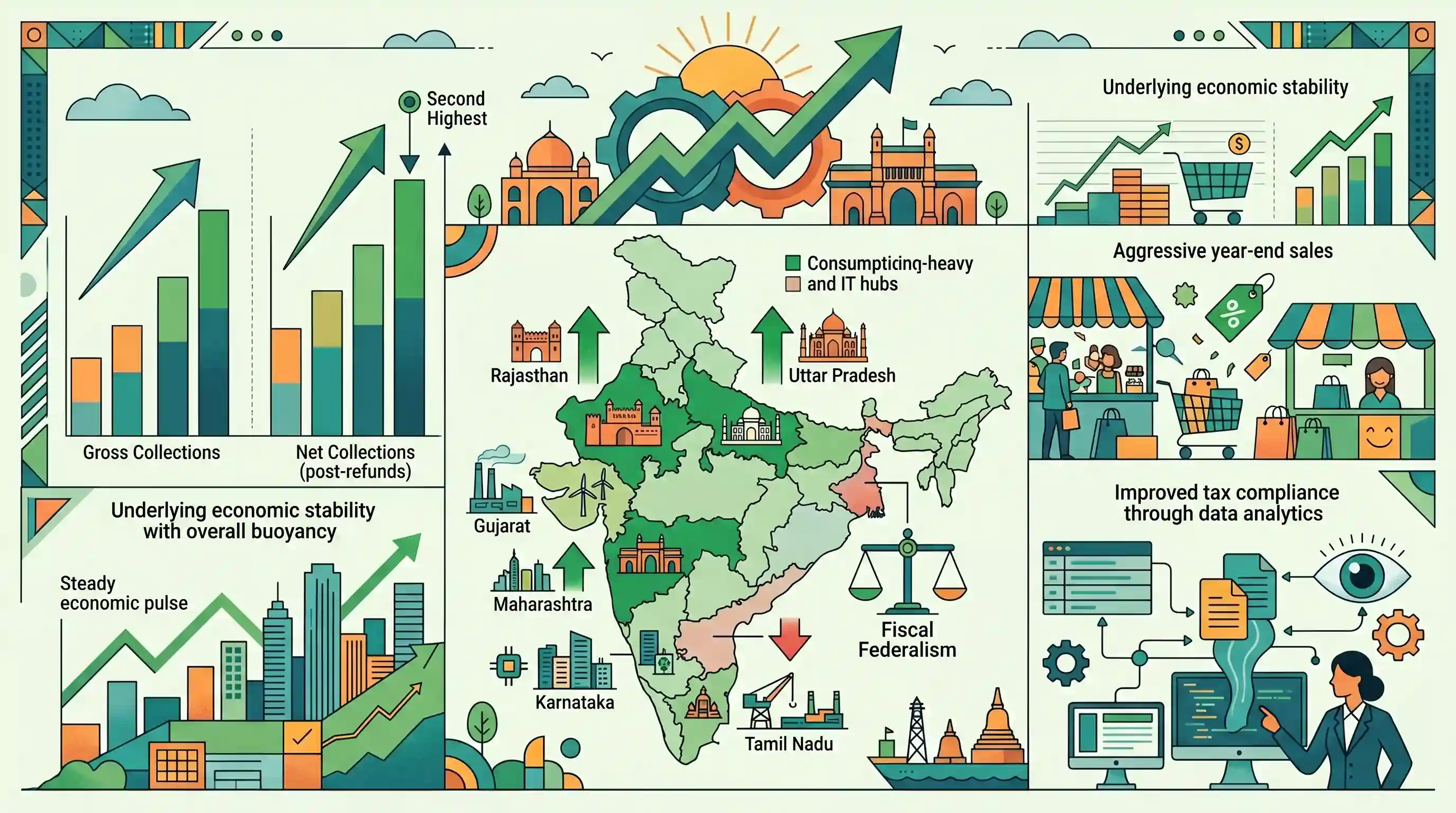
Consistent growth in GST collections reflects increased tax buoyancy and formalization of the economy, ensuring stable revenue generation for both the Centre and states. The disparity in state-wise growth emphasizes the consumption-based nature of GST and highlights evolving regional economic trends that are relevant to discussions on fiscal federalism and state finances.
Summary
The article reports a significant milestone in India's indirect tax regime, highlighting a 10% year-on-year growth in Goods and Services Tax (GST) collections for March 2025 to reach Rs 1.96 lakh crore, the second-highest monthly collection on record. For the full FY25, gross collections rose 9.4% to Rs 22.08 lakh crore, with net revenues (post-refunds) growing at a robust 11%. The data reveals a notable divergence in state-level performance: consumption-heavy states like Maharashtra, Uttar Pradesh, and Rajasthan experienced double-digit growth, whereas traditionally strong manufacturing and IT hubs such as Gujarat, Karnataka, and Tamil Nadu recorded sluggish growth or minor contraction. Tax experts attribute the overall buoyancy to underlying economic stability, aggressive year-end sales efforts by businesses, and improved tax compliance facilitated by data analytics.
Key Points
- GST collections in March 2025 grew 10% year-on-year to hit Rs 1.96 lakh crore, the second-highest monthly mop-up ever after April 2024.
- The total gross GST collection for the full fiscal year (April 2024-March 2025) stood at Rs 22.08 lakh crore, marking a 9.4% increase over the previous year.
- Net GST revenue (after refunds) for March grew 12% to Rs 1.83 lakh crore, and the full year's net revenue reached Rs 19.96 lakh crore (an 11% increase).
- Growth was driven by an 11% increase in revenues from domestic transactions and an equal 11% growth in revenues from imports of goods.
- State-wise disparities emerged: Key consumption states like Maharashtra, UP, and Rajasthan registered strong double-digit growth, while major manufacturing and tech hubs (Gujarat, Karnataka, Tamil Nadu) saw slower growth between -1% and 7%.
- Experts attribute the buoyant collections to economic stability, a strong year-end corporate sales push, and enhanced tax compliance driven by data analytics and systemic formalization.
Important Terms
Goods and Services Tax (GST)

A comprehensive, multi-stage, destination-based indirect tax levied on the supply of goods and services, subsuming most central and state indirect taxes.
UPSC context
GS Paper 3: Indian Economy; key for taxation reforms, formalization, and cooperative federalism.
Integrated GST (IGST)
A tax levied by the Central Government on all inter-state supplies of goods and services and imports, later shared with the consuming state.
UPSC context
GS Paper 3: Indian Economy; tests understanding of destination-based tax and inter-state trade.
GST Compensation Cess
An additional levy on luxury and "sin" goods (e.g., tobacco, coal) intended to compensate states for revenue losses during the GST transition.
UPSC context
GS Paper 3: Indian Economy; central to debates on fiscal federalism and state revenue security.
Fiscal Federalism
The financial relationship and division of resources and taxation responsibilities between the Union and State governments as per Constitutional provisions.
UPSC context
GS Paper 2: Polity & Governance; focuses on Centre-State relations and financial autonomy.
Resource Mobilization
The process of assembling and organizing financial, human, and natural assets (specifically through taxation and borrowing) to achieve developmental goals.
UPSC context
GS Paper 3: Indian Economy; directly mentioned in the syllabus under Planning and Growth.
CGST and SGST
Components of India's dual GST system levied simultaneously on intra-state supplies, where revenue is collected by the Centre and States respectively.
UPSC context
GS Paper 3: Indian Economy; tests knowledge of the dual-taxation structure and revenue sharing.
Prelims Trap
"Under GST, manufacturing states inherently collect higher tax revenues compared to consumption-heavy states."
GST is a destination-based tax. Revenue accrues to the state where the good is consumed, structurally favoring populous states over traditional manufacturing hubs.
Static Concepts Connected
How does the destination principle of GST impact state revenues?
- Destination-Based: Tax revenue accrues to the state where final consumption occurs, rather than where the goods are produced.
- IGST Mechanism: Integrated GST (IGST) collected on inter-state trade is ultimately apportioned to the destination state.
- Federal Impact: This structural shift inherently favors populous, consumption-heavy states (e.g., UP) while constraining revenue growth for traditional manufacturing states (e.g., Gujarat, Tamil Nadu).
What defines "Tax Buoyancy" in the context of economic growth?
- Definition: It measures the responsiveness of tax revenue growth to changes in GDP, without any alteration in the underlying tax rates.
- High Buoyancy: A buoyancy greater than 1 indicates that revenues are growing faster than national income, driven by better compliance, formalization, and data analytics.
Cross-Topic Patterns
16th Finance Commission & Regional Disparities
The sluggish GST growth in manufacturing/IT states versus booming consumption hubs will be a major friction point for the 16th Finance Commission's horizontal devolution negotiations.
High-Frequency Indicators & Digital Formalization
Record GST mop-ups correlate tightly with e-way bill generation and PMI data, reflecting how digital formalization (via GSTN) has structurally reduced evasion.

Mains 2026: Expect a question linking GST's destination-based nature to regional disparities and the 16th Finance Commission's mandate.
Linked PYQs · 4
Linked PYQs · 4
- 2019MainsGS3
Enumerate the indirect taxes which have been subsumed in the Goods and Services Tax (GST) in India. Also, comment on the revenue implications of the GST introduced in India since July 2017.
- 2020MainsGS3
Explain the rationale behind the Goods and Services Tax (Compensation to States) Act of 2017. How has COVID-19 impacted the GST compensation fund and created new federal tensions?
- 2017PrelimsGS1
What is/are the most likely advantages of implementing 'Goods and Services Tax (GST)'? 1. It will replace multiple taxes collected by multiple authorities and will thus create a single market in India. 2. It will drastically reduce the 'Current Account Deficit' of India and will enable it to increase its foreign exchange reserves. 3. It will enormously increase the growth and size of economy of India and will enable it to overtake China in the near future. Select the correct answer using the code given below:
- 2018PrelimsGS1
Consider the following items : 1. Cereal grains hulled 2. Chicken eggs cooked 3. Fish processed and canned 4. Newspapers containing advertising material Which of the above items is/are exempted under GST (Goods and Services Tax)?
