GST Evasion Trends and Input Tax Credit Fraud Detection
Source:The Hindu ↗
Why It Matters
Persistent GST evasion and ITC fraud underline the challenges in India's indirect tax administration. It highlights the critical role of technology and robust auditing mechanisms in plugging revenue leakages and ensuring fiscal stability.
Summary
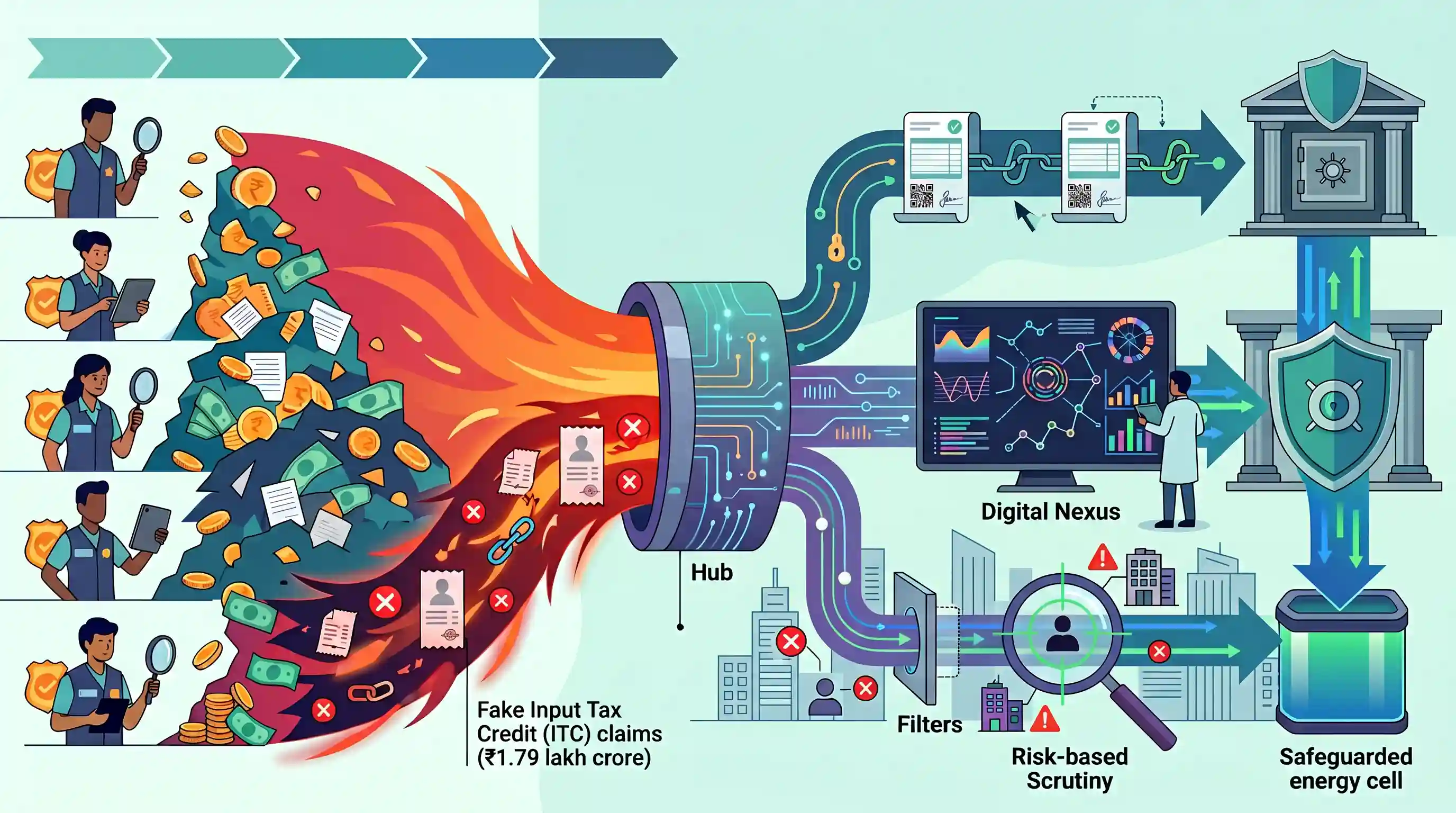
Over the last five years (FY21-FY25), CGST field officers have detected GST evasion amounting to ₹7.08 lakh crore, which includes ₹1.79 lakh crore in fake input tax credit (ITC) claims. To safeguard revenue, the government is increasingly relying on technological measures such as e-invoicing, data analytics, and targeted scrutiny based on risk parameters.
Key Points
- Over ₹7.08 lakh crore in GST evasion was detected between FY21 and FY25, highlighting significant revenue leakage.
- Fake Input Tax Credit (ITC) claims accounted for ₹1.79 lakh crore of the total evasion.
- In FY25 alone, CGST officers detected over ₹2.23 lakh crore in evasion, including ₹58,772 crore from ITC fraud.
- The government and GSTN are deploying technological tools like e-invoicing, data analytics, and risk-parameter-based scrutiny to curb evasion.
- Despite evasion, net CGST collections in FY25 exceeded ₹10.26 lakh crore, achieving 96.7% of the Revised Estimates.
Important Terms
Goods and Services Tax (GST)

A comprehensive, destination-based indirect tax levied on the supply of goods and services, replacing multiple central and state taxes to eliminate the cascading effect.
UPSC context
GS Paper 3: Indian Economy (Indirect Taxation); tests understanding of structural tax reforms and fiscal federalism.
Central Goods & Services Tax (CGST)
The central component of GST levied by the Union Government on the intra-state supply of goods and services under the CGST Act 2017.
UPSC context
GS Paper 3: Indian Economy (Taxation); tests knowledge of India's dual GST model and revenue division.
Input Tax Credit (ITC)
A mechanism allowing businesses to reduce their output tax liability by claiming credit for the GST already paid on purchases of inputs.
UPSC context
GS Paper 3: Indian Economy; critical for understanding value-added taxation and issues like fake invoice fraud.
Goods and Services Tax Network (GSTN)
The not-for-profit technological backbone of India's indirect tax system that provides IT infrastructure for registration, return filing, and real-time compliance tracking.
UPSC context
GS Paper 2 & 3: E-governance and Economy; tests the role of technology in administrative transparency.
E-invoicing
An electronic authentication system where B2B invoices are reported to a government portal to generate a unique Invoice Reference Number (IRN) for real-time tracking.
UPSC context
GS Paper 3: Indian Economy; tests digital interventions used to curb tax leakages and improve business compliance.
Tax Evasion
The illegal non-payment or underpayment of taxes by deliberately misrepresenting or concealing financial affairs, impacting the government's mobilization of resources.
UPSC context
GS Paper 3: Mobilization of Resources; tests challenges in revenue collection and measures to ensure fiscal integrity.
Prelims Trap
The Goods and Services Tax Network (GSTN) is a non-profit company jointly owned by the government and private financial institutions.
GSTN was originally created with 51% private equity, but the GST Council approved its conversion into a 100% government-owned entity (50% Centre, 50% States) to secure tax data.
Static Concepts Connected
What is the Input Tax Credit (ITC) mechanism and its core objective?
- Mechanism: Allows taxpayers to claim credit for taxes paid on business inputs, reducing their final output tax liability.
- Core Objective: Designed to eliminate the cascading effect (tax on tax) prevalent in pre-GST indirect tax regimes.
- Blocked Credits: ITC is not absolute; Section 17(5) of the CGST Act blocks credit for certain goods/services (e.g., motor vehicles for personal use, food and beverages).
What is the structure and voting mechanism of the GST Council?
- Constitutional Status: A constitutional body under Article 279A, introduced by the 101st Amendment Act and chaired by the Union Finance Minister.
- Voting Weightage: The Centre holds 1/3rd of the voting power, while all States combined hold a 2/3rd weightage.
- Decision Rule: Every decision requires a minimum 3/4th (75%) majority of the weighted votes of the members present and voting.
Cross-Topic Patterns
GST Evasion and PMLA Data Sharing
Fake ITC networks are increasingly investigated by the ED, as GST-related information sharing was brought under the purview of PMLA via a 2023 notification to tackle money laundering through shell companies.
E-invoicing driving MSME Formalization
Lowering the e-invoicing threshold to ₹5 crore aligns with the broader macroeconomic push to formalize MSMEs, facilitating their integration into formal credit networks like TReDS using verified GST data.

Expect a multi-statement Prelims 2026 question linking GSTN's 100% govt ownership, e-invoicing thresholds, and ITC exclusions.
Linked PYQs · 2
Linked PYQs · 2
- 2019MainsGS3
Enumerate the indirect taxes which have been subsumed in the Goods and Services Tax (GST) in India. Also, comment on the revenue implications of the GST introduced in India since July 2017.
- 2013MainsGS3
Discuss the rationale for introducing Goods and Services Tax (GST) in India. Bring out critically the reasons for the delay in roll out for its regime.
