GST Council Tax Administration Reforms and Arrest Powers
Source:Indian Express ↗
આ શા માટે મહત્વનું છે
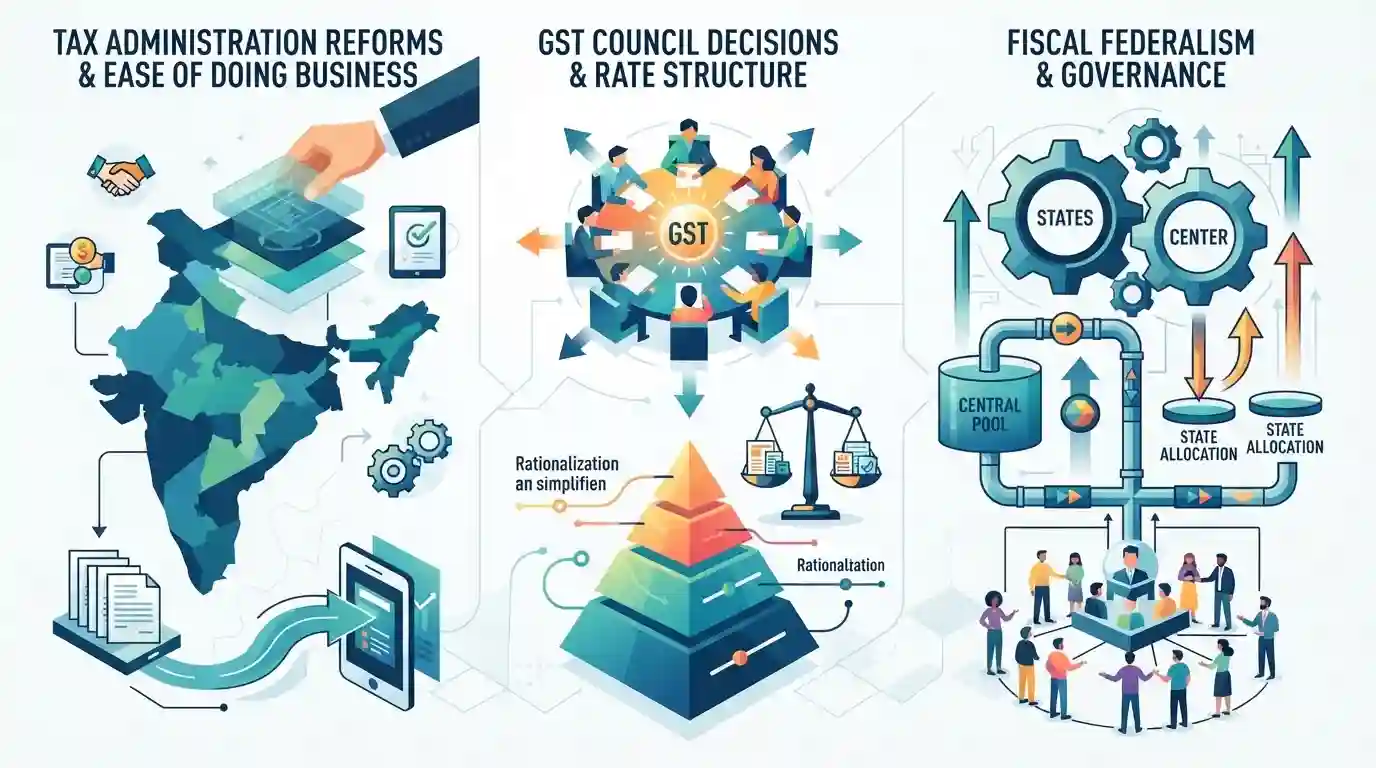
It highlights major updates in India's indirect tax framework, balancing tax compliance enforcement with the ease of doing business, and showcases the role of the GST Council in institutional governance.
સારાંશ
The article reports on developments from the GST Council meeting concerning tax administration reforms, rate structures, and powers of tax officers, bearing significance for India's fiscal federalism and ease of doing business.
મુખ્ય મુદ્દા
- The GST Council met to review key tax administration and rate structure measures.
- Discussions and decisions around rationalizing tax administration powers, such as checking overreach and altering arrest powers of tax officers, impact the ease of doing business.
- Reflects the evolving nature of indirect taxation reforms and cooperative federalism in India's fiscal architecture.
મહત્વપૂર્ણ શબ્દો
Goods and Services Tax (GST)

A comprehensive indirect tax levied on the manufacture, sale, and consumption of goods and services throughout India, replacing multiple cascading central and state taxes.
UPSC context
GS Paper III (Indian Economy - Tax Reforms, Mobilization of Resources). Tests understanding of indirect taxation, federal fiscal architecture, and business compliance.
GST Council
A constitutional federal body established under Article 279A to make recommendations on GST rates, rules, and exemptions, embodying cooperative federalism between the Centre and States.
UPSC context
GS Paper II (Polity - Federalism, Constitutional Bodies) and GS Paper III. Tests cooperative federalism, voting dynamics, and tax governance.
પ્રિલિમ્સ ટ્રેપ
the Central Government independently stripped tax officers of arrest powers under the GST framework
Aspirants often assume the Centre can unilaterally alter GST rates or tax enforcement powers without Council consensus due to its dominant fiscal role.
સંલગ્ન સ્થિર ખ્યાલો
What is the constitutional basis, composition, and voting weightage of the GST Council under Article 279A?
- Article 279A: Constitutional Status: Established under Article 279A, inserted by the 101st Constitutional Amendment Act, 2016.
- Council Members: Composition: Chaired by the Union Finance Minister, with State Finance/Taxation Ministers as members.
- Voting Share: Voting Weightage: Centre holds one-third (33.33%) and States collectively hold two-thirds (66.67%) of the total voting power.
- Majority Required: Decision Rule: Decisions require a majority of not less than three-fourths (75%) of the weighted votes cast.
આંતર-વિષય પેટર્ન
GST Reforms & Ease of Doing Business
Changes to GST prosecution thresholds and administrative overreach balance Ease of Doing Business indices with aggressive fiscal enforcement frameworks.
Cooperative Federalism & Fiscal Decentralization
Decisions in the GST Council underscore the operational mechanics of cooperative federalism where Centre and States negotiate revenue sharing.

Expect statement-based questions on Article 279A, voting weightage in GST Council, and recent changes to prosecution/arrest thresholds.
સંલગ્ન PYQ · 3
સંલગ્ન PYQ · 3
- 2025MainsGS2
Examine the evolving pattern of Centre-State financial relations in the context of planned development in India. How far have the recent reforms impacted the fiscal federalism in India?
- 2024MainsGS2
What changes has the Union Government recently introduced in the domain of Centre-State relations ? Suggest measures to be adopted to build the trust between the Centre and the States and for strengthening federalism.
- 2015MainsGS2
The concept of cooperative federalism has been increasingly emphasized in recent years. Highlight the drawbacks in the existing structure and the extent to which cooperative federalism would answer the shortcomings.
