GST Council Overhauls Indirect Tax Structure and Rates
Source:The Hindu ↗
Why It Matters
The transition toward a simplified, two-tier GST rate structure is one of the most critical indirect tax reforms since GST's inception. It provides a direct case study on tax rationalization, cooperative federalism, and the macroeconomic balancing act between revenue forgone and anticipated tax buoyancy.
Summary
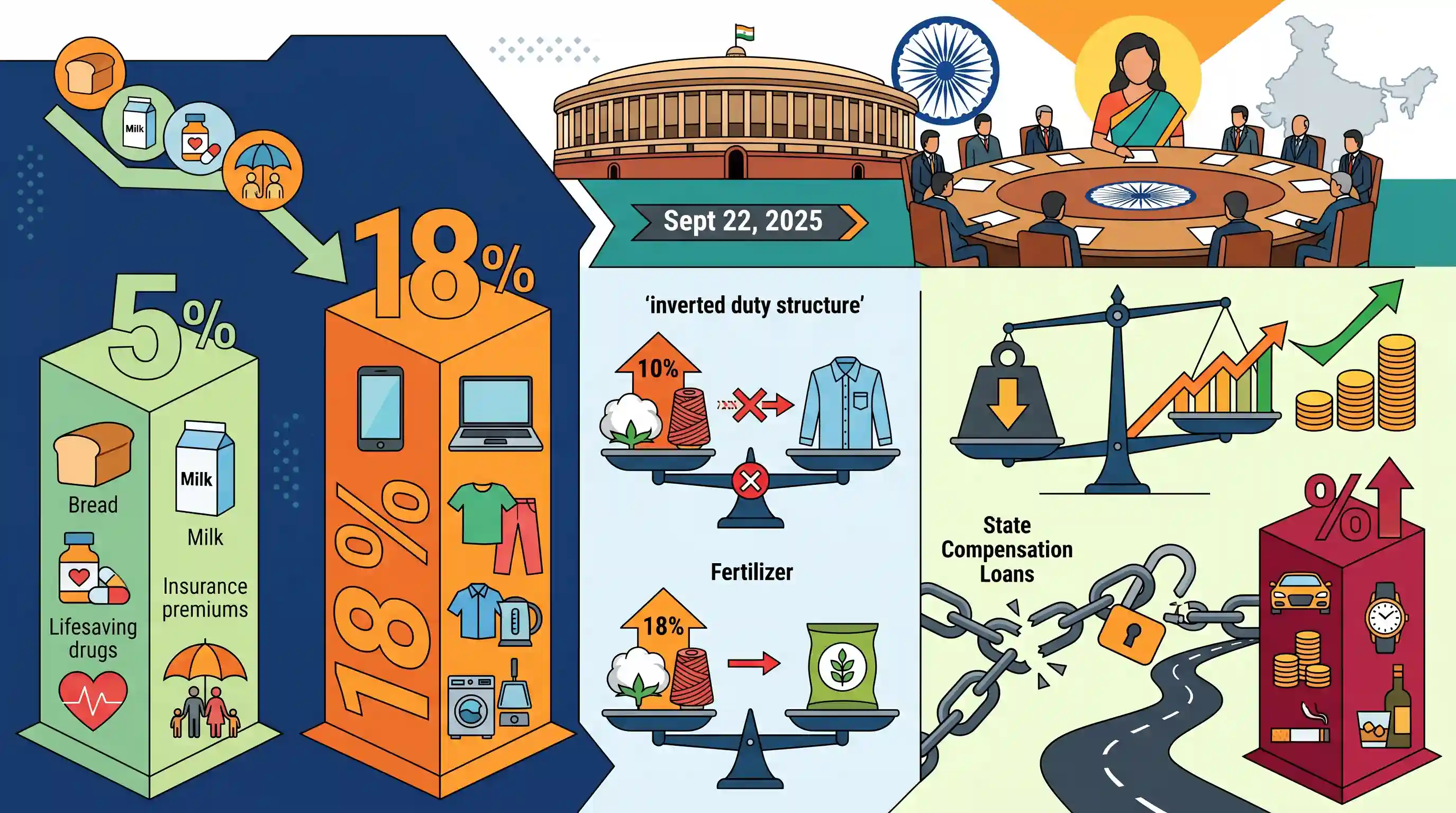
The 56th GST Council meeting, chaired by Finance Minister Nirmala Sitharaman in Srinagar, heralded a major structural reform in India's indirect tax system by streamlining it into a primarily two-rate structure (5% and 18%). Effective September 22, 2025, the sweeping rate rationalization will see taxes slashed on common consumer items, lifesaving drugs, and insurance premiums, resolving long-standing inverted duty structure anomalies in sectors like textiles and fertilizers. While the changes incur an immediate ₹48,000 crore fiscal cost, the government projects tax buoyancy to bridge the gap. Furthermore, a roadmap was laid out to transition luxury and 'sin' goods to a 40% bracket once state compensation loans are discharged by year-end.
Key Points
- The 56th GST Council meeting approved a significant overhaul of the indirect tax regime, shifting to a primarily two-rate system (5% and 18%) effective September 22, 2025.
- Key rate cuts include everyday consumer goods, health and life insurance (dropped to 0%), and cement (28% to 18%), aiming to ease the burden on the middle class.
- The immediate fiscal hit is estimated at ₹48,000 crore, but the government anticipates improved compliance and tax buoyancy will offset this shortfall.
- Long-standing anomalies like the inverted duty structure were resolved for manmade textiles and fertilizers, reducing input taxes to 5%.
- 'Sin goods' like tobacco and luxuries will move to a new 40% special tax slab once the Centre clears existing compensation cess loans to states, expected by late 2025.
Important Terms
GST Council

A constitutional body under Article 279A, chaired by the Union Finance Minister, responsible for recommendations on GST rates, exemptions, and administrative rules.
UPSC context
GS-II/III; tests knowledge of cooperative federalism, voting mechanisms, and constitutional provisions (Article 279A) in indirect tax governance.
Goods and Services Tax (GST)
A destination-based, multi-stage indirect tax on the supply of goods and services, subsuming central/state taxes to create a unified national market.
UPSC context
GS-III (Mobilization of Resources); fundamental for understanding India\'s transition to a "One Nation, One Tax" regime.
Rate Rationalization
The process of simplifying the GST slab structure to reduce complexity, resolve anomalies, and improve compliance, often by merging multiple tax brackets.
UPSC context
GS-III (Taxation); tests awareness of structural reforms aimed at enhancing tax efficiency and boosting consumer demand.
Compensation Cess
An additional levy on luxury and "sin" goods (e.g., tobacco, high-end cars) used to bridge the revenue gap for states post-GST transition.
UPSC context
GS-III (Fiscal Policy); critical for understanding fiscal federalism and the financial relationship between the Centre and States.
Inverted Duty Structure
An anomaly where tax rates on inputs (raw materials/services) are higher than on finished products, leading to accumulated tax credits and blocked capital.
UPSC context
GS-III (Economy); tests identification of tax distortions that hinder domestic manufacturing and the "Make in India" initiative.
Tax Buoyancy
A fiscal indicator measuring how tax revenue growth responds to GDP growth; a value above 1 means revenue grows faster than the economy.
UPSC context
GS-III (Fiscal Policy); essential for analyzing government revenue health and the effectiveness of tax mobilization strategies.
Prelims Trap
The GST Council's recommendations are constitutionally binding on both the Centre and the States.
The Supreme Court (Mohit Minerals, 2022) ruled that GST Council recommendations hold only persuasive value. They are advisory, not legally binding on Parliament or State Legislatures.
Static Concepts Connected
What is an Inverted Duty Structure?
- Definition: Occurs when tax rates on raw materials (inputs) are higher than the taxes on the finished goods (outputs).
- Impact: Results in the accumulation of unutilized Input Tax Credit (ITC) with the government, blocking crucial working capital for domestic manufacturers.
- Trade effect: Makes imported finished goods cheaper than domestically manufactured ones, actively discouraging domestic value addition and manufacturing.
What is Tax Buoyancy?
- Definition: Measures how responsive tax revenue collection is to changes in the country's Gross Domestic Product (GDP).
- Formula: Calculated as the percentage change in tax revenue divided by the percentage change in nominal GDP.
- Ideal Scenario: A buoyancy greater than 1 means tax revenue is growing faster than the economy, indicating strong tax compliance and efficient administration.
Cross-Topic Patterns
Compensation Cess & Fiscal Federalism
Sunsetting compensation loans and shifting sin goods to a 40% slab impacts states' independent fiscal capacity, relating directly to Centre-State federal disputes and FRBM borrowing limits.
Indirect Tax Cuts & Core Inflation
Dropping taxes on consumer staples, cement, and insurance to lower brackets acts as a fiscal supply-side measure to actively curb core CPI inflation.

The shift to a two-rate GST structure makes Tax Buoyancy and Inverted Duty anomalies prime targets for 2026 Prelims and Mains.
Linked PYQs · 4
Linked PYQs · 4
- 2019MainsGS3
Enumerate the indirect taxes which have been subsumed in the Goods and Services Tax (GST) in India. Also, comment on the revenue implications of the GST introduced in India since July 2017.
- 2013MainsGS3
Discuss the rationale for introducing Goods and Services Tax (GST) in India. Bring out critically the reasons for the delay in roll out for its regime.
- 2017PrelimsGS1
What is/are the most likely advantages of implementing 'Goods and Services Tax (GST)'? 1. It will replace multiple taxes collected by multiple authorities and will thus create a single market in India. 2. It will drastically reduce the 'Current Account Deficit' of India and will enable it to increase its foreign exchange reserves. 3. It will enormously increase the growth and size of economy of India and will enable it to overtake China in the near future. Select the correct answer using the code given below:
- 2025MainsGS2
Examine the evolving pattern of Centre-State financial relations in the context of planned development in India. How far have the recent reforms impacted the fiscal federalism in India?
