GST collections surge on festive demand and compliance growth
Source:The Hindu ↗
Why It Matters
Understanding trends in GST revenue collection is critical for aspirants analyzing fiscal federalism, domestic consumption patterns, tax buoyancy, and government resource mobilization in India.
Summary
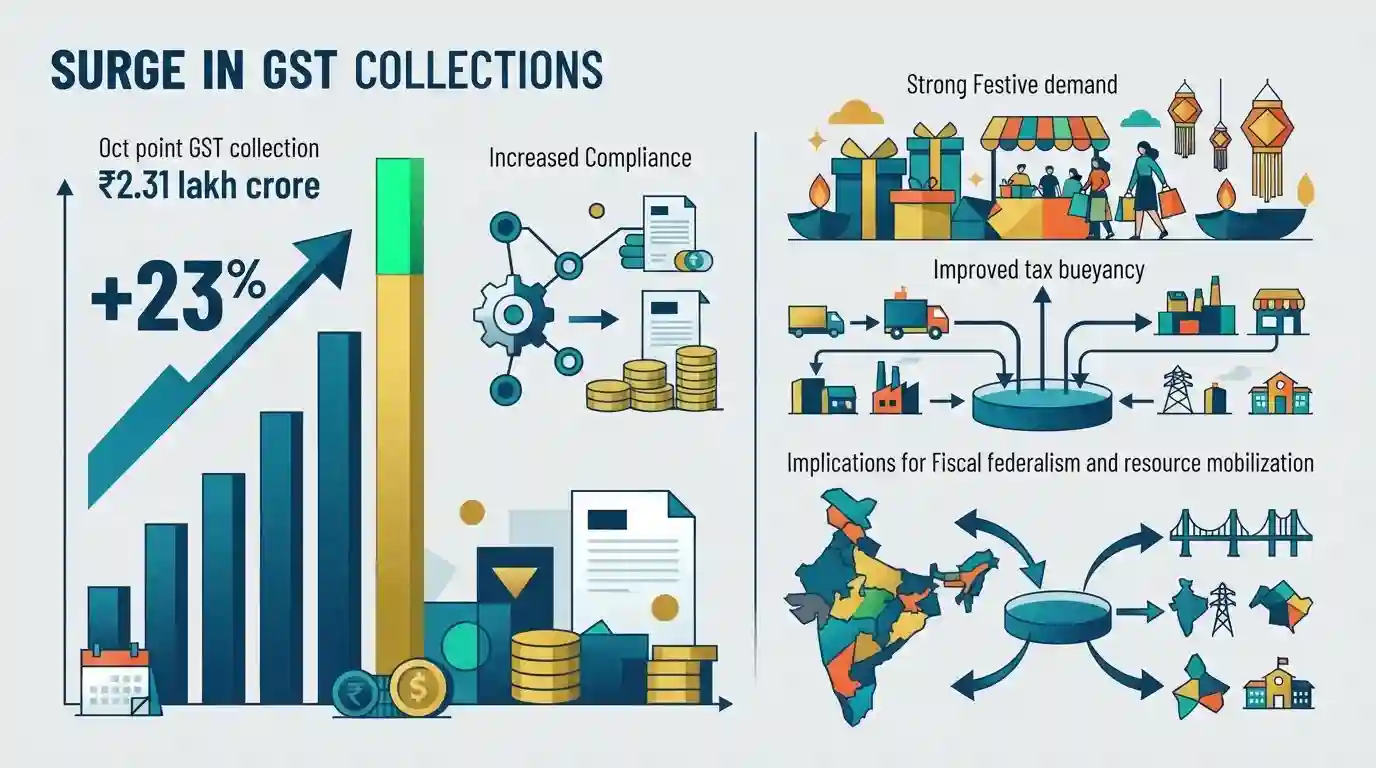
GST collections in October witnessed a sharp 23% surge, touching ₹2.31 lakh crore—the second-highest mop-up on record—spurred by festive demand and heightened compliance. This trend highlights the resilience of domestic consumption and improved tax buoyancy, carrying significant implications for fiscal federalism and government resource mobilization.
Key Points
- Goods and Services Tax (GST) revenue collections surged 23% year-on-year to reach ₹2.31 lakh crore in October, marking the second-highest monthly collection ever recorded.
- The robust growth was driven by a combination of festive season demand, improved compliance, and strong domestic economic activity.
- Strong indirect tax collections reflect broader trends in consumer spending and corporate tax compliance, serving as a key indicator of economic buoyancy.
- Consistent high tax collection figures strengthen public finances and provide fiscal space for capital expenditure by the government.
Important Terms
Goods and Services Tax Act

A comprehensive, destination-based indirect tax levied on the supply of goods and services across India, introduced via the 101st Constitutional Amendment Act to replace multiple cascading federal and state taxes.
UPSC context
UPSC Prelims/Mains (GS Paper III): Core pillar of Indian economy, tax structure, and resource mobilization.
Goods and Services Tax Council
A constitutional body established under Article 279A comprising Union and State finance ministers to make recommendations on GST rates, exemptions, and administrative procedures.
UPSC context
UPSC Mains (GS Paper II/III): Crucial example of cooperative federalism and fiscal governance in India.
Ministry of Finance
The apex ministry of the Government of India responsible for economic policy, financial legislation, public expenditure, fiscal federalism, and the preparation of the Union Budget.
UPSC context
UPSC Prelims/Mains (GS Paper II/III): Important for understanding governance structures, public resource mobilization, and macroeconomic management.
Prelims Trap
Record-breaking monthly GST collections directly translate into a proportional, predictable surge in state-level revenues without accounting for settlement mechanisms.
Aspirants often confuse record monthly collections with structural annual growth or assume high GST automatically implies uniform state distributions without factoring IGST settlement mechanics.
Static Concepts Connected
What are the core constitutional provisions and institutional structures governing the Goods and Services Tax in India?
- Constitutional Basis: Article 246A empowers Parliament and State Legislatures to make laws w.r.t. GST; Article 279A establishes the GST Council as a federal body.
- Tax Architecture: Comprises CGST, SGST/UTGST, and IGST; Compensation Cess levied on luxury/demerit goods to protect states from revenue loss for a transition period.
- GST Council Voting: Decisions require a 3/4th majority, where the Centre has 1/3rd weight and all states combined have 2/3rd weight, institutionalizing cooperative federalism.
Cross-Topic Patterns
GST Revenue & Fiscal Deficit Management
High indirect tax collections expand fiscal space, enabling increased capital expenditure allocation in the Union Budget without breaching fiscal deficit targets.
Tax Buoyancy & K-Shaped Recovery Debates
Surging consumption-led tax collections directly reflect urban demand recovery, offering a counter-perspective to rural distress narratives in economic analysis.

GST buoyancy and record collections will be tested via analytical statements on fiscal federalism and compensation cess dynamics.
Linked PYQs · 3
Linked PYQs · 3
- 2019MainsGS3
Enumerate the indirect taxes which have been subsumed in the Goods and Services Tax (GST) in India. Also, comment on the revenue implications of the GST introduced in India since July 2017.
- 2017PrelimsGS1
What is/are the most likely advantages of implementing 'Goods and Services Tax (GST)'? 1. It will replace multiple taxes collected by multiple authorities and will thus create a single market in India. 2. It will drastically reduce the 'Current Account Deficit' of India and will enable it to increase its foreign exchange reserves. 3. It will enormously increase the growth and size of economy of India and will enable it to overtake China in the near future. Select the correct answer using the code given below:
- 2020MainsGS3
Explain the rationale behind the Goods and Services Tax (Compensation to States) Act of 2017. How has COVID-19 impacted the GST compensation fund and created new federal tensions?
