GST Compliance Exemption for Existing Pharma and Medical Stocks
Source:Indian Express ↗
Why It Matters
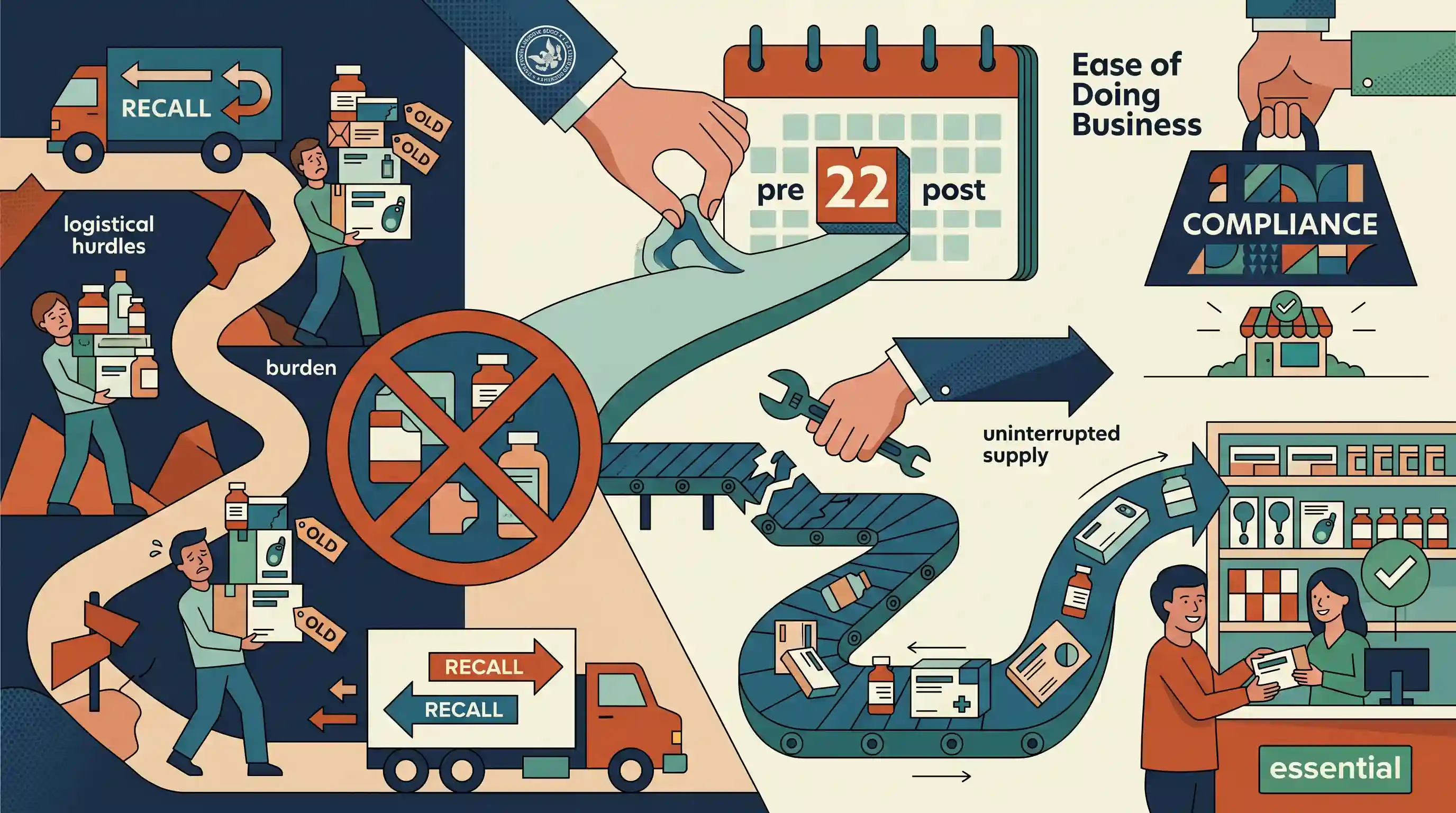
Highlights the practical challenges of implementing tax rate changes in critical supply chains and demonstrates how regulatory flexibility can prevent disruptions in the healthcare sector, a vital component of public health and governance.
Summary
The government has clarified that the re-labelling of existing stocks of drugs and medical devices, issued or manufactured prior to September 22, is not mandatory under recent GST rate transitions. This regulatory relaxation aims to ease the immediate compliance burden on the pharmaceutical industry and healthcare distributors. By removing the logistical hurdle of recalling and re-pricing old stock, the measure prevents supply chain disruptions and ensures the uninterrupted availability of essential healthcare products to consumers while promoting the ease of doing business.
Key Points
- The government has exempted existing stocks of drugs and medical devices (issued before September 22) from mandatory re-labelling under recent GST rate revisions.
- This clarification aims to significantly reduce the compliance and logistical burden on pharmaceutical companies, distributors, and retailers.
- By avoiding mandatory re-labelling, the move prevents potential supply chain disruptions, ensuring continuous availability of essential medicines and healthcare products.
- The decision reflects a balance between enforcing tax administration and promoting ease of doing business in critical sectors.
Important Terms
GST Council

A constitutional body (Article 279A) chaired by the Union Finance Minister that recommends GST rates, exemptions, and policy changes to the Union and State governments.
UPSC context
GS Paper II/III; tests cooperative federalism and institutional mechanisms for indirect tax policy-making.
National Pharmaceutical Pricing Authority (NPPA)
An independent regulatory body under the Ministry of Chemicals and Fertilizers that fixes ceiling prices for essential medicines and monitors drug availability under the DPCO.
UPSC context
GS Paper II; tests government interventions in healthcare and pricing of essential commodities to ensure public affordability.
GST 2.0
The phase of GST reforms focused on simplifying the tax structure through rate rationalization, technology-driven compliance, and reducing the burden on essential sectors like healthcare.
UPSC context
GS Paper III; tests knowledge of evolving tax reforms and the 'Ease of Doing Business' agenda.
Central Board of Indirect Taxes and Customs (CBIC)
A statutory body under the Ministry of Finance responsible for policy formulation and administration of Customs, GST, and Central Excise across India.
UPSC context
GS Paper III; tests the role of executive agencies in tax collection and administrative reforms.
Drugs (Prices Control) Order (DPCO)
Issued under the Essential Commodities Act, this order authorizes the government to regulate drug prices, ensuring life-saving medicines remain affordable for the public.
UPSC context
GS Paper II; tests legal frameworks governing healthcare accessibility and consumer protection.
Goods and Services Tax (GST) Act
The legal framework for a comprehensive, destination-based indirect tax that replaced multiple central and state taxes to create a unified national market.
UPSC context
GS Paper III; fundamental for understanding India’s indirect tax structure and fiscal federalism.
Prelims Trap
The GST Council regulates the Maximum Retail Price (MRP) of essential medicines following tax revisions.
The GST Council only decides tax rates. The MRP of essential medicines is regulated by the NPPA under the DPCO, using powers derived from the Essential Commodities Act.
Static Concepts Connected
How are essential medicines priced and regulated in India?
- NPPA: The National Pharmaceutical Pricing Authority (NPPA) regulates prices of essential medicines under the Drugs (Prices Control) Order (DPCO).
- ECA 1955: The DPCO is issued under the Essential Commodities Act, 1955, allowing the government to declare specific medicines as essential commodities.
- Pricing Mechanism: Price caps are based on the National List of Essential Medicines (NLEM), and annual price hikes are linked to the Wholesale Price Index (WPI).
What governs the declaration of MRP on packaged commodities in India?
- Legal Metrology Act: The Legal Metrology Act, 2009, and its Packaged Commodities Rules mandate that all pre-packaged goods must prominently display an MRP.
- Tax Inclusive: The declared MRP must be inclusive of all taxes. Consequently, any GST rate change requires managing the re-labelling of existing inventory unless exempted.
Cross-Topic Patterns
GST revisions and Out-of-Pocket Expenditure
GST rate cuts on medical devices directly impact healthcare affordability, addressing India's high out-of-pocket expenditure (OOPE) without increasing direct budgetary health subsidies.
Transitional provisions in taxation and MSMEs
Regulatory forbearance, like exempting legacy stock from re-labelling under the Legal Metrology Act, prevents MSME supply-chain bottlenecks and promotes ease of doing business during tax regime shifts.

Expect a 2026 multi-statement question combining NPPA's drug pricing mechanisms (WPI linkage) with the Legal Metrology Act's MRP rules.
Linked PYQs · 5
Linked PYQs · 5
- 2019MainsGS3
Enumerate the indirect taxes which have been subsumed in the Goods and Services Tax (GST) in India. Also, comment on the revenue implications of the GST introduced in India since July 2017.
- 2020MainsGS3
Explain the rationale behind the Goods and Services Tax (Compensation to States) Act of 2017. How has COVID-19 impacted the GST compensation fund and created new federal tensions?
- 2024MainsGS2
In a crucial domain like the public healthcare system the Indian State should play a vital role to contain the adverse impact of marketisation of the system. Suggest some measures through which the State can enhance the reach of public healthcare at the grassroots level.
- 2017PrelimsGS1
What is/are the most likely advantages of implementing 'Goods and Services Tax (GST)'? 1. It will replace multiple taxes collected by multiple authorities and will thus create a single market in India. 2. It will drastically reduce the 'Current Account Deficit' of India and will enable it to increase its foreign exchange reserves. 3. It will enormously increase the growth and size of economy of India and will enable it to overtake China in the near future. Select the correct answer using the code given below:
- 2018PrelimsGS1
Consider the following items : 1. Cereal grains hulled 2. Chicken eggs cooked 3. Fish processed and canned 4. Newspapers containing advertising material Which of the above items is/are exempted under GST (Goods and Services Tax)?
