GST Reforms and Indirect Taxation Structure Evolution
Source:Indian Express ↗
কেন এটি গুরুত্বপূর্ণ
GST is a pillar of India's indirect taxation and fiscal federalism. Evaluating 'GST 2.0' reforms helps aspirants understand ongoing structural changes in tax administration, revenue mobilisation, and ease of doing business.
সারসংক্ষেপ
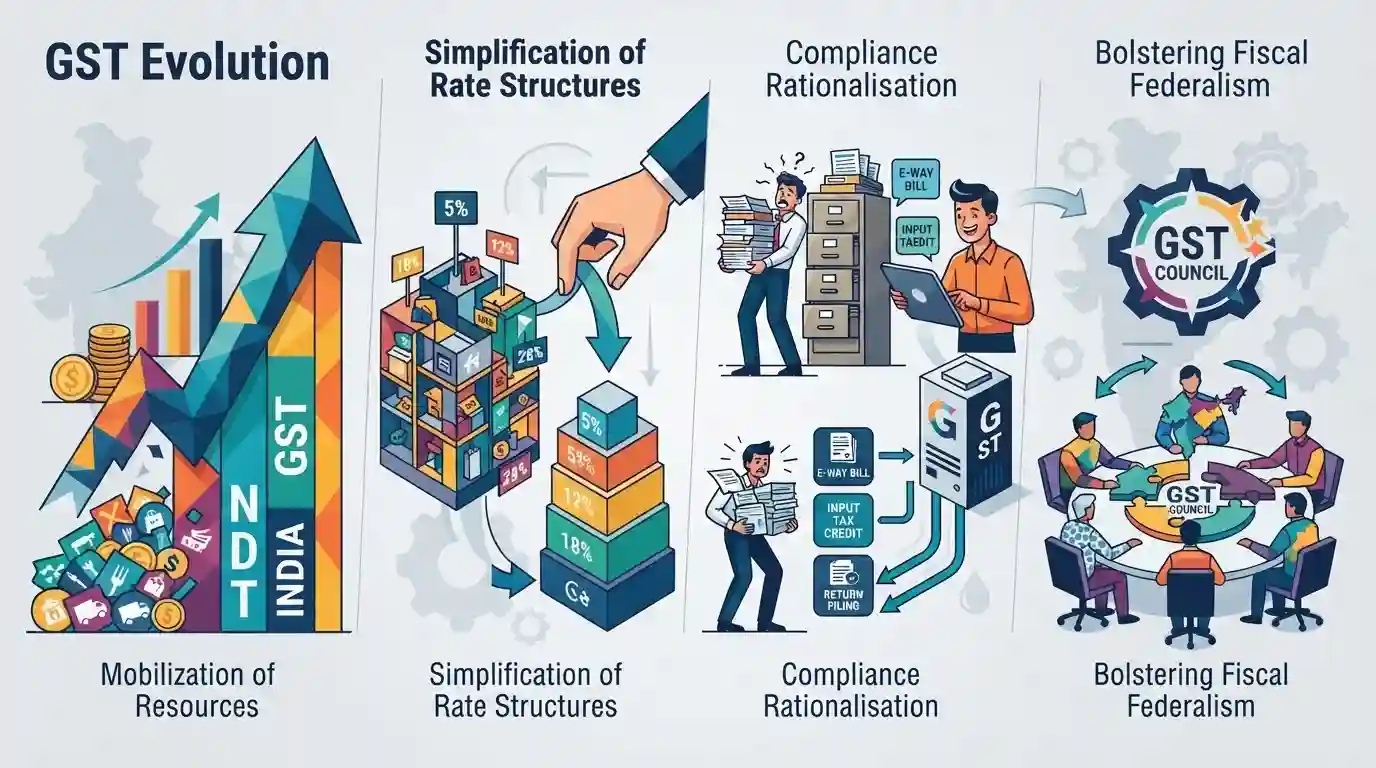
The article discusses the necessity and contours of 'GST 2.0', evaluating the evolution of India's indirect tax architecture, the rationale for further simplification of rate structures, compliance rationalisation, and bolstering fiscal federalism through the GST Council.
মূল বিষয়
- GST 2.0 represents a crucial phase of indirect tax reforms in India aimed at rationalising tax slabs, reducing compliance burdens, and addressing structural distortions.
- The debate centers around simplifying rate structures (moving towards fewer slabs), addressing inverted duty structures, and enhancing cooperative federalism through the GST Council.
- Streamlining compliance using technology and expanding the tax base are critical for boosting revenue productivity while maintaining consumer welfare.
গুরুত্বপূর্ণ শব্দ
Goods and Services Tax (GST)

A comprehensive, multi-stage, destination-based indirect tax levied on the supply of goods and services across India, designed to eliminate the cascading tax effect and unify the national market.
UPSC context
UPSC Prelims & Mains (GS Paper III): Crucial for Indian economy, resource mobilization, indirect taxation reforms, and the ease of doing business.
GST Council
A constitutional federal body established under Article 279A to make recommendations on GST rates, exemptions, and thresholds, jointly comprising Union and State representatives.
UPSC context
UPSC Prelims & Mains (GS Paper II & III): Tests cooperative federalism, constitutional bodies, and centre-state fiscal coordination.
Goods and Services Tax Act
The primary central legislation enacted following the 101st Constitutional Amendment Act, 2016, providing the legal framework for administering India's indirect tax regime.
UPSC context
UPSC Mains (GS Paper III): Important for understanding statutory frameworks governing indirect taxation, tax compliance, and legislative evolution.
সংযুক্ত স্থির ধারণা
What are the constitutional provisions and structural mechanics of the Goods and Services Tax (GST) Council in India?
- Article 279A: Constitutional Basis: Established under Article 279A (introduced by the 101st Constitutional Amendment Act, 2016) by the President.
- Composition: Composition: Chaired by the Union Finance Minister, with State Finance/Taxation Ministers as members.
- Voting Weight: Voting Mechanism: Centre holds one-third weightage; all states combined hold two-thirds. Decisions require a three-fourths majority, ensuring collective consensus.
- Binding Nature: Judicial Pronouncement: Supreme Court (Mohit Minerals, 2022) held that GST Council recommendations are persuasive, protecting state taxation autonomy.
আন্তঃবিষয় প্যাটার্ন
GST 2.0 & Cooperative Federalism
The evolution of the GST Council mirrors broader debates on cooperative federalism, balancing Centre-State legislative autonomy with uniform economic integration under Schedule VII.

Expect UPSC statement-based questions on Article 279A, GST Council voting weights, and the Mohit Minerals judgment on non-binding recommendations.
সংযুক্ত PYQ · 3
সংযুক্ত PYQ · 3
- 2019MainsGS3
Enumerate the indirect taxes which have been subsumed in the Goods and Services Tax (GST) in India. Also, comment on the revenue implications of the GST introduced in India since July 2017.
- 2013MainsGS3
Discuss the rationale for introducing Goods and Services Tax (GST) in India. Bring out critically the reasons for the delay in roll out for its regime.
- 2017PrelimsGS1
What is/are the most likely advantages of implementing 'Goods and Services Tax (GST)'? 1. It will replace multiple taxes collected by multiple authorities and will thus create a single market in India. 2. It will drastically reduce the 'Current Account Deficit' of India and will enable it to increase its foreign exchange reserves. 3. It will enormously increase the growth and size of economy of India and will enable it to overtake China in the near future. Select the correct answer using the code given below:
