GSECL And NPCIL Nuclear Power Project Collaboration In Gujarat
Source:timesofindia-indiatimes ↗
Why It Matters
Demonstrates strategic decentralization and state-level partnerships with central bodies like NPCIL to accelerate India's nuclear energy capacity and clean energy transition.
Summary
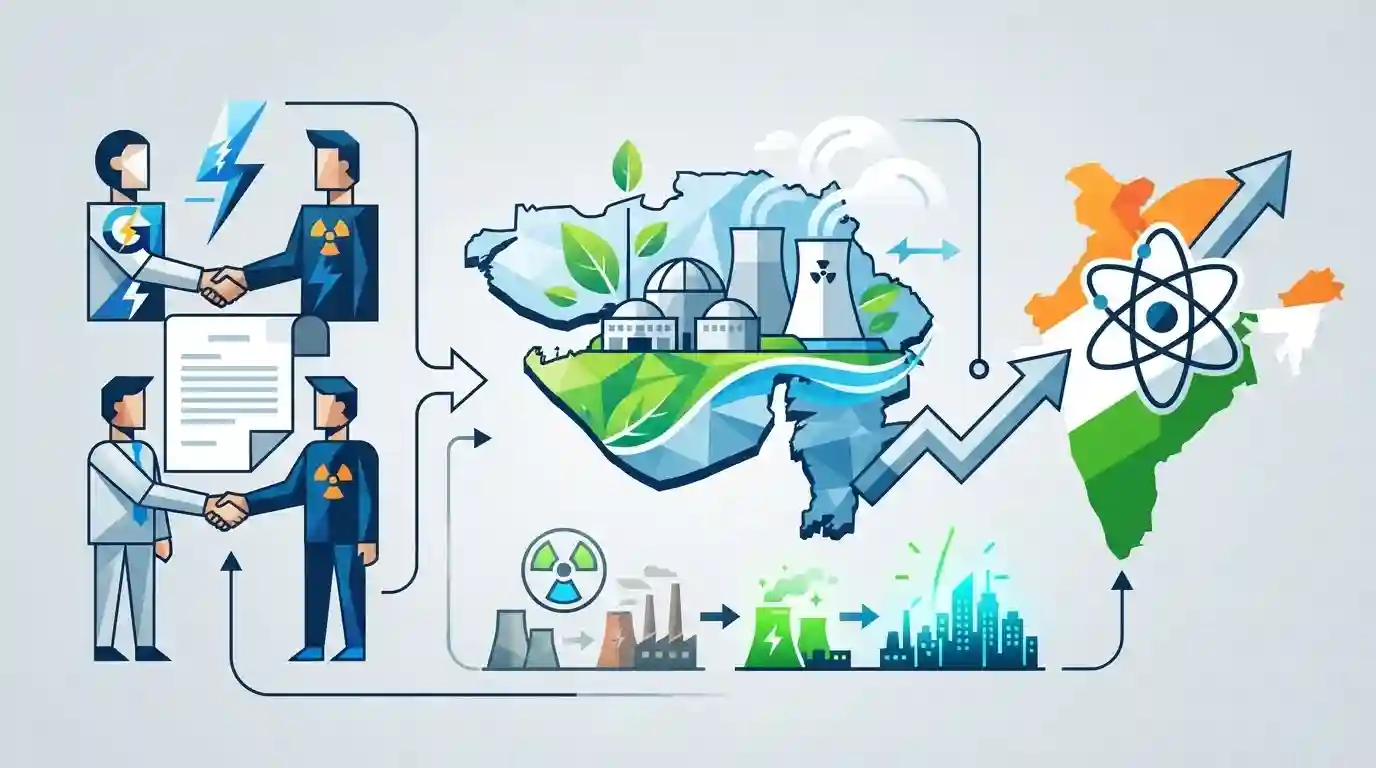
GSECL and NPCIL have signed an MoU to collaborate on developing nuclear power projects, boosting Gujarat's clean energy landscape and aligning with national atomic energy goals.
Key Points
- Gujarat State Electricity Corporation Limited (GSECL) and Nuclear Power Corporation of India Limited (NPCIL) signed a Memorandum of Understanding (MoU) to develop nuclear power projects.
- The collaboration aims to enhance clean energy capacity, diversify Gujarat's power generation portfolio, and contribute to India's net-zero carbon emission targets.
- Nuclear energy collaboration highlights state-level participation in expanding India's base-load atomic power capacity.
Important Terms
GSECL

A state-owned power generation company under the Government of Gujarat responsible for generating and supplying electricity across the state through thermal, gas, and renewable sources.
UPSC context
Important for GPSC Paper 3 (Economy & Infrastructure) covering Gujarat's state energy sector and power infrastructure initiatives.
NPCIL
A wholly-owned public sector enterprise under India's Department of Atomic Energy responsible for the design, construction, and operation of nuclear power reactors.
UPSC context
Crucial for GPSC Paper 3 (Science & Technology) testing India's nuclear energy policy, atomic power generation, and clean energy milestones.
Government of Gujarat
The sub-national executive authority of Gujarat, responsible for policy formulation, administrative governance, and infrastructure development within the state.
UPSC context
Essential for GPSC Paper 1 and 2 (Polity, Governance & State Schemes) focusing on state-level administrative decisions and developmental partnerships.
Prelims Trap
State governments have no constitutional or operational role in nuclear power development since atomic energy is a Union Subject.
Aspirants often assume nuclear power is exclusively under the Union government's legislative and operational domain, overlooking state PSU joint ventures like NPCIL-GSECL MoUs.
Static Concepts Connected
What is the constitutional and statutory framework governing nuclear energy in India?
- Constitutional Basis: Union List entry 6 atomic energy and mineral resources is exclusively under Parliament legislative competence under Schedule VII.
- Statutory Authority: The Atomic Energy Act of 1962 empowers the Central Government to produce, develop, and control atomic energy.
- Implementing Agency: NPCIL (Nuclear Power Corporation of India Limited) is a PSU under the Department of Atomic Energy (DAE).
Cross-Topic Patterns
Nuclear Energy + Environmental Clearance Regulations
Nuclear expansion under NPCIL requires massive cooling water and land acquisition, intersecting directly with coastal zone regulations and environmental clearances in Gujarat.
State Utilities + National Net-Zero Targets
State utilities like GSECL diversifying into atomic energy mirrors India's broader decentralised push for net-zero baseload power generation.

NPCIL joint ventures with state PSU utilities for nuclear baseload capacity will likely feature in matching or statement-based questions.
Linked PYQs · 2
Linked PYQs · 2
- 2026GPSC_PRELIMSGS1
What is the primary technical objective of the Second Stage of India's Three-Stage Nuclear Power Programme?
- 2026GPSC_PRELIMSGS1
Which of the following statement/s is/are correct about India's nuclear energy programme? 1. India's three-stage nuclear programme is centered on plutonium-based fast breeder reactors. 2. The thorium-based Advanced Heavy Water Reactor (AHWR) is the main component of India's third stage. 3. Kaiga Atomic Power Station houses India's first Indigenous Pressurised Heavy Water Reactor (PHWR). Select the correct option from the following.
