Industrial Activity Slowdown and MSME Vulnerabilities in India
Source:The Hindu ↗
Why It Matters
It provides a macroeconomic overview of India's current industrial slowdown, highlighting structural issues like the rural-urban consumption divide, the impact of food inflation, and the vulnerabilities of the export-driven MSME sector—all of which are recurring themes in GS3 Economy and GS2 International Relations trade discussions.
Summary
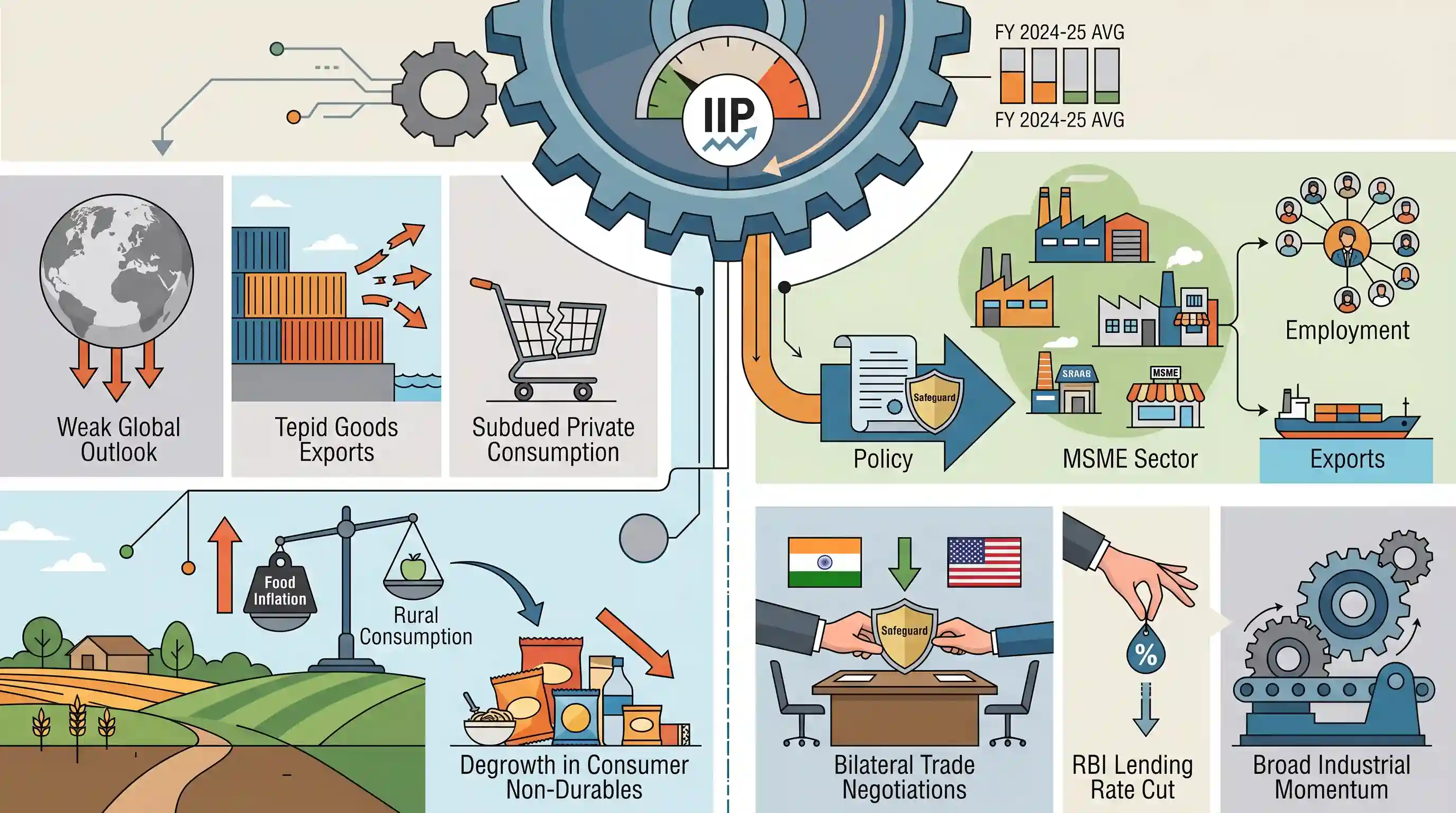
The article analyzes the slowdown in India's industrial activity, noting that the Index of Industrial Production (IIP) averaged just 4% growth in FY 2024-25. The deceleration is attributed to a weak global economic outlook, tepid goods exports, and subdued private consumption. Notably, high food inflation continues to strain rural consumption, evidenced by the degrowth in consumer non-durables. The author stresses that the MSME sector, vital for employment and exports, requires immediate policy intervention and safeguards in upcoming bilateral trade negotiations with the US, as minor lending rate cuts by the RBI are insufficient to revive broad industrial momentum.
Key Points
- India's Index of Industrial Production (IIP) growth decelerated to 4% in FY 2024-25, compared to 6% in the previous year.
- A stark rural-urban consumption divide is visible; consumer durables saw a doubling in growth, while consumer non-durables experienced degrowth due to high food inflation.
- Stagnant goods exports are heavily impacting MSMEs, which play a major role in employment generation and the export economy.
- The article advocates for prioritizing MSME support during bilateral trade negotiations, especially with the US, alongside structural domestic reforms beyond RBI rate cuts.
Important Terms
Index of Industrial Production (IIP)

A monthly index released by the NSO that measures volume changes in industrial production. It serves as a key barometer for manufacturing, mining, and electricity sectors.
UPSC context
GS Paper 3: Economic Development. Tests understanding of high-frequency indicators and industrial sector health.
Micro, Small and Medium Enterprises (MSMEs)
Enterprises classified by investment and turnover limits (e.g., Micro: <₹1cr investment, <₹5cr turnover). They are vital for employment, contributing significantly to India's GDP and exports.
UPSC context
GS Paper 3: Industrial Policy. Tests knowledge of sectoral contributions and policy interventions for inclusive growth.
Bilateral Trade Agreement
A trade treaty between two nations to reduce tariffs, quotas, and barriers to encourage economic cooperation and market access.
UPSC context
GS Paper 2/3: International Relations & Trade. Tests understanding of India's trade diplomacy and WTO compliance.
Reserve Bank of India (RBI)
India's central bank responsible for regulating the money supply and interest rates. It uses monetary policy tools to balance inflation control with economic growth.
UPSC context
GS Paper 3: Indian Economy. Tests knowledge of monetary policy, inflation targeting, and central bank functions.
Consumer Non-durables
Essential goods used immediately or within a short period (typically <3 years), such as food and toiletries. Their demand reflects mass-market and rural consumption health.
UPSC context
GS Paper 3: Economic Growth. Tests ability to analyze consumption patterns and their impact on industrial output.
Private Consumption
The total market value of all goods and services, including durables and non-durables, purchased by households. It is a primary driver of domestic demand and GDP.
UPSC context
GS Paper 3: Planning & Mobilization of Resources. Tests understanding of demand-side drivers of the economy.
Prelims Trap
"Consumer non-durables carry the highest weightage in the Index of Industrial Production (IIP)."
In the use-based classification of IIP (base 2011-12), Primary Goods hold the highest weight (~34%). Aspirants often confuse news emphasis on consumption trends with actual index weights.
Static Concepts Connected
What are the key components and classifications of the IIP?
- Sectoral composition: Divided into Manufacturing (~77.6%), Mining (~14.3%), and Electricity (~7.9%).
- Use-based classification: Categorized into Primary, Capital, Intermediate, Infrastructure/Construction, Consumer durables, and Consumer non-durables.
- Publishing agency: The National Statistical Office (NSO) under MoSPI releases it monthly, using the base year 2011-12.
What characterizes a K-shaped economic recovery?
- Divergent paths: Different sectors, demographic groups, or industries recover at vastly different rates after a recession—some rise while others fall.
- Consumption divide: Evidenced by surging sales of premium goods (durables) while mass-market goods (non-durables) stagnate or contract due to inflation.
- Inequality indicator: It often points to widening wealth gaps, wage stagnation at the bottom of the pyramid, and distress in rural/unorganized sectors.
Cross-Topic Patterns
MSME protection in bilateral FTAs
India's upcoming FTAs (e.g., with the US/UK) increasingly intersect with domestic MSME survival. Tariff elimination requires stringent 'Rules of Origin' to prevent third-party dumping and protect local manufacturing employment.
Food inflation vs. Monetary Policy limits
Structural food inflation limits the RBI's ability to cut repo rates to boost industry. Monetary policy struggles to address supply-side food shocks, highlighting the friction between inflation targeting and growth stimulation.

Expect a 2026 prelims question linking IIP's use-based components (durables vs non-durables) with structural inflation and K-shaped growth.
Linked PYQs · 4
Linked PYQs · 4
- 2015PrelimsGS1
In the 'Index of Eight Core Industries', which one of the following is given the highest weight?
- 2023MainsGS3
Faster economic growth requires increased share of the manufacturing sector in GDP, particularly of MSMEs. Comment on the present policies of the Government in this regard.
- 2017MainsGS3
Account for the failure of manufacturing sector in achieving the goal of labour-intensive exports. Suggest measures for more labour-intensive rather than capital-intensive exports.
- 2022PrelimsGS1
With reference to the Indian economy, consider the following statements: 1. If the inflation is too high, Reserve Bank of India (RBI) is likely to buy government securities. 2. If the rupee is rapidly depreciating, RBI is likely to sell dollars in the market. 3. If interest rates in the USA or European Union were to fall, that is likely to induce RBI to buy dollars. Which of the statements given above are correct?
