Jaishankar on Domestic Growth and Educational Diplomacy
Source:The Hindu ↗
Why It Matters
The speech comprehensively encapsulates India's evolving foreign policy doctrine, which blends strategic autonomy, firm counter-terrorism postures, the 'Neighborhood First' policy in crisis management, and the rising role of educational soft power in global diplomacy.
Summary
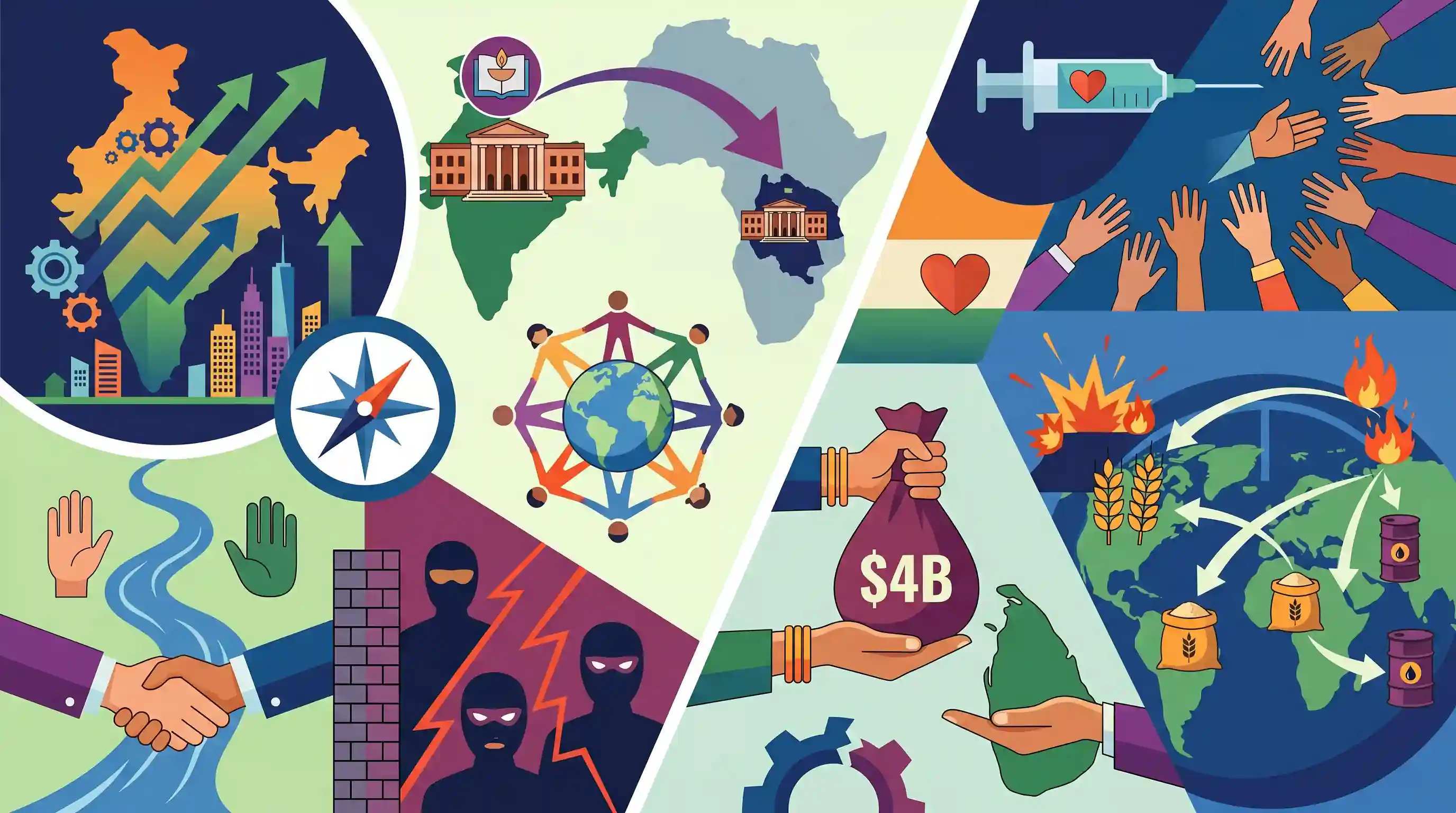
External Affairs Minister S. Jaishankar emphasized that India must foster robust domestic growth before fully leveraging the global environment, echoing the philosophy of 'Vasudhaiva Kutumbakam'. Speaking at IIT Madras, he highlighted India's growing educational diplomacy, notably the opening of an IIT Madras campus in Tanzania. On regional security, Jaishankar reaffirmed that India cannot maintain normal relations or uphold goodwill treaties like the Indus Waters Treaty with neighbors that sponsor terrorism. He also underscored India's proactive leadership during global crises, referencing its vaccine diplomacy, a $4 billion aid package during Sri Lanka's economic collapse, and efforts to mitigate food and fuel shortages sparked by the Ukraine war.
Key Points
- Domestic development is the foundational prerequisite for India to effectively leverage its position in the global arena.
- India's soft power and educational diplomacy are expanding, illustrated by the establishment of an IIT Madras campus in Tanzania and the launch of the IITM Global Research Foundation.
- India maintains a zero-tolerance policy towards state-sponsored terrorism; agreements like the Indus Waters Treaty and normal relations with Pakistan rely on a baseline of goodwill.
- India has established itself as a reliable first responder in crises, evidenced by its $4 billion assistance package to Sri Lanka, global vaccine diplomacy, and interventions to secure food and fuel amidst the Ukraine conflict.
Important Terms
Indus Waters Treaty

A 1960 World Bank-brokered water-sharing agreement between India and Pakistan, allocating the Eastern rivers (Ravi, Beas, Sutlej) to India and Western rivers (Indus, Jhelum, Chenab) to Pakistan.
UPSC context
GS Paper II: International Relations; tests knowledge of transboundary water governance and its linkage with national security and cross-border terrorism.
Vasudhaiva Kutumbakam
An ancient Indian philosophical concept meaning "the world is one family," serving as the ethical cornerstone of India's humanitarian diplomacy and inclusive global leadership.
UPSC context
GS Paper II and IV: Ethics & IR; examines the philosophical foundations of India’s soft power and its "Vaccine Maitri" initiative.
Educational Diplomacy
A strategic foreign policy tool using academic collaborations and overseas institutional presence (e.g., IIT Madras in Zanzibar) to foster long-term bilateral relations and human resource development.
UPSC context
GS Paper II: Soft Power & Education; evaluates India’s efforts to internationalize higher education under the National Education Policy 2020.
IITM Global Research Foundation
An international initiative launched in 2026 to transform IIT Madras into a multinational university and a globally networked hub for deep-tech innovation, research, and entrepreneurship.
UPSC context
GS Paper III: Science & Technology; relates to India’s vision of becoming a global knowledge superpower and indigenous innovation ecosystem.
Neighborhood First Policy
A pillar of India's foreign policy that prioritizes immediate neighbors through economic assistance (e.g., $4 billion to Sri Lanka), infrastructure development, and proactive crisis management.
UPSC context
GS Paper II: India and its Neighborhood; tests understanding of regional stability, countering external influences (China), and humanitarian leadership.
Prelims Trap
India has officially suspended the Indus Waters Treaty (IWT) under international law due to cross-border terrorism.
The IWT lacks a unilateral suspension clause. While India has issued notices to modify the treaty and paused some engagements, the 1960 treaty remains legally binding and active.
Static Concepts Connected
What is the water-sharing framework under the 1960 Indus Waters Treaty?
- Eastern Rivers: India has unrestricted use and control over the waters of the Ravi, Beas, and Sutlej.
- Western Rivers: Allocated to Pakistan, but India is permitted limited agricultural and non-consumptive uses, including run-of-the-river hydroelectric projects.
- Dispute Resolution: Brokered by the World Bank, the treaty mandates a Permanent Indus Commission to resolve disputes between the two nations.
What are the formal institutional mechanisms driving India's soft power diplomacy?
- ITEC Program: The Indian Technical and Economic Cooperation program builds global goodwill by training partner nations' civilian and military personnel.
- ICCR: The Indian Council for Cultural Relations drives cultural exchange, language promotion, and overseas scholarship distribution under the MEA.
- Development Assistance: The Development Partnership Administration (DPA) within the MEA oversees Lines of Credit, disaster relief, and infrastructure grants.
Cross-Topic Patterns
Educational diplomacy + Africa policy
The IIT Zanzibar campus signals a strategic shift in Africa policy from mere capacity-building to institutional asset creation, countering China's hard-infrastructure diplomacy with high-value educational soft power.
Transboundary water + counter-terrorism leverage
Linking the Indus Waters Treaty to terrorism reflects an evolving doctrine of using transboundary water agreements as a diplomatic lever, moving beyond traditional border security measures.

GS2 2026 may test India's shift from basic capacity building to institutional asset creation (overseas IITs) in its soft power diplomacy.
Linked PYQs · 3
Linked PYQs · 3
- 2012MainsGS2
The situation today is far different to that prevalent fifty years back when the Indus Water Treaty was signed." Highlight the complexity of the current challenges on both sides of the border in this regard. Do you think that a review of the Treaty is in India's best interests?
- 2022MainsGS2
India is an age-old friend of Sri Lanka.’ Discuss India's role in the recent crisis in Sri Lanka in the light of the preceding statement.
- 2015MainsGS2
The quality of higher education in India requires major improvements to make it internationally competitive. Do you think that the entry of foreign educational institutions would help improve the quality of higher and technical education in the country? Discuss.
