Gujarat cotton farming distress pest attacks and MSP procurement gaps
Source:The Hindu ↗
Why It Matters
Agriculture and farmer welfare are core components of the UPSC GS3 syllabus. The vulnerability of commercial crops like cotton to pest attacks (like pink bollworm on Bt cotton) and climate change, alongside the ongoing debates over MSP and crop insurance, are highly testable themes in both Prelims and Mains.
Summary
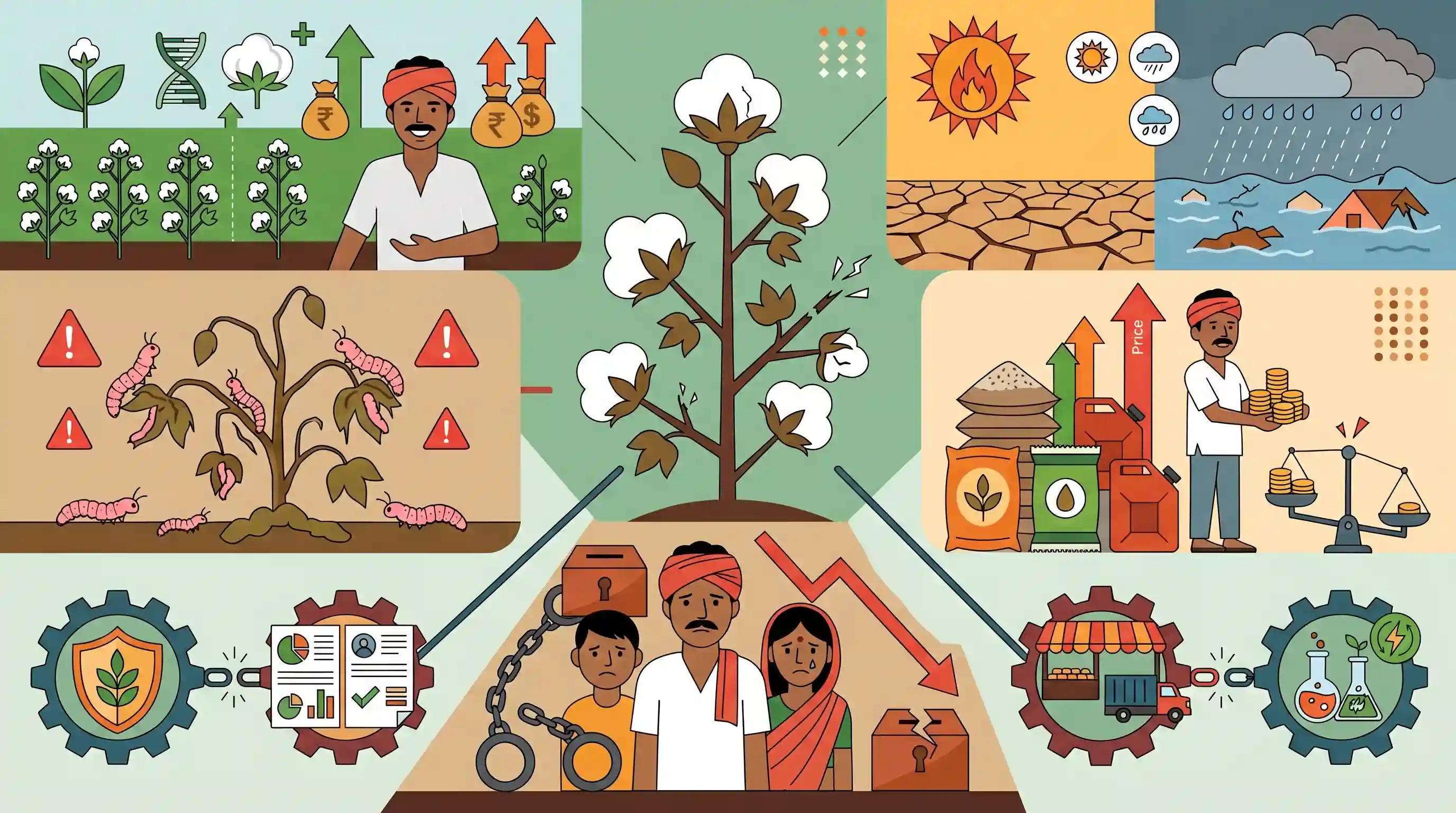
The article explores the deepening agricultural distress among cotton farmers in Gujarat. While the introduction of Bt cotton once brought prosperity to the region, farmers are currently grappling with severe challenges including recurrent pink bollworm infestations, erratic monsoon rains, and rising input costs. Coupled with an unreliable Minimum Support Price (MSP) procurement network, these issues have devastated farmer incomes and led to widespread debt. The situation highlights the urgent necessity for policy interventions in crop insurance, agricultural marketing, and sustainable farming technologies to rescue the agrarian economy.
Key Points
- Cotton farmers in Gujarat are facing severe distress due to stagnant yields, mounting input costs, and unpredictable weather patterns driven by climate change.
- The rising incidence of pest attacks, notably the pink bollworm on Bt cotton, has heavily undermined the profitability and long-term sustainability of the crop.
- Inadequate procurement mechanisms and reliance on local markets often force farmers to sell below the Minimum Support Price (MSP), trapping them in a cycle of debt.
- The crisis underscores the urgent need for systemic reforms, including crop diversification, robust crop insurance, and the introduction of next-generation climate-resilient seeds.
Important Terms
Minimum Support Price (MSP)

The pre-announced minimum price at which the government purchases crops from farmers to prevent distress sales when market prices fall, recommended by CACP.
UPSC context
GS Paper 3 (Agriculture). Tests understanding of price stability, food security, and government intervention in agrarian markets.
Pradhan Mantri Fasal Bima Yojana (PMFBY)
A flagship crop insurance scheme launched in 2016 to provide financial support for crop loss due to natural calamities, pests, and diseases.
UPSC context
GS Paper 2/3 (Welfare/Agriculture). Evaluates knowledge of risk mitigation and financial stability for small farmers.
Cotton Corporation of India (CCI)
A central public sector undertaking under the Ministry of Textiles responsible for cotton procurement at MSP and ensuring equitable distribution in the industry.
UPSC context
GS Paper 3 (Agriculture). Relevant for questions on institutional procurement and price support mechanisms for cash crops.
Agricultural Produce Market Committee (APMC)
State-regulated marketing boards that manage 'mandis' to ensure fair trade, price discovery, and protection of farmers from exploitation by intermediaries.
UPSC context
GS Paper 3 (Agricultural Marketing). Essential for discussing market reforms, e-NAM, and doubling farmers' income.
Pink Bollworm
A destructive pest that burrows into cotton bolls, damaging lint and seeds. It has notably developed resistance to Bt cotton across India.
UPSC context
GS Paper 3 (S&T/Agriculture). Tests knowledge of pest management, crop failure, and limitations of GM technology.
Bt Cotton
Genetically modified cotton variety containing soil bacteria genes to resist bollworms. While initially successful, it now faces challenges from pest resistance.
UPSC context
GS Paper 3 (S&T). Covers biotechnology applications in agriculture and their socio-economic impact on farmers.
Prelims Trap
Bt cotton varieties possess permanent immunity against the pink bollworm and other pests.
Pink bollworms have evolved resistance to the Cry1Ac and Cry2Ab toxins in Bollgard I and II, making current Bt cotton strains highly susceptible.
Static Concepts Connected
What are the ideal geographical conditions for cotton cultivation?
- Temperature: Requires 210 frost-free days and bright sunshine with temperatures ranging between 21°C and 30°C.
- Rainfall: Needs 50 to 100 cm of moderate rainfall; as a kharif crop, it is heavily reliant on timely monsoons.
- Soil: Thrives best in moisture-retentive deep black soils (Regur) of the Deccan Plateau and Saurashtra region.
What is the regulatory and procurement framework for cotton in India?
- Procurement Agency: The Cotton Corporation of India (CCI) under the Ministry of Textiles is the nodal central agency for undertaking MSP operations.
- GM Regulation: The Genetic Engineering Appraisal Committee (GEAC) under MoEFCC regulates the approval of GM crops like Bt Cotton.
Cross-Topic Patterns
Biotech + Ecological adaptation
The evolution of pink bollworm resistance highlights the ecological limits of single-gene GM crops, shifting focus toward next-gen climate-resilient varieties and integrated pest management.
Climate shifts + Agri-credit
Erratic monsoons causing successive crop failures expose the operational gaps in PMFBY payouts, pushing dryland farmers away from institutional credit into informal debt traps.

Expect a 2026 multi-statement Prelims question fusing cotton's geographical needs (210 frost-free days) with pink bollworm resistance.
Linked PYQs · 5
Linked PYQs · 5
- 2018MainsGS3
What do you mean by Minimum Support Price (MSP)? How will MSP rescue the farmers from the low income trap?
- 2017MainsGS3
How do subsidies affect the cropping pattern, crop diversity and economy of farmers? What is the significance of crop insurance, minimum support price and food processing for small and marginal farmers?
- 2023MainsGS3
Explain the changes in cropping pattern in India in the context of changes in consumption pattern and marketing conditions.
- 2021PrelimsGS1
Bollgard I and Bollgard II technologies are mentioned in the context of
- 2020PrelimsGS1
"The crop is subtropical in nature. A hard frost is injurious to it. It requires at least 210 frost-free days and 50 to 100 centimeters of rainfall for its growth. A light well-drained soil capable of retaining moisture is ideally suited for the cultivation of the crop." Which one of the following is that crop?
