Punjab Groundwater Depletion Deepens Agrarian Inequality
Source:The Hindu ↗
हे का महत्त्वाचे आहे
It links environmental degradation (groundwater depletion) with socio-economic inequality in a key agrarian State, offering critical insights for policy interventions like crop diversification and subsidy rationalization.
सारांश
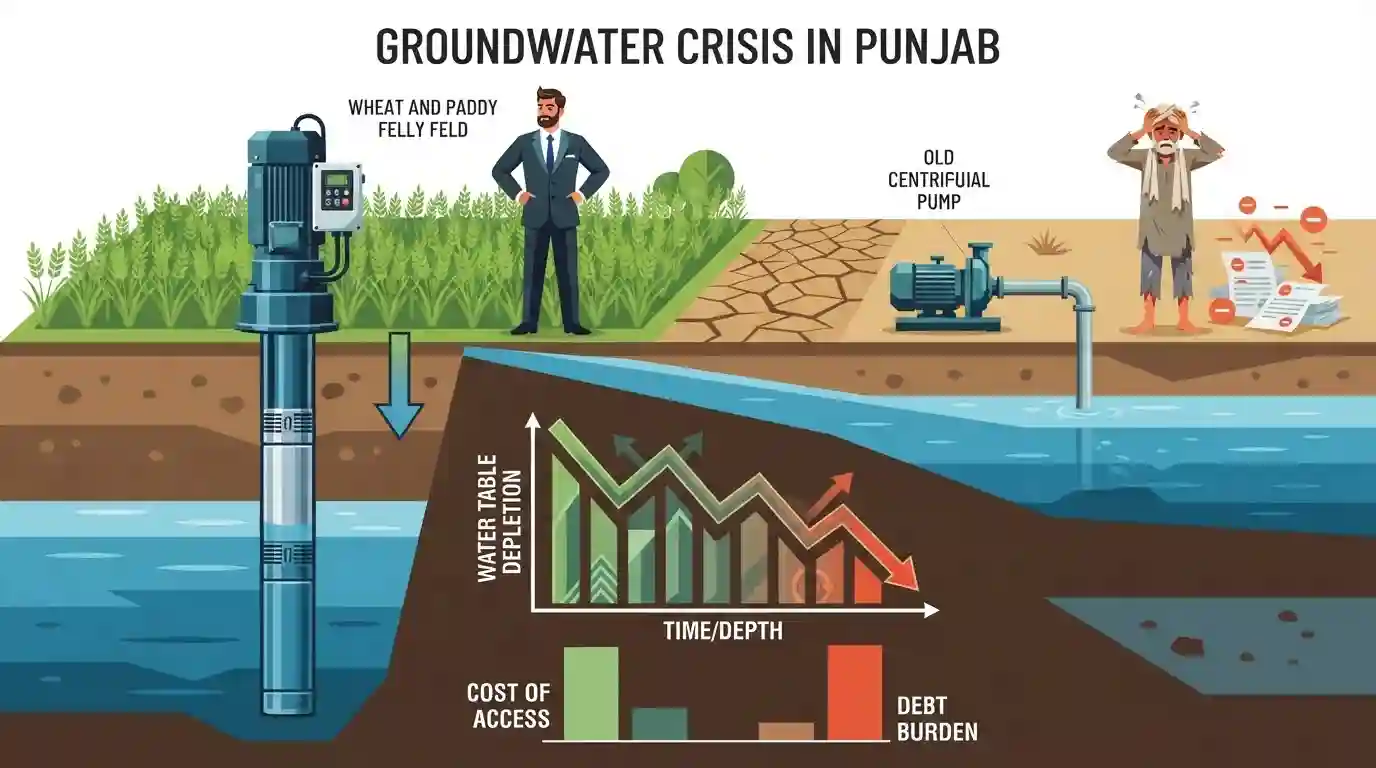
A study on Punjab's groundwater crisis reveals that depleting water tables are widening socio-economic inequalities. While large farmers afford deeper submersible pumps to tap receding water, small and marginal farmers face crushing debt, highlighting the intersection of ecological degradation and agrarian inequality.
मुख्य मुद्दे
- A recent study highlights that the severe groundwater crisis in Punjab is worsening social and economic disparities between large landowners and marginal/small farmers.
- Declining water tables force farmers to deepen tube wells and install expensive submersible pumps, an investment that marginal farmers cannot afford.
- Large farmers can easily adapt by deepening their wells and securing access, while smallholders face mounting debt or are forced to lease out their land.
- The crisis underscores the urgent need for crop diversification, rationalization of power subsidies, and sustainable water management policies to prevent agrarian distress and social polarization.
महत्त्वाच्या संज्ञा
Free electricity policy for agriculture

A state welfare measure providing zero-cost power to agricultural tube wells, which incentivizes intensive groundwater extraction and heavily depletes aquifers while straining state exchequers.
UPSC context
Mains GS-3 (Agriculture / Economy): Evaluates the perverse incentives of input subsidies on resource degradation, fiscal federalism, and agrarian distress.
Punjab Agricultural University
A premier state agricultural university in Ludhiana, Punjab, renowned for research on regional crop science, water table depletion, and sustainable farming systems.
UPSC context
Mains GS-3 / Prelims: Important institution referenced for regional data on agricultural science, groundwater tables, and crop diversification studies.
पूर्वपरीक्षा सापळा
All groundwater blocks in Punjab are officially classified as over-exploited.
Aspirants often assume all blocks in Punjab are over-exploited uniformly; however, the correct statistic is that over 76% of blocks are over-exploited.
संबंधित स्थिर संकल्पना
What are the constitutional provisions and institutional mechanisms for water resource management in India?
- Constitutional Status: Water is a State List subject (Entry 17, List II), except for regulation and development of inter-State rivers under Union List Entry 56.
- Apex Body: The Central Ground Water Board (CGWB) under the Ministry of Jal Shakti monitors groundwater levels and resource assessment nationally.
- Categorization: The CGWB categorizes assessment units into safe, semi-critical, critical, and over-exploited based on stage of groundwater extraction.
आंतर-विषय नमुने
Power Subsidies + Fiscal Federalism + Groundwater Depletion
Free power subsidies drive intensive groundwater extraction while simultaneously draining fiscal health, creating a dual policy trap for state governments.
MSP Distortion + Agrarian Distress + Smallholder Debt
Unremunerative MSP skewed toward paddy forces smallholders into perpetual debt cycles as ecological degradation compounds structural agrarian inequality.

Groundwater over-exploitation tied to free electricity and MSP incentives will likely feature as a multi-statement Mains/Prelims question.
संबंधित PYQ · 3
संबंधित PYQ · 3
- 2025MainsGS3
Examine the factors responsible for depleting groundwater in India. What are the steps taken by the government to mitigate such depletion of groundwater?
- 2021MainsGS3
How and to what extent would micro-irrigation help in solving India's water crisis?
- 2024MainsGS3
What are the major challenges faced by Indian irrigation system in recent times? State the measures taken by the government for efficient irrigation management.
