Heatwaves Drive Dangerous Ground-Level Ozone Spikes in India
Source:Indian Express ↗
Why It Matters
Ground-level ozone is a recurring topic in UPSC Prelims (often featured in questions on photochemical smog and WHO air quality guidelines) and Mains (pollution impact on health, National Clean Air Programme). Understanding the exacerbating effect of climate-change-induced heatwaves on secondary pollutant formation provides critical fodder for essay and GS-3 answers.
Summary
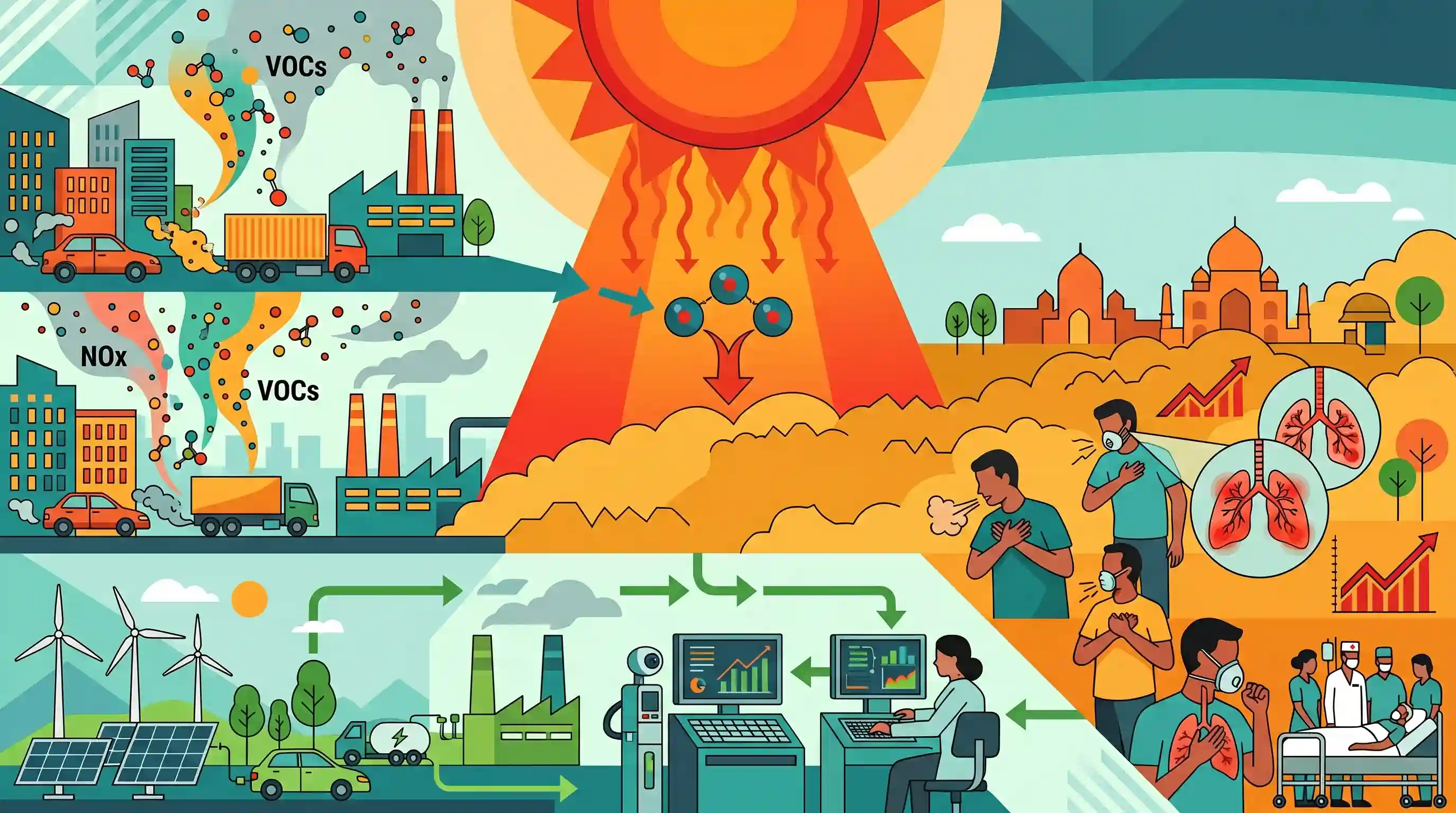
A recent study published in the 'Clean Air' journal reveals a lethal correlation between intense heatwaves and rising concentrations of ground-level ozone in India. Unlike beneficial stratospheric ozone, surface-level ozone is a secondary pollutant created when vehicular and industrial emissions (NOx and VOCs) undergo photochemical reactions accelerated by extreme heat. Background ozone levels in regions like North-Western India and the Gangetic plains regularly exceed safe limits, severely aggravating respiratory conditions like COPD. As heatwaves become more frequent, India faces an escalating public health crisis, necessitating enhanced monitoring by environmental agencies and robust emission control strategies.
Key Points
- Ground-level ozone is a secondary pollutant formed via photochemical reactions between nitrogen oxides (NOx) and volatile organic compounds (VOCs) under sunlight, which accelerate during heatwaves.
- Unlike stratospheric ozone, which provides a protective UV shield, tropospheric (surface) ozone is highly toxic and causes severe respiratory and cardiovascular ailments, such as COPD and Ischemic Heart Disease.
- In 2024, extreme heat-driven ozone spikes were estimated to be responsible for over 830 deaths in India, while prolonged ozone exposure aggravated ~234,000 COPD deaths in 2023.
- Background ozone levels in India hover at 50-55 ppb, precariously close to unsafe thresholds, primarily affecting North-Western India and the Gangetic plains.
- Experts urge extensive and continuous monitoring of ground-level ozone by agencies like the IMD and CPCB, given that high concentrations can persist for days even after a heatwave ends.
Important Terms
Central Pollution Control Board (CPCB)

A statutory body under the Ministry of Environment, Forest and Climate Change (1974) responsible for air and water quality monitoring and standard-setting in India.
UPSC context
GS Paper 3 (Environment); tests knowledge of statutory bodies and their role in environmental pollution control and regulation.
India Meteorological Department (IMD)
The principal government agency under the Ministry of Earth Sciences responsible for weather forecasting, climate monitoring, and issuing heatwave alerts.
UPSC context
GS Paper 1 (Geography) and GS 3 (Disaster Management); tests understanding of climate monitoring and disaster warning systems.
World Health Organization (WHO)
A United Nations agency focused on international public health. It provides scientific guidelines for safe levels of atmospheric pollutants, used as benchmarks globally.
UPSC context
GS Paper 2 (International Bodies/Health); tests knowledge of global health benchmarks and their influence on national environmental policy.
State of Global Air report
An annual comprehensive analysis of global air quality and health impacts, published by the Health Effects Institute to inform environmental and public health policy.
UPSC context
GS Paper 3 (Environment/Pollution); tests ability to cite international data to support arguments on India's air quality crisis.
Health Effects Institute (HEI)
An independent, nonprofit research institute that provides impartial science on air pollution's health effects and partners with global agencies for data reporting.
UPSC context
GS Paper 3 (Environment); tests awareness of scientific collaborations and organizations shaping global and domestic environmental standards.
IIT Kharagpur
A premier Indian research university; its CORAL center led the pioneering study identifying the lethal link between heatwaves and ground-level ozone in India.
UPSC context
GS Paper 3 (Science & Tech); tests knowledge of domestic research contributions toward solving complex environmental and public health challenges.
Prelims Trap
"Ground-level ozone is directly emitted by industrial plants and vehicles during intense heatwaves."
Tropospheric ozone is a secondary pollutant. It is never emitted directly; it forms only when primary pollutants (NOx and VOCs) react under sunlight and high temperatures.
Static Concepts Connected
What distinguishes Primary from Secondary air pollutants?
- Primary Pollutants: Emitted directly into the atmosphere from a specific source. Examples: SO2, NO, NO2, CO, and primary Particulate Matter.
- Secondary Pollutants: Not emitted directly. Formed in the lower atmosphere by chemical reactions between primary pollutants and natural components. Examples: Ground-level Ozone, PAN (Peroxyacetyl Nitrate), and Smog.
- Role of Heat: Sunlight and high temperatures act as catalysts, accelerating the photochemical reactions needed to generate pollutants like tropospheric ozone.
Which pollutants are monitored under India's National Ambient Air Quality Standards (NAAQS)?
- Regulating Authority: Notified by the Central Pollution Control Board (CPCB) under the Air (Prevention and Control of Pollution) Act, 1981.
- 12 Pollutants: Includes PM10, PM2.5, SO2, NO2, CO, Ozone (O3), Ammonia (NH3), Lead (Pb), Benzene, Benzopyrene, Arsenic, and Nickel.
- UPSC Exclusions: CO2 and Chlorofluorocarbons (CFCs) are frequently used as trap options in Prelims. Neither is monitored under NAAQS.
Cross-Topic Patterns
Urban Heat Islands & Photochemical Smog
Rising urban heat island (UHI) effects act as localized catalysts for photochemical smog, directly linking urban infrastructure planning (geography) with secondary air pollution and public health crises.
Geography of the Indo-Gangetic Airshed
The Indo-Gangetic plain's topography is traditionally studied for winter smog (inversions), but intense summer insolation and heatwaves now make it a dual-season hotspot for tropospheric ozone formation.

Expect a 2026 Prelims multi-statement question pairing tropospheric ozone formation (NOx + VOCs + heat) with urban heat island effects.
Linked PYQs · 3
Linked PYQs · 3
- 2022PrelimsGS1
In the context of WHO Air Quality Guidelines, consider the following statements: 1. The 24-hour mean of PM2.5 should not exceed 15 µg/m³ and annual mean of PM2.5 should not exceed 5 µg/m³. 2. In a year, the highest levels of ozone pollution occur during the periods of inclement weather. 3. PM10 can penetrate the lung barrier and enter the bloodstream. 4. Excessive ozone in the air can trigger asthma. Which of the statements given above are correct?
- 2013PrelimsGS1
Photochemical smog is a resultant of the reaction among
- 2021MainsGS3
Describe the key points of the revised Global Air Quality Guidelines (AQGs) recently released by the World Health Organisation (WHO). How are these different from its last update in 2005? What changes in India's National Clean Air Programme are required to achieve these revised standards?
