Banking Sector Gross Non-Performing Assets Multi-Decade Low
Source:Indian Express ↗
ఇది ఎందుకు ముఖ్యం
The health of the banking sector is foundational to macroeconomic stability and credit availability. A historic low in Gross NPAs indicates enhanced resilience against shocks and a stronger capacity to fund India's infrastructure and industrial growth ambitions.
సారాంశం
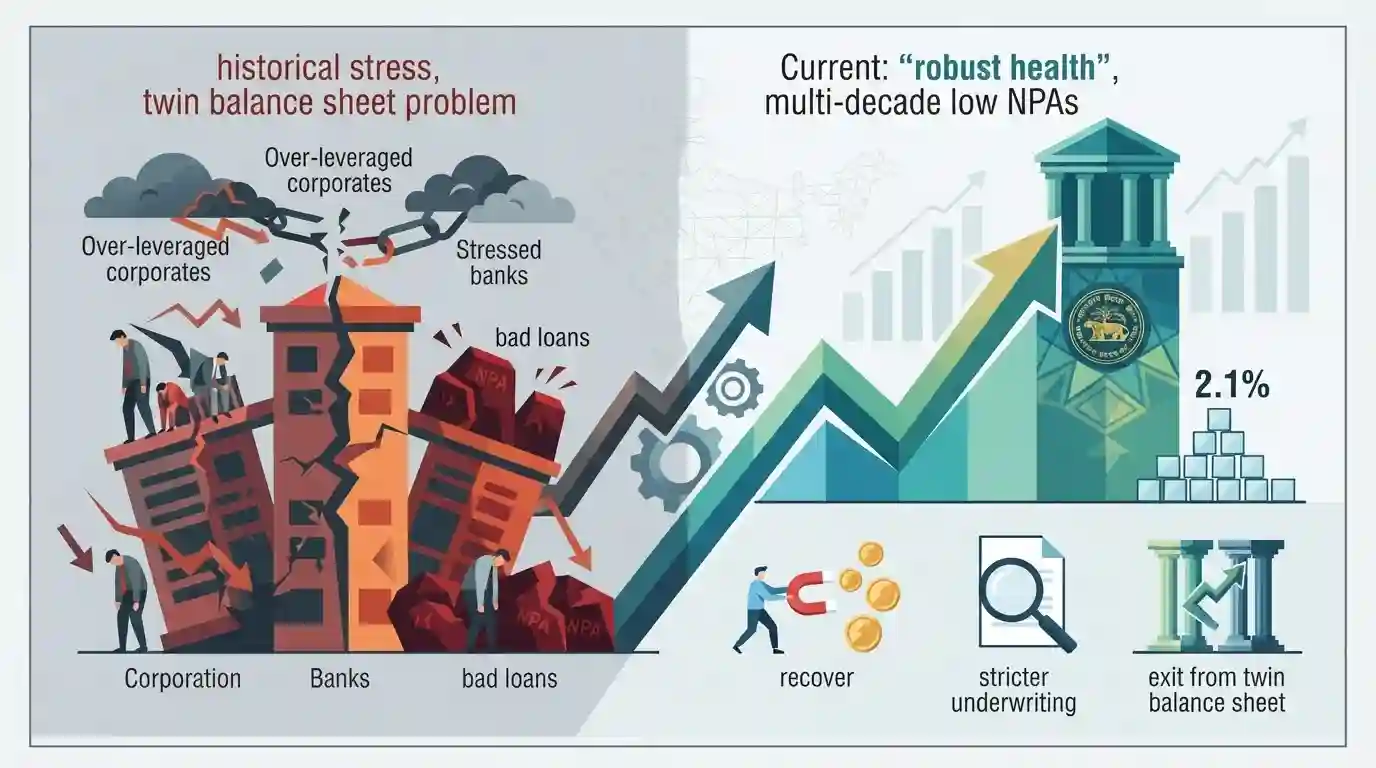
According to an RBI report, the Gross Non-Performing Assets (NPAs) of Indian scheduled commercial banks dropped to a multi-decade low of 2.1% by the end of September 2025. This improvement signifies robust health in the Indian banking sector, reflecting better recovery mechanisms, stricter underwriting standards, and a decisive exit from historical stress like the twin balance sheet problem.
ముఖ్య అంశాలు
- Gross Non-Performing Assets (NPAs) of Indian banks fell to a multi-decade low of 2.1% as of end-September 2025 according to an RBI report.
- The sharp decline highlights the strengthening of bank balance sheets, overcoming the legacy 'twin balance sheet' problem.
- Improved asset quality enables banks to boost credit growth and support broader economic expansion.
ముఖ్యమైన పదాలు
Gross Non-Performing Assets (NPAs)

Gross Non-Performing Assets (GNPA) represent the total value of all loans and advances where principal or interest payments have remained overdue for more than 90 days.
UPSC context
UPSC CSE Prelims and Mains (GS Paper III - Economy): Tests understanding of banking sector health, asset quality, and financial stability metrics.
Reserve Bank of India (RBI)
India's central banking institution that controls monetary policy, regulates the banking system, issues currency, and manages foreign exchange reserves.
UPSC context
UPSC CSE Prelims and Mains (GS Paper III - Economy): Evaluates monetary policy formulation, banking regulation, and macroeconomic stability assessments.
ప్రిలిమ్స్ ఉచ్చు
A multi-decade low in Gross NPAs implies that the Indian banking sector is entirely free from systemic credit risks.
A low Gross NPA ratio does not mean zero bad loans or the complete elimination of credit risk; provisioning and Net NPAs must also be evaluated.
అనుసంధానమైన స్థిర భావనలు
What are the key classifications of Non-Performing Assets (NPAs) in the Indian banking system?
- Sub-standard Assets: An asset becomes an NPA when interest or principal installment remains overdue for a period of more than 90 days.
- Doubtful Assets: An asset remains in the doubtful category if it has remained in the sub-standard category for a period of 12 months.
- Loss Assets: Loss assets are identified by internal or external auditors/RBI inspection where loss is identified, but amount has not been fully written off.
అంతర-అంశ నమూనాలు
NPA Declines + Monetary Policy Transmission
The resolution of historical bad loans directly facilitates RBI's liquidity management and transmission of repo rate changes into productive commercial lending.
Banking Health + Infrastructure Capex Financing
Clean bank balance sheets provide the necessary capital buffer to finance India's ambitious green transition and capital expenditure roadmap.

RBI asset quality trends + Twin Balance Sheet problem likely to appear as a multi-statement conceptual trap in Prelims.
అనుసంధాన PYQలు · 1
అనుసంధాన PYQలు · 1
- 2026PrelimsGS1
Consider the following statements about the Non-Banking Financial Companies (NBFCs) in India : 1. NBFCs cannot accept demand deposits. 2. All the NBFCs operating in India have to be registered with the RBI. 3. NBFCs form part of the payment and settlement system and can issue cheque drawn on itself. 4. Deposit insurance facility of Deposit Insurance and Credit Guarantee Corporation (DICGC) is not available to the depositors of deposit taking NBFCs. Which of the statements given above is/are correct ?
