Gross GST collections register eight percent growth in February
Source:The Hindu ↗
Why It Matters
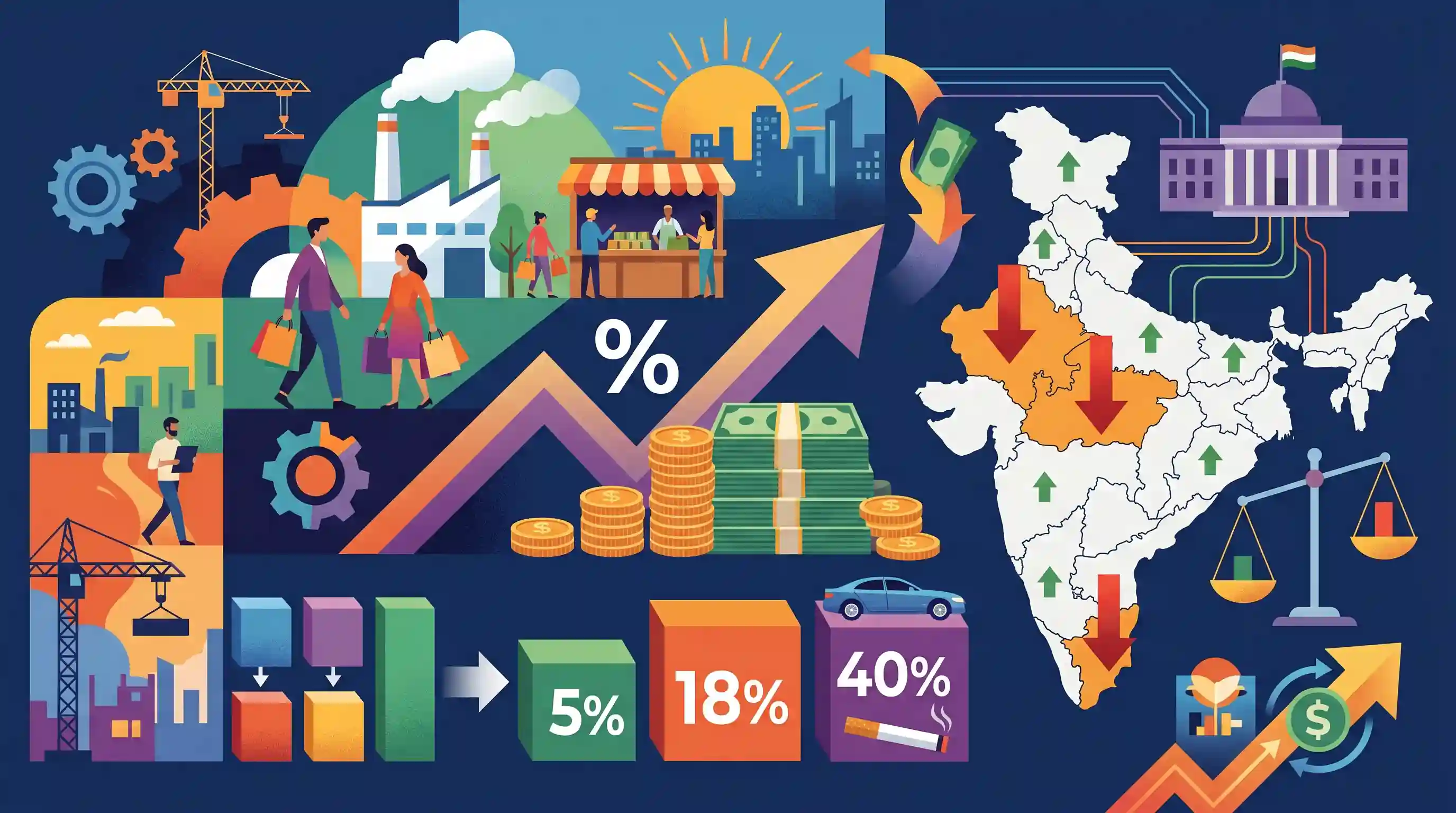
Illustrates the macroeconomic impact of the landmark September 2025 GST rate rationalization and highlights the emerging fiscal federalism challenge where several major states are experiencing revenue contraction despite national aggregate growth.
Summary
Gross Goods and Services Tax (GST) collections rose by 8.1% to ₹1.83 lakh crore in February 2026, supported by robust domestic consumption that has offset the recent major rate rationalizations. The structural reform implemented in September 2025 merged the previous four tax slabs into two (5% and 18%) and introduced a 40% rate for luxury and tobacco goods. While the overall numbers suggest a maturing tax ecosystem and strong macroeconomic momentum, negative revenue growth in key states such as Tamil Nadu, Madhya Pradesh, and Rajasthan highlights growing regional disparities in revenue mobilization, posing challenges for federal fiscal dynamics.
Key Points
- Gross GST collections grew by 8.1% to ₹1.83 lakh crore in February 2026, reflecting resilient domestic consumption and higher import revenues.
- In September 2025, GST rates underwent major rationalization: four previous slabs (5%, 12%, 18%, 28%) were merged into just two (5% and 18%), while a 40% slab was introduced for ultra-luxury goods and tobacco products.
- Despite the rate cuts making around 375 items cheaper, the strong consumption uptick has more than compensated for potential revenue losses.
- A stark regional divergence has emerged in collections, with major states like Tamil Nadu (-6%), Madhya Pradesh (-8%), and Rajasthan (-1%) reporting negative growth, raising concerns about state-level fiscal health.
Important Terms
Goods and Services Tax (GST)

A multi-stage, destination-based tax levied on value addition at every stage of the supply chain, replacing most of India's previous central and state indirect taxes.
UPSC context
GS Paper III (Economy); tests mobilization of resources, tax reforms, and the 'One Nation, One Tax' framework.
GST Council
A constitutional body established under Article 279A, comprising Union and State representatives, tasked with making recommendations on GST rates, exemptions, and administrative rules.
UPSC context
GS Paper II (Polity); tests understanding of constitutional bodies and the practical application of cooperative federalism.
Rate Rationalization
The policy process of streamlining tax slabs to simplify the tax structure, resolve inverted duty structures, and boost consumption by adjusting rates on essential and luxury goods.
UPSC context
GS Paper III (Economy); tests analysis of fiscal policy, revenue neutrality, and the 2025 'GST 2.0' structural reforms.
Fiscal Federalism
The framework governing the distribution of financial powers and revenue between the Centre and States, crucial for maintaining balanced regional development and state fiscal autonomy.
UPSC context
GS Paper II (Federal Structure); tests issues pertaining to Centre-State financial relations and vertical/horizontal imbalances.
Destination-based Tax
A tax system where the tax revenue belongs to the state where the final consumption occurs, rather than the state where the goods or services originated.
UPSC context
GS Paper III (Economy); tests understanding of GST’s varied impact on 'producing' (e.g., Tamil Nadu) versus 'consuming' states.
Indirect Tax
A tax imposed on the consumption of goods and services, where the burden is shifted from the supplier to the end consumer.
UPSC context
GS Paper III (Economy); tests knowledge of taxation types and their regressive or progressive nature in the economy.
Prelims Trap
"Negative GST revenue growth in a state directly indicates a decline in its manufacturing output."
GST is a destination-based consumption tax. Negative revenue growth indicates falling domestic consumption and purchasing power within that state, not necessarily a decline in its manufacturing output.
Static Concepts Connected
What is the difference between Tax Buoyancy and Tax Elasticity?
- Tax Buoyancy: Measures the responsiveness of tax revenue to GDP growth, factoring in the impact of discretionary policy changes like GST rate revisions.
- Tax Elasticity: Measures the inherent responsiveness of tax revenue to GDP growth, calculated under the assumption that tax rates and structures remain entirely constant.
What is an Inverted Duty Structure (IDS) in the GST regime?
- The Mechanism: A scenario that occurs when the tax rates on raw materials or inputs are higher than the tax rate levied on the final finished product.
- The Consequence: It leads to accumulated Input Tax Credit (ITC) which blocks manufacturers' working capital and creates administrative burdens for tax refunds.
Cross-Topic Patterns
Destination Tax vs State Revenues
Sluggish GST growth in key states will influence the 16th Finance Commission's horizontal devolution formula, as states demand greater grants-in-aid to offset consumption-tax shortfalls.
GST as a Macroeconomic Proxy
UPSC increasingly tests high-frequency indicators. GST mop-ups, like E-way bills and PMI, act as real-time proxies for Private Final Consumption Expenditure (PFCE), tracking aggregate domestic demand.

Mains 2026 will likely link the two-slab GST rationalisation to fiscal federalism challenges, given widening state revenue disparities.
Linked PYQs · 4
Linked PYQs · 4
- 2019MainsGS3
Enumerate the indirect taxes which have been subsumed in the Goods and Services Tax (GST) in India. Also, comment on the revenue implications of the GST introduced in India since July 2017.
- 2020MainsGS3
Explain the rationale behind the Goods and Services Tax (Compensation to States) Act of 2017. How has COVID-19 impacted the GST compensation fund and created new federal tensions?
- 2013MainsGS3
Discuss the rationale for introducing Goods and Services Tax (GST) in India. Bring out critically the reasons for the delay in roll out for its regime.
- 2025MainsGS2
Examine the evolving pattern of Centre-State financial relations in the context of planned development in India. How far have the recent reforms impacted the fiscal federalism in India?
