Gross foreign direct investment reaches fifteen year peak
Source:The Hindu ↗
આ શા માટે મહત્વનું છે
FDI is a crucial non-debt-creating capital flow for India, driving economic growth, technological advancement, and employment. Tracking FDI trends helps assess the macroeconomic investment climate and the stability of India's external sector and Balance of Payments.
સારાંશ
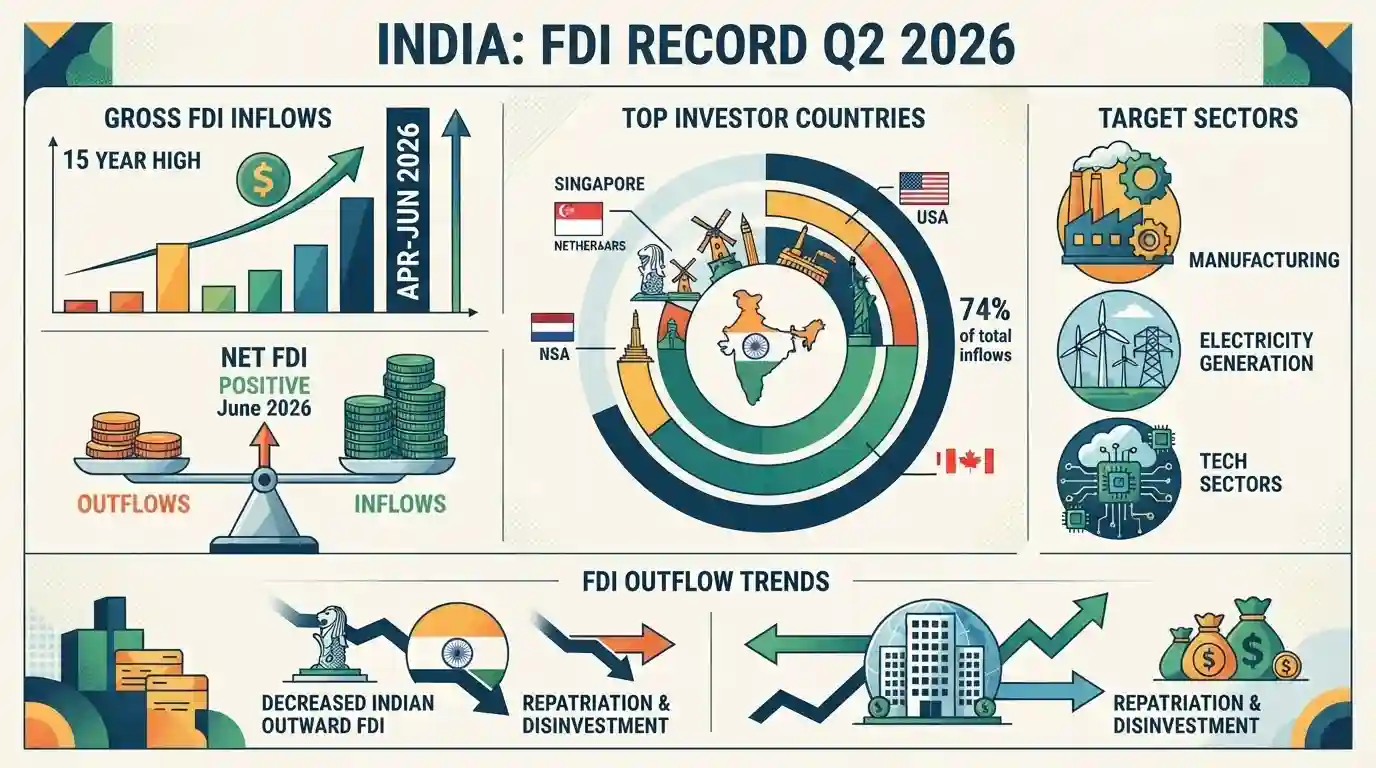
India recorded a 15-year high in Gross Foreign Direct Investment (FDI), reaching $30.7 billion in the April-June 2026 quarter. Concurrently, net FDI turned positive in June 2026, highlighting a favorable balance of capital flows. Singapore, the Netherlands, the US, and Canada contributed to 74% of these inflows, primarily targeting the manufacturing, electricity generation, and tech sectors. Outflows displayed mixed trends, with decreased outward FDI by Indian enterprises contrasted against growing repatriation and disinvestment by foreign entities.
મુખ્ય મુદ્દા
- Gross Foreign Direct Investment (FDI) in India reached a 15-year high of $30.7 billion in the April-June 2026 quarter.
- Net FDI turned positive in June 2026, with inflows exceeding outflows by $1.3 billion.
- Singapore, the Netherlands, the US, and Canada were major contributors, accounting for 74% of the inflows.
- Top sectors attracting FDI included manufacturing, electricity generation, and computer and communication services.
- While outward FDI by Indian companies declined, there was an increase in repatriation and disinvestment by foreign companies.
મહત્વપૂર્ણ શબ્દો
Net Foreign Direct Investment (Net FDI)

The ultimate difference between total incoming foreign direct investment (Gross FDI) and structural capital outflows, which include profit repatriation, corporate disinvestments, and outward investments by domestic companies.
UPSC context
GS Paper 3 (Indian Economy). Crucial for evaluating the true addition of productive capital and long-term investor confidence.
Foreign Direct Investment (FDI)
A long-term cross-border investment where a foreign entity acquires a lasting interest and managerial influence in a domestic enterprise, generally bringing capital, technology, and expertise.
UPSC context
GS Paper 3 (Investment Models). Key to analyzing economic growth, employment generation, and infrastructure development in India.
Capital Repatriation
The process by which foreign investors withdraw their capital, sell domestic assets, or send profits and dividends from a host country back to their home nation.
UPSC context
GS Paper 3 (External Sector). Vital for analyzing balance of payments pressures and understanding why net capital gains might fall despite high gross inflows.
Balance of Payments (BoP)
A systematic accounting statement recording all economic transactions—including trade in goods, services, and capital flows like FDI—between a country and the rest of the world over a specific period.
UPSC context
GS Paper 3 (Indian Economy). Fundamental for understanding macroeconomic stability, currency demand, and the financing of current account deficits.
Outward FDI (Overseas Direct Investment)
Investments made by domestic enterprises to set up operations, acquire assets, or form joint ventures in foreign countries. This registers as a capital outflow in the balance of payments.
UPSC context
GS Paper 3 (Capital Flows). Reflects the global expansion of Indian businesses but contributes to a lower net FDI balance.
Reserve Bank of India (RBI)
India's central banking institution, which regulates monetary policy, manages foreign exchange reserves, monitors capital flows, and compiles official statistical data on the Balance of Payments and FDI.
UPSC context
GS Paper 3 (Indian Economy). Core to questions on monetary policy, external sector management, and institutional regulation of the economy.
પ્રિલિમ્સ ટ્રેપ
Net FDI flows into India have shown consistent year-on-year growth over the last decade, mirroring Gross FDI trends.
Net FDI accounts for disinvestment and repatriation. These outflows can rise sharply, causing Net FDI to drop or diverge significantly from Gross FDI trends.
સંલગ્ન સ્થિર ખ્યાલો
What is the difference between FDI and FPI as per the Arvind Mayaram Committee?
- Threshold Limit: FDI is defined as an investment where the foreign investor holds 10% or more of the post-issue paid-up equity capital of a listed company.
- Portfolio Investment: Any investment by a foreign entity that is below the 10% threshold in a listed company is classified as Foreign Portfolio Investment (FPI).
- BoP Classification: Both FDI and FPI are recorded under the Capital Account of India's Balance of Payments (BoP).
What are the primary components of Gross FDI inflows accounted by the RBI?
- Equity Capital: Direct financial investments made by foreign entities to acquire equity shares in Indian enterprises.
- Reinvested Earnings: The foreign investor's share of surplus/retained earnings of the Indian subsidiary that are not distributed as dividends.
- Other Capital: Refers to short- or long-term inter-corporate debt transactions (loans) between parent companies and affiliate branches.
આંતર-વિષય પેટર્ન
FDI sectoral shifts + PLI scheme impact
Increased FDI in manufacturing and electricity aligns with India's Production Linked Incentive (PLI) schemes, shifting foreign capital from service-sector dominance to core asset-heavy industries.
FDI sources + Bilateral Tax Treaties
The dominance of Singapore and Netherlands highlights the strategic role of Double Taxation Avoidance Agreements (DTAAs) and bilateral investment treaties in structuring capital routing.

UPSC will likely couple FDI classification thresholds with Balance of Payments accounting rules, focusing on how disinvestment impacts Net FDI.
સંલગ્ન PYQ · 3
સંલગ્ન PYQ · 3
- 2020PrelimsGS1
With reference to Foreign Direct Investment in India, which one of the following is considered its major characteristic?
- 2013PrelimsGS1
The balance of payments of a country is a systematic record of
- 2014MainsGS3
Foreign Direct Investment (FDI) in the defence sector is now set to be liberalized. What influence this is expected to have on Indian defence and economy in the short and long run?
