Political parties and internal leadership recruitment mechanisms
Source:Indian Express ↗
Why It Matters
Understanding the structure, functioning, and leadership recruitment processes of political parties is vital for GS Paper 2 (Indian Polity). Issues of internal party democracy, dynastic politics, and the distinction between national cadre-based and regional personality-driven parties frequently feature in discussions on electoral reforms.
Summary
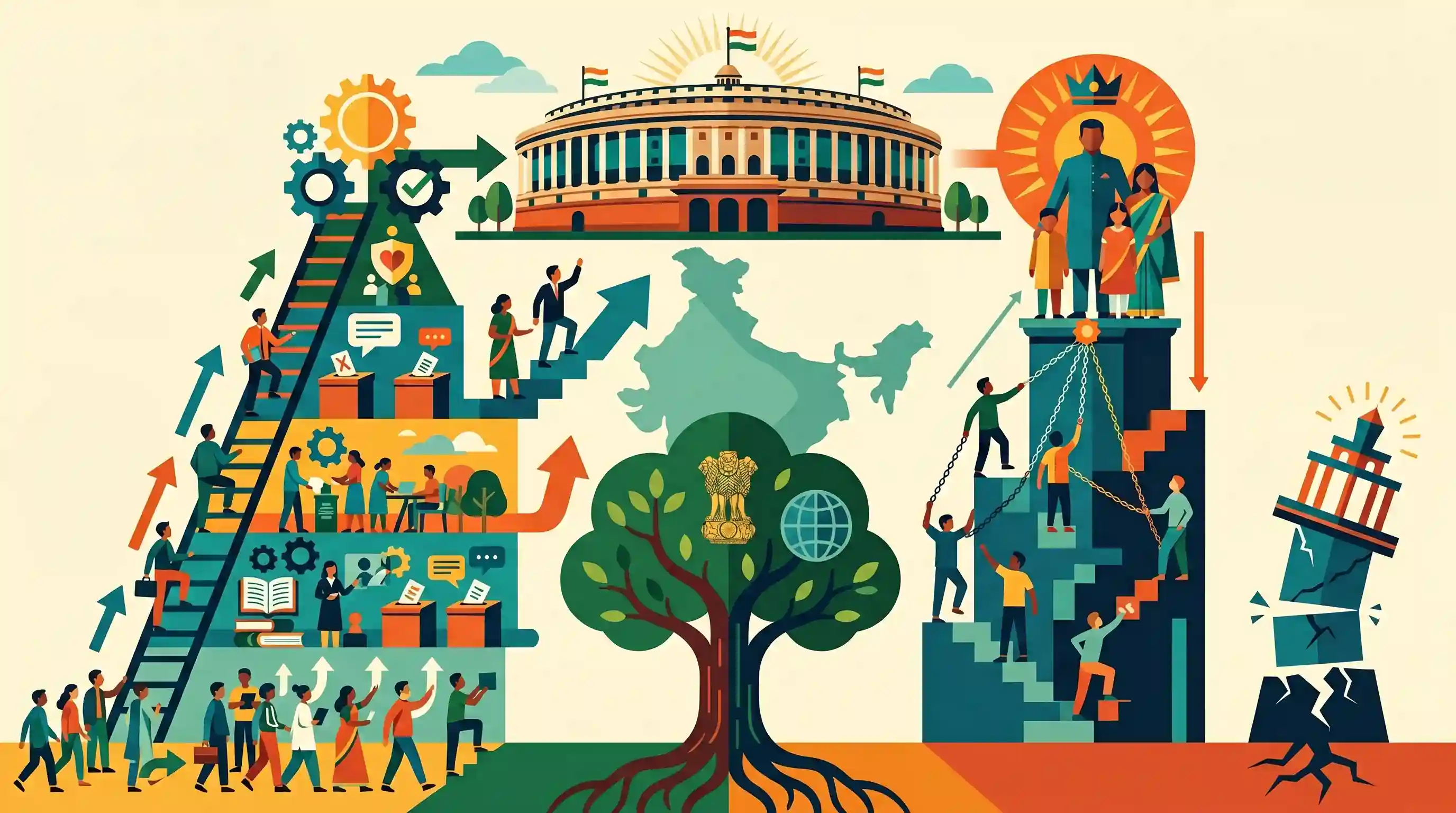
This opinion piece analyzes the process of grooming new political leaders within the Bharatiya Janata Party (BJP), linking it to the broader ethos of cadre-based political organizations. It contrasts this approach with dynastic or personality-driven party structures, emphasizing that continuous political recruitment, structured upward mobility, and internal democracy are crucial for the institutional health of national parties. From a UPSC perspective, the article touches upon the functioning of political parties in India, the need for internal party democracy under the Representation of the People Act, and the impact of leadership transitions on democratic governance.
Key Points
- The article discusses the institutional mechanism of political parties in grooming a second line of leadership.
- Emphasizes internal party democracy and cadre-building as essential factors for the long-term survival and success of national political parties.
- Highlights the distinction between cadre-based parties which possess established systems for upward mobility of leaders, and personality-driven or dynastic parties.
- Points to the broader democratic necessity for continuous political recruitment and transparent leadership transitions to ensure robust democratic governance in India.
Important Terms
Representation of the People Act, 1951

A parliamentary act regulating the conduct of elections, qualifications for membership, and the registration of political parties under Section 29A, requiring them to follow democratic principles.
UPSC context
GS Paper II: Polity. Crucial for understanding electoral reforms, party registration, and disqualification of legislators (Section 8).
Election Commission of India (ECI)
A permanent constitutional body (Article 324) responsible for administering election processes in India and registering political parties while monitoring their adherence to internal constitutions.
UPSC context
GS Paper II: Constitutional Bodies. Relevant for discussions on electoral integrity, party oversight, and internal democratic reforms.
Internal Party Democracy
The practice of establishing internal rules for decision-making and leadership selection within a party, ensuring power is not concentrated and transitions follow a transparent process.
UPSC context
GS Paper II: Governance/Polity. Tests knowledge on party structures, the impact of dynastic politics, and the health of representative democracy.
Cadre-based Party
A political organization primarily driven by trained, ideological, and disciplined members (cadres/karyakartas) rather than solely by a single leader or dynasty.
UPSC context
GS Paper II: Political Parties. Analyzes organizational diversity, political recruitment models, and institutional continuity in Indian politics.
Bharatiya Janata Party (BJP)
India’s ruling party since 2014, known for its hierarchical cadre-based structure, adherence to Hindutva and Integral Humanism, and a systematic focus on leadership grooming.
UPSC context
GS Paper II: Polity. Essential for case studies on party functioning, internal recruitment, and the evolution of national parties.
Prelims Trap
"The Election Commission can deregister a political party under RPA 1951 if it fails to conduct regular internal elections."
The ECI registers parties under Section 29A of the RPA 1951, but the Supreme Court explicitly ruled it lacks statutory power to deregister them for this.
Static Concepts Connected
What are the ECI's powers regarding the deregistration of political parties?
- General Rule: The ECI has no statutory power under the RPA 1951 to deregister a political party, even if it violates its own constitution or fails to hold internal elections.
- Supreme Court Exceptions: The Supreme Court (2002) outlined only three exceptions: registration obtained by fraud, party declared unlawful, or party abandons constitutional allegiance.
How does the Tenth Schedule paradoxically impact internal party democracy?
- Centralization of Power: The anti-defection law forces strict adherence to the party whip, legally concentrating decision-making power in the party's leadership or 'high command'.
- Suppression of Dissent: It penalizes voting against the party line with disqualification, effectively restricting intra-party debate and making independent legislative dissent nearly impossible.
Cross-Topic Patterns
Intra-party Democracy & State Funding
Law Commission and Indrajit Gupta Committee reports argue that state funding of elections should only be granted to political parties demonstrating verifiable internal democracy and transparent financial audits.
Electoral Finance & Party Autonomy
The historical opacity of party funding centralized leadership control; the Supreme Court striking down electoral bonds brings internal financial governance and intra-party accountability back into the spotlight.

Expect a 2026 Prelims statement on ECI's inability to deregister parties, paired with a GS-2 Mains question on the 10th Schedule paradox.
Linked PYQs · 2
Linked PYQs · 2
- 2022MainsGS2
“While the national political parties in India favour centralisation, the regional parties are in favour of State autonomy.” Comment.
- 2019MainsGS2
“The reservation of seats for women in the institutions of local self-government has had a limited impact on the patriarchal character of the Indian Political Process.” Comment.
