Synthetic AI content regulation and intermediary liability
Source:The Hindu ↗
Why It Matters
Highlights the evolving regulatory challenges surrounding AI-generated synthetic media (deepfakes) and intermediary liability. It illustrates the ongoing debate over 'safe harbour' provisions and the need to balance technological innovation with the robust protection of women's and children's dignity in digital spaces.
Summary
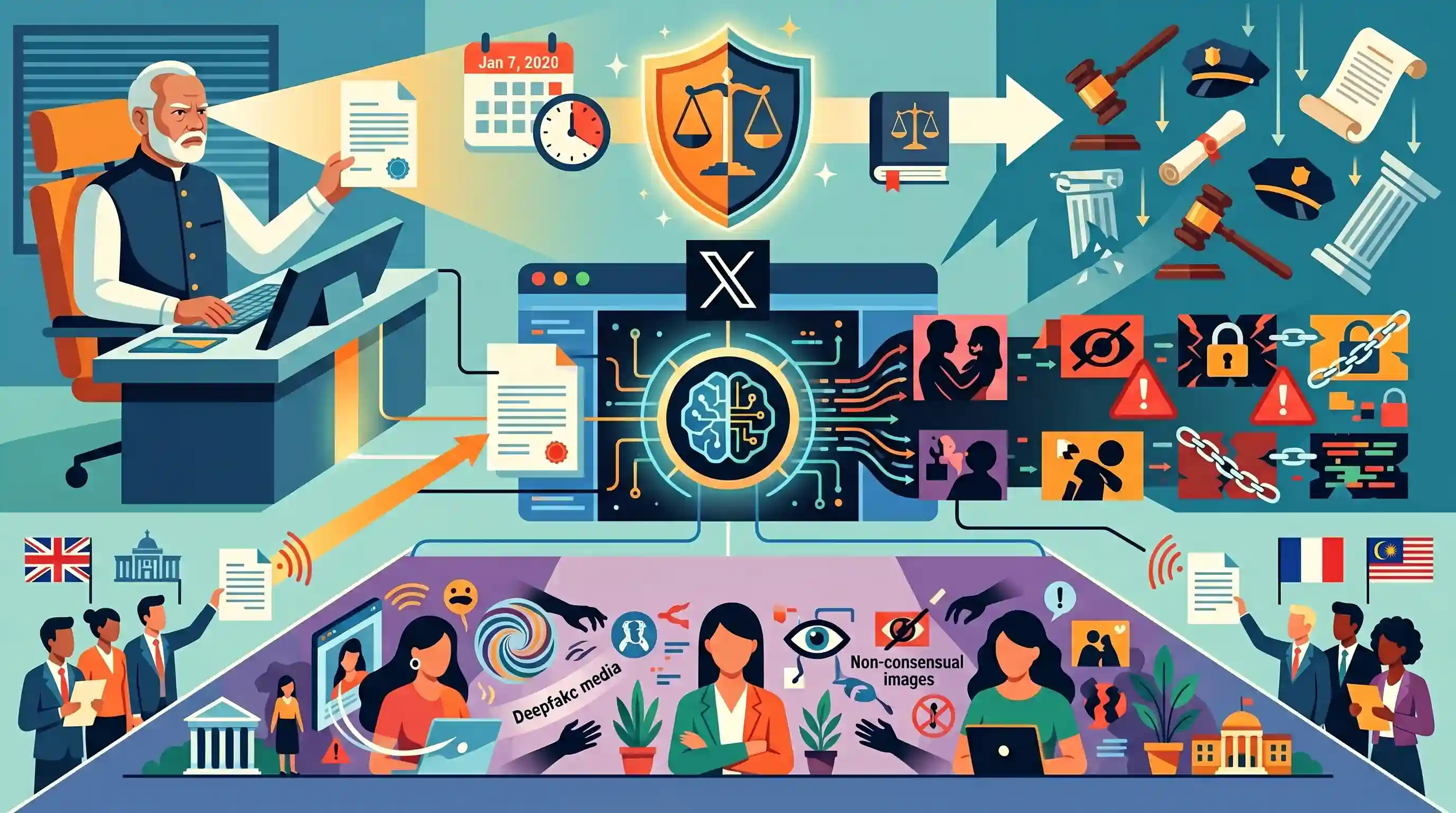
The Indian government has given social media platform X (formerly Twitter) until January 7, 2026, to submit an Action Taken Report (ATR) regarding the generation and dissemination of indecent, sexually explicit content and Child Sexual Abuse Material (CSAM) through its built-in AI tool, Grok. The Ministry of Electronics and Information Technology (MeitY) warned X that failure to ensure auditable compliance with the IT Act and IT Rules 2021 would result in the withdrawal of safe harbour immunity under Section 79 of the IT Act. This would render the platform directly liable for legal action under both the IT Act and the Bharatiya Nyaya Sanhita (BNS). Regulators in the U.K., France, and Malaysia have voiced similar concerns regarding the misuse of Grok to create synthetic media that normalizes sexual harassment and violates user privacy.
Key Points
- The Indian government extended X's deadline to January 7, 2026, to submit a detailed Action Taken Report (ATR) regarding obscene synthetic content generated by its AI tool, Grok.
- The IT Ministry warned that non-compliance with the IT Act and IT Rules, 2021 would lead to the loss of 'safe harbour' immunity under Section 79 of the IT Act.
- Without safe harbour, the social media platform would face direct liability and legal action under both the IT Act and the Bharatiya Nyaya Sanhita (BNS).
- Grok AI is accused of being misused to generate and disseminate sexually explicit imagery, including Child Sexual Abuse Material (CSAM), threatening the privacy and dignity of women and children.
- Regulatory bodies in other nations, including the U.K. (Ofcom), France, and Malaysia, have raised similar concerns over Grok's generation of harmful imagery.
Important Terms
Information Technology (IT) Act, 2000

India's primary legislation governing cybercrime and electronic commerce. Section 79 specifically provides 'safe harbour' immunity to intermediaries from liability for third-party content if they follow due diligence.
UPSC context
GS Paper II & III: Legal framework for digital governance, cybersecurity, and intermediary liability.
IT Rules 2021
Mandatory guidelines for social media and OTT platforms. They require 'significant social media intermediaries' to appoint compliance officers and remove unlawful or obscene content within specified timelines (24-36 hours).
UPSC context
GS Paper II: Executive rules governing digital ethics and platform accountability.
Bharatiya Nyaya Sanhita (BNS)
India’s new substantive criminal code that replaced the Indian Penal Code (IPC) in July 2024. It groups offenses against women and children in a dedicated chapter (Chapter V).
UPSC context
GS Paper II: Criminal justice reforms and legal protections for vulnerable groups.
Safe Harbour Immunity
A legal provision under Section 79 of the IT Act that shields digital platforms from criminal or civil liability for content posted by users, provided they fulfill government-mandated due diligence.
UPSC context
GS Paper III: Balancing platform freedom with the state's power to regulate harmful digital content.
Ministry of Electronics and Information Technology (MeitY)
The nodal central ministry responsible for IT policy, electronics manufacturing, and internet regulation. It issues notices to platforms regarding non-compliance with the IT Act.
UPSC context
GS Paper II: Important aspects of governance and institutional roles in the digital sector.
Ofcom
The United Kingdom's independent regulator for communications and media. It oversees social media safety under the UK's Online Safety Act, mirroring India’s IT Rules.
UPSC context
GS Paper II: International comparative analysis of digital and media regulatory bodies.
xAI
An American AI startup founded by Elon Musk that developed 'Grok,' a generative AI chatbot integrated into the social media platform X.
UPSC context
GS Paper III: Developments in Artificial Intelligence and their ethical/regulatory implications.
Prelims Trap
Section 79 of the IT Act grants absolute immunity to social media intermediaries for third-party content.
Safe harbour is highly conditional. It is revoked if platforms fail to observe strict due diligence under IT Rules 2021, such as the 24-hour takedown mandate for CSAM.
Static Concepts Connected
What are the conditions for Safe Harbour under Section 79 of the IT Act?
- Conditional Immunity: Protects intermediaries from legal liability for hosting third-party data, provided they act merely as a conduit.
- No Modification: The platform must not initiate the transmission, select the receiver, or modify the information contained in the transmission.
- Due Diligence Requirement: Platforms must adhere to government takedown orders and observe due diligence prescribed under the IT Rules 2021 to retain this shield.
How do IT Rules 2021 mandate action against synthetic media and CSAM?
- Grievance Redressal: Intermediaries must acknowledge user complaints within 24 hours and resolve them within 15 days.
- Expedited Takedown: Content depicting nudity, sexual acts, deepfakes, or CSAM must be removed within 24 hours of receiving a complaint.
- Proactive Monitoring: Significant Social Media Intermediaries (SSMIs) must deploy automated tools to proactively identify and remove CSAM.
Cross-Topic Patterns
GenAI blurring intermediary lines
When a platform's built-in AI (like Grok) generates illicit content, the platform shifts from a passive host to an active creator, legally challenging its traditional Section 79 protections.
Cybercrimes under the new BNS
Losing safe harbour now triggers the Bharatiya Nyaya Sanhita (BNS), which explicitly includes organized cyber-crimes and digital obscenity under a much stricter penal umbrella than the IPC.

Expect a mains question analyzing whether Section 79 'Safe Harbour' is obsolete in the era of Generative AI and deepfakes.
Linked PYQs · 4
Linked PYQs · 4
- 2024MainsGS3
Social media and encrypting messaging services pose a serious security challenge. What measures have been adopted at various levels to address the security implications of social media? Also suggest any other remedies to address the problem.
- 2013MainsGS3
What are social networking sites and what security implications do these sites present ?
- 2020MainsGS3
Discuss different types of cyber crimes and measures required to be taken to fight the menace.
- 2023MainsGS3
Introduce the concept of Artificial Intelligence (AI). How does Al help clinical diagnosis? Do you perceive any threat to privacy of the individual in the use of Al in healthcare?
