International Space Station Resupply Mission and Microgravity Lab
Source:Indian Express ↗
Why It Matters
The article highlights how microgravity environments like the ISS are leveraged for cutting-edge scientific research. Understanding fundamental physics (Cold Atom Lab) and the behavior of cryogenic fuels in space are foundational to India's own space aspirations, such as the Gaganyaan mission and future deep-space endeavors, directly intersecting with the GS3 Science & Technology syllabus.
Summary
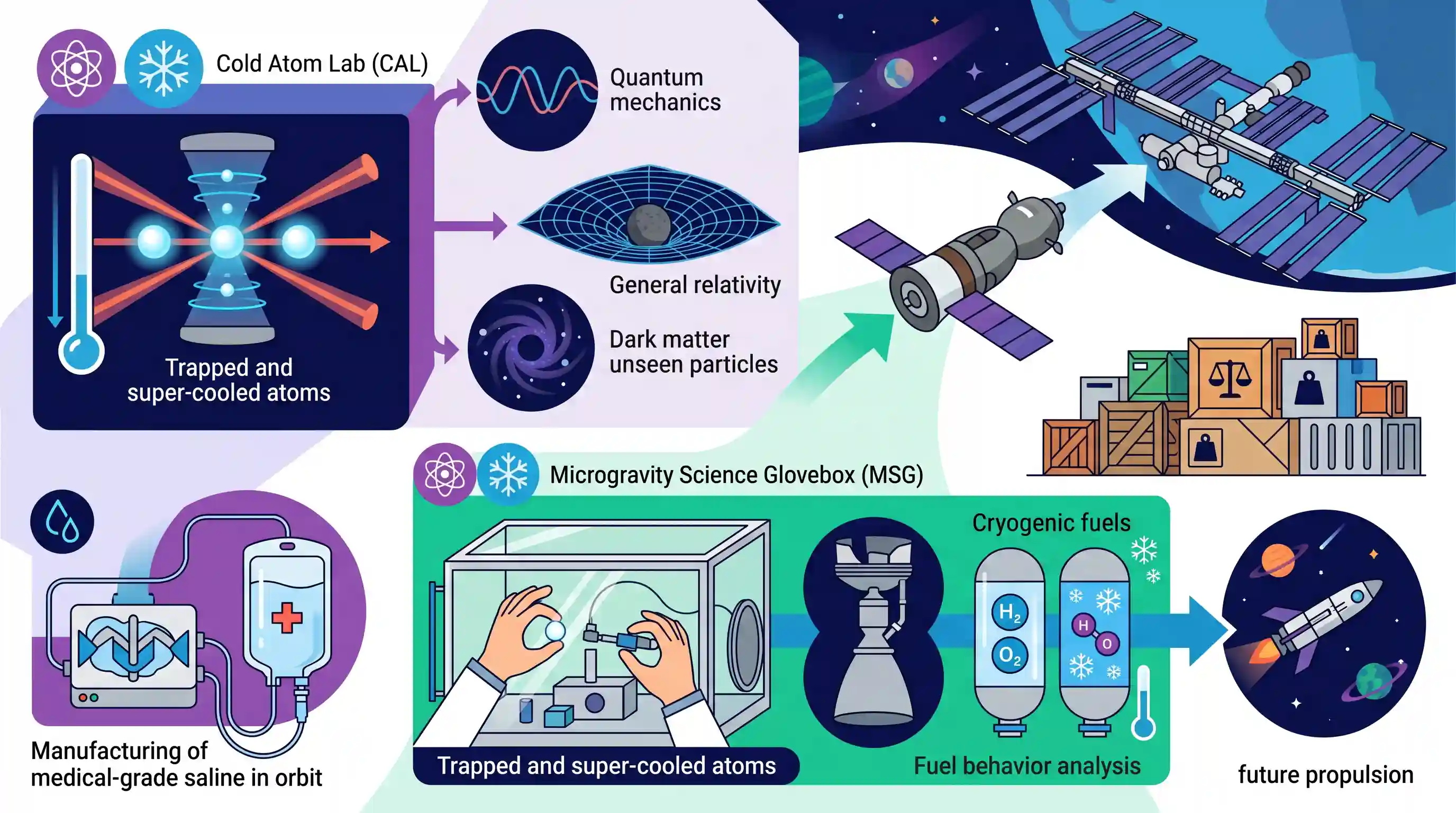
The uncrewed Progress 95 spacecraft recently delivered nearly 3 tonnes of cargo to the International Space Station (ISS). The payload included crucial scientific equipment for microgravity research, such as hardware for the Cold Atom Lab to study fundamental physics—including dark matter and general relativity—at temperatures near absolute zero. Furthermore, the resupply mission brought components for the Microgravity Science Glovebox to analyze the behavior of cryogenic fuels in space, a critical step for future deep-space propulsion systems, alongside supplies for manufacturing medical-grade saline in orbit.
Key Points
- An uncrewed Russian Progress 95 spacecraft successfully docked with the ISS, delivering nearly three tonnes of essential supplies, fuel, and scientific equipment.
- The payload includes hardware for NASA's Cold Atom Lab, a facility that cools atoms to near absolute zero to study quantum mechanics, dark matter, and general relativity in a microgravity environment.
- Equipment was delivered for the Microgravity Science Glovebox to study the complex dynamics of cryogenic fuels (like liquid oxygen and hydrogen) sloshing in microgravity, which is vital for designing future deep-space spacecraft.
- The mission also carried supplies for biological and medical experiments, including the continuous production of medical-grade saline solutions in space.
Important Terms
International Space Station (ISS)

A modular research laboratory in low Earth orbit, jointly operated by five space agencies. It enables long-duration human presence and scientific experimentation in a microgravity environment.
UPSC context
GS Paper III: Science & Technology. Tests knowledge of international space cooperation and orbital research labs.
Cold Atom Lab (CAL)
A NASA facility on the ISS that cools atoms to near absolute zero, allowing scientists to study quantum phenomena and fundamental physics without Earth's gravitational interference.
UPSC context
GS Paper III: Science & Technology. Relates to quantum mechanics, fundamental physics, and space-based research infrastructure.
Progress 95 mission
A Russian uncrewed resupply mission that delivered nearly three tonnes of fuel, food, and scientific hardware to the International Space Station in 2026.
UPSC context
GS Paper III: Science & Technology. Covers space logistics, resupply operations, and mission-specific current affairs.
Microgravity Science Glovebox (MSG)
A sealed, enclosed workspace on the ISS that allows astronauts to safely conduct experiments involving liquids, flames, or hazardous materials without contaminating the station's cabin.
UPSC context
GS Paper III: Science & Technology. Tests understanding of hardware enabling complex scientific research in space.
NASA
The U.S. federal agency responsible for the civilian space program and space exploration, serving as a lead partner and primary developer of ISS scientific modules.
UPSC context
GS Paper III: Science & Technology. Relevant for global space governance and technological leadership in exploration.
Roscosmos
Russia's state space corporation responsible for the country's space flight programs, including the launch of Progress cargo vehicles and the Soyuz spacecraft to the ISS.
UPSC context
GS Paper III: Science & Technology. Important for studying international partnerships and key actors in global space technology.
Prelims Trap
The ISS experiences zero gravity because it is located completely outside Earth's gravitational pull.
The ISS is in Low Earth Orbit where gravity is ~90% as strong as on Earth. Weightlessness occurs because the station is in a continuous state of free-fall, creating microgravity.
Static Concepts Connected
What is a Bose-Einstein Condensate (BEC) and why study it in space?
- Formation: It is considered the fifth state of matter, formed when a gas of bosons is cooled to temperatures very close to absolute zero (-273.15°C).
- Quantum Behavior: At these extreme temperatures, quantum effects become macroscopic. The atoms lose individual identities and behave as a single coherent quantum entity or 'super atom'.
- Microgravity Advantage: Earth's gravity rapidly pulls BECs down, limiting observation time to fractions of a second. Microgravity allows these atom clouds to float and be studied longer.
Why are cryogenic engines and fuels critical for deep space missions?
- Extreme Propellants: Cryogenic engines use highly efficient liquid oxygen and liquid hydrogen, which must be stored at extremely low sub-zero temperatures.
- High Efficiency: They provide significantly greater thrust per kilogram of propellant (Specific Impulse) compared to traditional solid or earth-storable liquid rocket fuels.
- Microgravity Challenges: Managing these fuels in space is difficult due to fluid sloshing and boil-off in microgravity, requiring specialized orbital research for future mission designs.
Cross-Topic Patterns
In-space pharmaceutical manufacturing
Microgravity eliminates convection and sedimentation, allowing for purer protein crystal growth and advanced drug synthesis. This bridges basic space exploration with commercial biotechnology and future healthcare.
Cryogenics and ISRO's Gaganyaan
Global research into cryogenic fuel behavior in microgravity parallels ISRO's focus on the CE-20 cryogenic engine powering LVM3, essential for India's Gaganyaan and future deep-space architectures.

Expect a 2026 multi-statement question combining Bose-Einstein Condensates, microgravity physics, and in-orbit manufacturing applications.
Linked PYQs · 3
Linked PYQs · 3
- 2025PrelimsGS1
Consider the following space missions : I. Axiom-4 II. SpaDeX III. Gaganyaan How many of the space missions given above encourage and support micro-gravity research?
- 2024PrelimsGS1
With reference to radioisotope thermoelectric generators (RTGs), consider the following statements: 1. RTGs are miniature fission reactors. 2. RTGs are used for powering the onboard systems of spacecrafts. 3. RTGs can use Plutonium-238, which is a by-product of weapons development. Which of the statements given above are correct?
- 2016MainsGS3
Discuss India's achievements in the field of Space Science and Technology. How the application of this technology has helped India in its socio-economic development?
