Kerala River Sand Mining Policy and Environmental Concerns
Source:The Hindu ↗
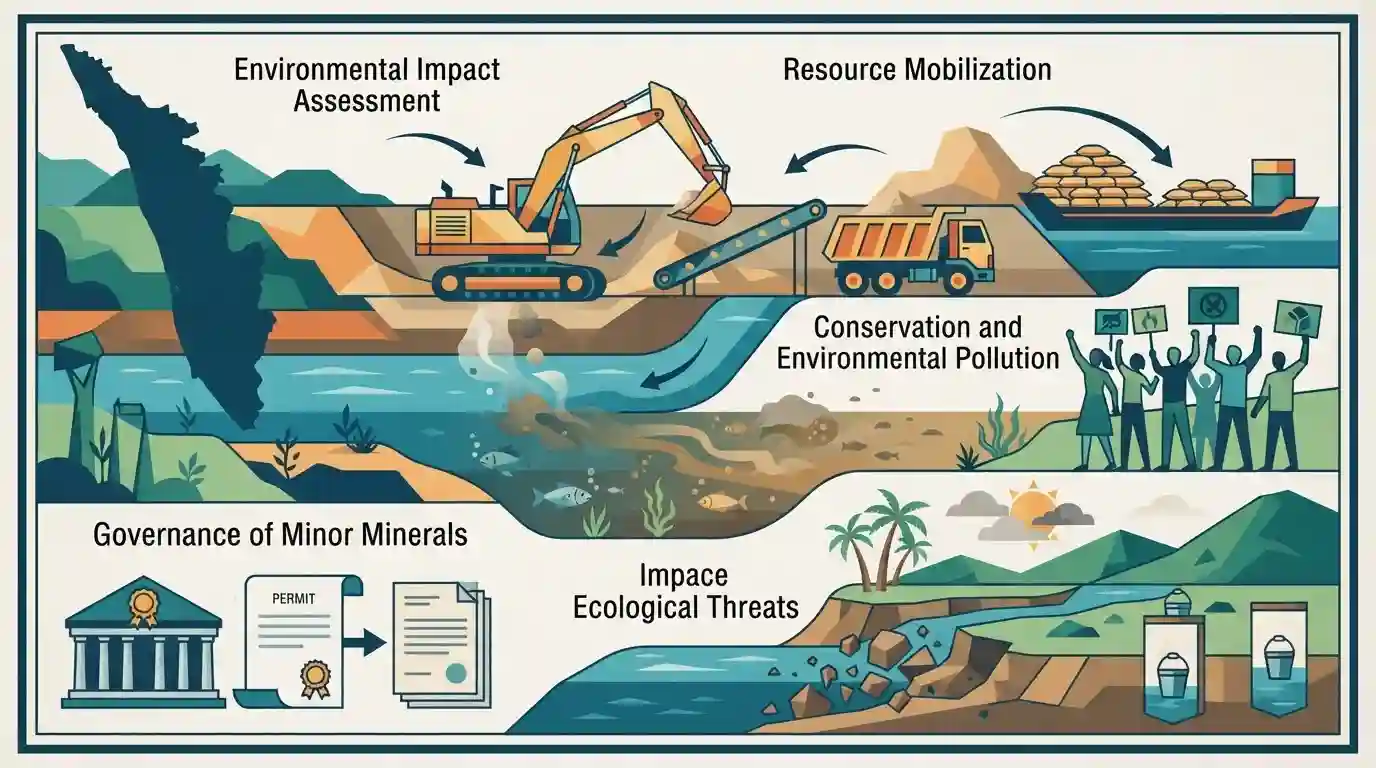
ఇది ఎందుకు ముఖ్యం
It illustrates the persistent policy challenge of balancing infrastructure development and construction material demands with riverine ecosystem conservation and sustainable resource governance.
సారాంశం
Environmentalists in Kerala have raised strong concerns over the state government's move to permit sand extraction in 17 rivers, citing severe ecological threats to river ecosystems, water security, and local geomorphology.
ముఖ్య అంశాలు
- Environmental groups in Kerala have strongly opposed the state government's decision to permit sand mining across 17 rivers.
- Critics warn that large-scale river sand mining will severely degrade river ecosystems, lower water tables, and disrupt local hydrological cycles.
- The move highlights the ongoing friction between developmental and commercial demands for construction aggregate and critical environmental conservation needs.
ముఖ్యమైన పదాలు
Mines and Minerals (Development and Regulation) Act

An Indian legislation that governs the development and regulation of mines and minerals under Union control, classifying sand as a minor mineral and empowering state governments to frame rules for prevention of illegal mining.
UPSC context
UPSC Prelims/Mains (GS Paper II/III): Tests knowledge of statutory frameworks governing minor minerals, federal legislative powers, and environmental resource governance.
అనుసంధానమైన స్థిర భావనలు
What are the statutory provisions governing 'minor minerals' and river sand mining in India?
- MMDR Act 1957: Statutory Definition: Sand is classified as a minor mineral under Section 3(e) of the MMDR Act, 1957.
- State Powers: Rule-Making Power: State Governments possess rule-making powers under Section 15 to regulate minor mineral concessions and prevent illegal mining under Section 23C.
- Mandatory EIA: Environmental Clearance: Commercial sand mining requires prior Environmental Clearance from SEIAA based on a comprehensive EIA report and district survey reports.
అంతర-అంశ నమూనాలు
Minor Minerals vs State Water Rights
Sand mining disputes highlight the friction between federal mineral acts and state-level river basin governance, testing cooperative federalism under Entry 18 (State List) versus Entry 54 (Union List).
Riverbed Mining & Coastal Zone Vulnerability
Unregulated riverbed mining accelerates coastal erosion and saline water intrusion, merging inland resource extraction battles with broader coastal zone management and climate adaptation challenges.

MMDR Act minor mineral powers + EIA requirement for river sand mining frequently appear as a statement-based prelims question.
అనుసంధాన PYQలు · 3
అనుసంధాన PYQలు · 3
- 2018PrelimsGS1
Which of the following is/are the possible consequence/s of heavy sand mining in riverbeds? 1. Decreased salinity in the river 2. Pollution of groundwater 3. Lowering of the water-table Select the correct answer using the code given below:
- 2019PrelimsGS1
With reference to the management of minor minerals in India, consider the following statements: 1. Sand is a 'minor mineral' according to the prevailing law in the country. 2. State Governments have the power to grant mining leases of minor minerals, but the powers regarding the formation of rules related to the grant of minor minerals lie with the Central Government. 3. State Governments have the power to frame rules to prevent illegal mining of minor minerals. Which of the statements given above is/are correct?
- 2019MainsGS3
Coastal sand mining, whether legal or illegal, poses one of the biggest threats to our environment. Analyze the impact of sand mining along the Indian coasts, citing specific examples.
