Greenland Shark Longevity Study and Cardiovascular Insights
Source:Indian Express ↗
Why It Matters
Understanding extremophile biology provides crucial context for applied biotechnology and genetics in human health, aligning with UPSC's focus on scientific advancements targeting human diseases, cardiovascular health, and DNA repair.
Summary
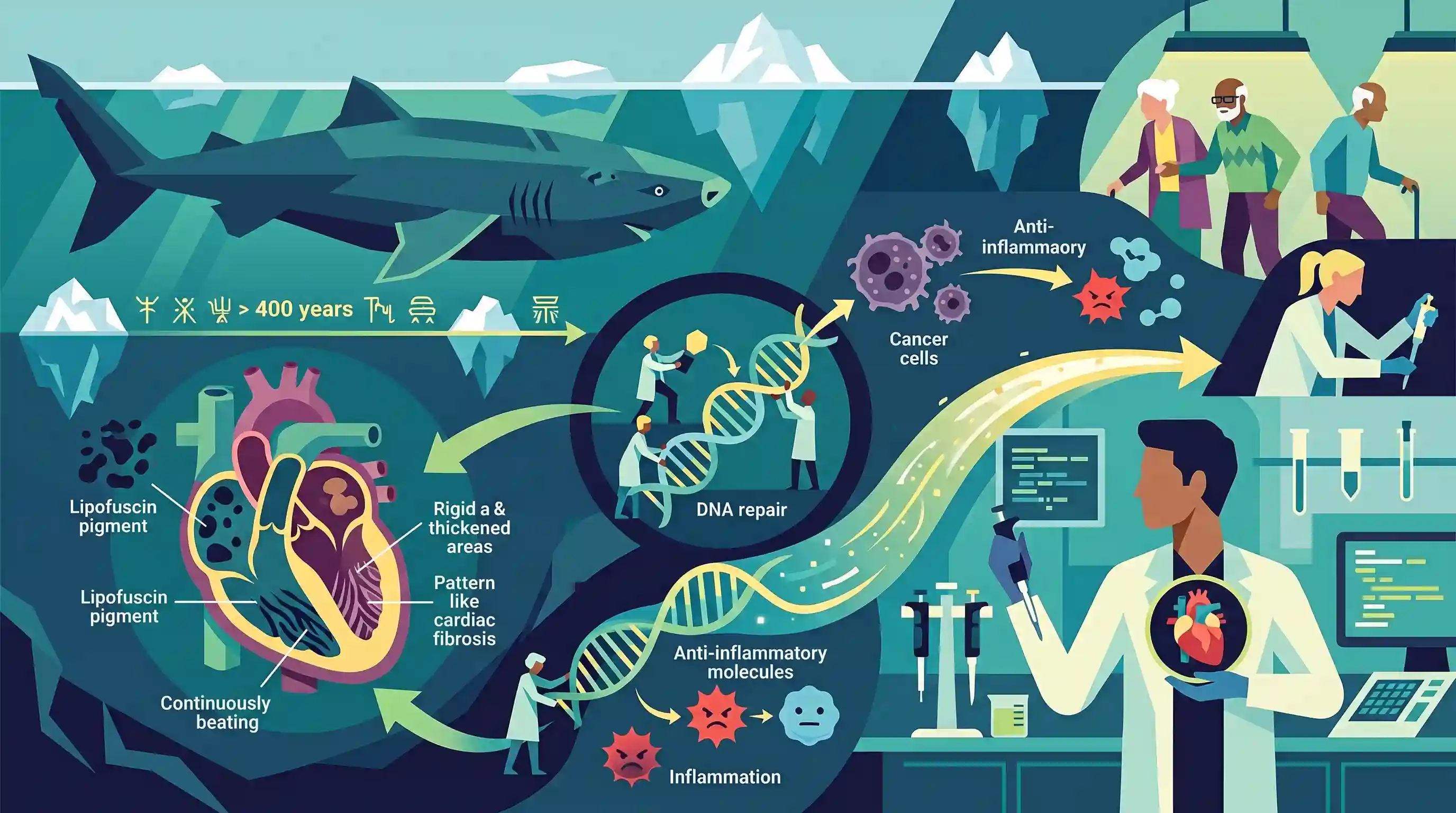
The Greenland shark, renowned as the world's longest-living vertebrate capable of surviving over 400 years, possesses unique cardiovascular resilience. A study by the University of Manchester reveals that despite showing severe signs of aging—such as massive accumulation of the pigment lipofuscin, cardiac stiffening, and fibrosis—the shark's heart functions continuously without age-related failure. Attributed to highly efficient DNA repair, cancer suppression, and anti-inflammatory mechanisms, the shark's evolutionary biology offers vital insights into mitigating human age-related cardiovascular decline.
Key Points
- The Greenland shark is the world's longest-living vertebrate, with a lifespan capable of exceeding 400 years and reaching sexual maturity around age 150.
- A University of Manchester study found that the shark's heart functions efficiently for centuries despite exhibiting typical signs of ageing, such as cardiac stiffening, severe fibrosis, and the massive accumulation of lipofuscin (an age-related pigment).
- The shark's longevity is attributed to its highly efficient DNA repair mechanisms, robust cancer suppression, anti-inflammatory properties, and a strong immune system.
- Insights from the Greenland shark's evolutionary adaptations could pave the way for advancements in applied biotechnology aimed at mitigating age-related cardiovascular decline in humans.
Important Terms
Greenland Shark (Somniosus microcephalus)

The world’s longest-living vertebrate (up to 400+ years) found in Arctic/North Atlantic waters. Characterized by slow metabolism and growth, it is classified as "Vulnerable" on the IUCN Red List.
UPSC context
GS Paper III: Biodiversity/Conservation. Tests knowledge of unique species, IUCN status, and threats from overfishing or climate change.
Lipofuscin
A yellow-brown 'age pigment' consisting of oxidized proteins and lipids. It accumulates in postmitotic cells like the heart and brain, serving as a primary marker for cellular aging and metabolic wear-and-tear.
UPSC context
GS Paper III: Science & Technology. Relevant for understanding cellular biology, aging mechanisms, and biomarkers of health.
Cardiac Fibrosis
The abnormal accumulation of collagen and extracellular matrix in heart tissue, causing stiffening and reduced pumping efficiency. It is a leading factor in human heart failure and age-related cardiovascular decline.
UPSC context
GS Paper III: Health/Science. Tests understanding of non-communicable diseases (NCDs) and cardiovascular pathology in humans.
DNA Repair Mechanisms
Cellular processes that identify and correct damage to DNA molecules. Highly efficient repair is a hallmark of long-lived species, providing stability against cancer and genomic instability.
UPSC context
GS Paper III: Biotechnology/Genetics. Important for topics on genetic engineering, longevity research, and therapeutic breakthroughs.
Biological Resilience
An organism's ability to maintain stable physiological functions despite significant molecular or tissue damage. It is a key concept in 'geroscience' aimed at extending human healthspan.
UPSC context
GS Paper III: Science & Technology. Relevant for emerging fields in longevity, healthcare policy, and biotechnology applications.
Prelims Trap
"The age of the Greenland shark is accurately determined using modern genetic tools such as DNA barcoding."
False. Scientists use radiocarbon dating of the shark's eye lens proteins to determine its age. DNA barcoding is strictly for species identification, not age determination.
Static Concepts Connected
How do natural DNA repair mechanisms relate to CRISPR-Cas9 technology?
- Innate Defense: Cells possess innate mechanisms to detect and repair DNA damage, a trait highly evolved in cancer-resistant, long-lived species.
- CRISPR Reliance: CRISPR-Cas9 acts only as scissors to cut DNA; it relies entirely on the cell's natural DNA repair machinery to insert, delete, or mend the targeted genetic sequence.
How is radiocarbon dating applied to living or recently deceased biological tissues?
- Carbon-14 Decay: It measures the decay of Carbon-14 isotopes that were incorporated into the organism's tissues while it was alive.
- Inert Tissues: For accurate age estimation in long-lived vertebrates, scientists test metabolically inert tissues formed at birth, such as eye lens crystallins, which do not regenerate.
Cross-Topic Patterns
Extreme environments as bio-mimicry models
UPSC frequently tests extremophiles and long-lived species (like tardigrades or Greenland sharks) as primary models for human biotechnology advancements, specifically in CRISPR, DNA repair, and anti-aging applications.
Radiocarbon dating vs DNA barcoding
UPSC tests methodological distinctions. Radiocarbon dating estimates biological age via Carbon-14 decay in inert tissues, whereas DNA barcoding identifies species taxonomy using short genetic markers.

Expect a 2026 Prelims statement mixing biological age markers (Carbon-14 in eye lenses) with CRISPR's reliance on innate DNA repair.
Linked PYQs · 5
Linked PYQs · 5
- 2021PrelimsGS1
In the context of hereditary diseases, consider the following statements : 1. Passing on mitochondrial diseases from parent to child can be prevented by mitochondrial replacement therapy either before or after in vitro fertilization of egg. 2. A child inherits mitochondrial diseases entirely from mother and not from father. Which of the statements given above is/are correct?
- 2024PrelimsGS1
Which one of the following is synthesised in human body that dilates blood vessels and increases blood flow?
- 2021MainsGS3
What are the research and developmental achievements in applied biotechnology? How will these achievements help to uplift the poorer sections of the society?
- 2019PrelimsGS1
'RNA interference (RNAi)' technology has gained popularity in the last few years. Why? 1. It is used in developing gene silencing therapies. 2. It can be used in developing therapies for the treatment of cancer. 3. It can be used to develop hormone replacement therapies. 4. It can be used to produce crop plants that are resistant to viral pathogens. Select the correct answer using the code given below.
- 2020PrelimsGS1
Consider the following statements: 1. Genetic changes can be introduced in the cells that produce eggs or sperms of a prospective parent. 2. A person's genome can be edited before birth at the early embryonic stage. 3. Human induced pluripotent stem cells can be injected into the embryo of a pig. Which of the statements given above is/are correct?
