NGO Demands Stricter Penalties for Tree Felling and Climate Action
Source:The Hindu ↗
Why It Matters
Highlights the evolving demands of environmental pressure groups and civil society in India, advocating for stricter ecological laws (criminalizing tree felling) and highlighting the inadequacy of current bureaucratic frameworks in addressing climate emergencies. Very relevant for GS-2 (Pressure Groups/NGOs) and GS-3 (Environmental Conservation).
Summary
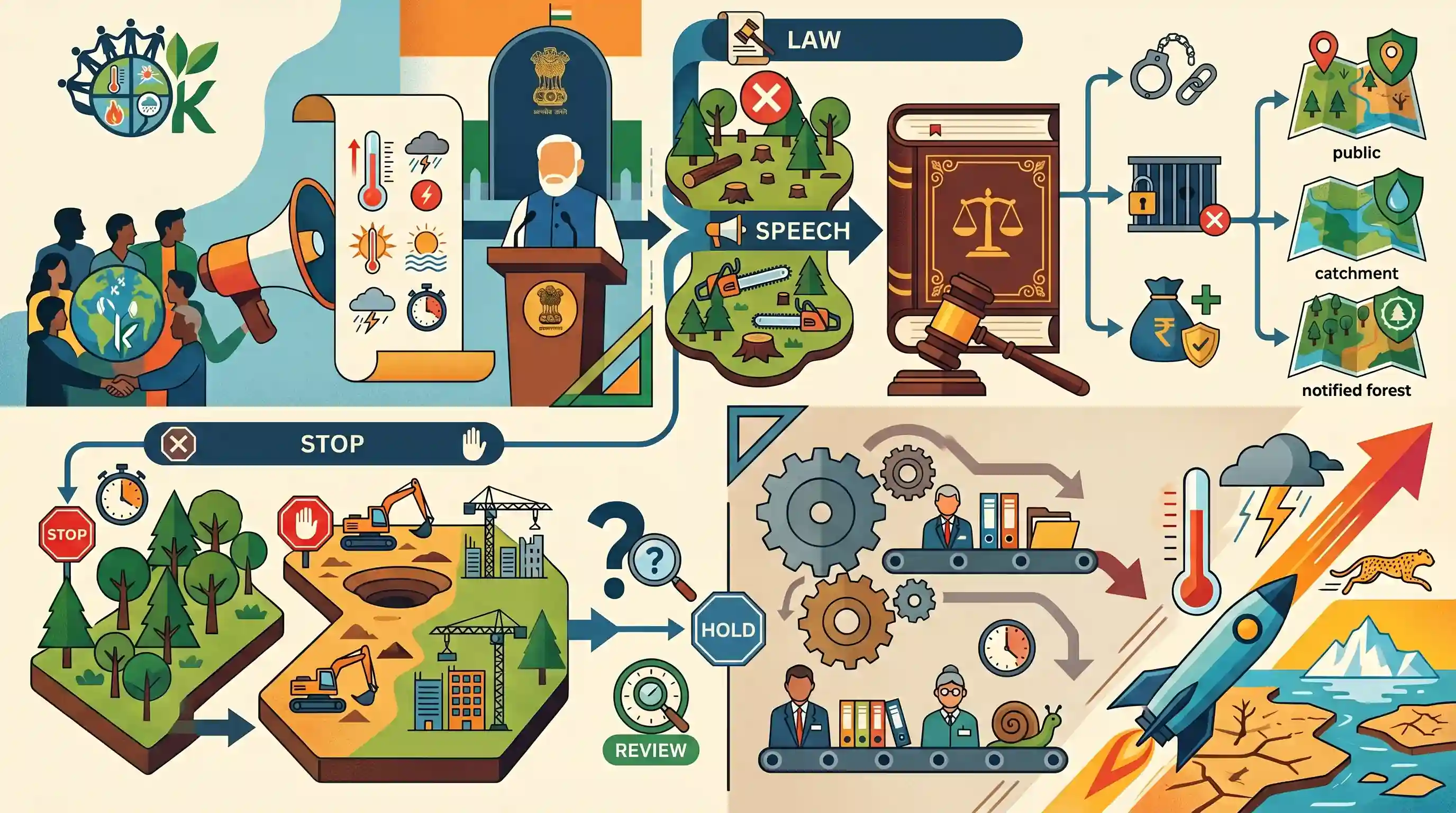
The Karnataka-based environmental NGO 'Parisarakkaagi Naavu' has appealed to Prime Minister Narendra Modi for urgent action to address climate emergencies. The group is demanding stricter legal consequences for unauthorized tree felling, proposing it be made a cognisable and non-bailable offence with mandatory penalties across public, catchment, and notified forest lands. Additionally, the NGO has called for an immediate moratorium on the diversion of forest land for non-essential projects such as mining and real estate, pending a national review. The group criticized the current institutional pace of environmental governance, arguing that standard bureaucratic processes are inadequate for the accelerating pace of climate change.
Key Points
- Karnataka-based green NGO Parisarakkaagi Naavu wrote to the PM seeking immediate interventions against climate emergencies.
- Demanded making tree felling on public, urban, catchment, and notified forest lands a cognisable, non-bailable offence with strict mandatory penalties.
- Called for an immediate moratorium on the diversion of forest land for non-essential projects (like infrastructure, mining, real estate) pending a comprehensive national review.
- Highlighted that the current institutional mechanisms—reliant on committees, phased rollouts, and periodic reviews—are too slow to tackle the accelerating climate threat.
Important Terms
Parisarakkaagi Naavu

A Karnataka-based environmental coalition launched in 2025, led by A.T. Ramaswamy. It advocates for state-wide climate action, stricter forest protection laws, and community-led conservation to address the 'climate emergency'.
UPSC context
GS III: Environment & Role of NGOs. Tests understanding of civil society's role in environmental advocacy and governance.
Cognisable Offence
A legal classification where police can arrest a suspect without a warrant and start an investigation without court permission. NGOs advocate this status for environmental crimes to ensure immediate enforcement.
UPSC context
GS II: Polity (Criminal Justice System) & GS III: Environment. Tests knowledge of legal deterrents against ecological damage.
Forest Diversion
The legal process of reallocating forest land for non-forestry purposes like mining or infrastructure. Regulated by the Forest (Conservation) Amendment Act, 2023, it often involves 'Net Present Value' payments.
UPSC context
GS III: Environment (Conservation). Focuses on the balance between developmental needs and ecological preservation.
Environmental Governance
The framework of rules, institutions, and processes used to manage the environment. It involves government policy, judicial oversight (like NGT), and the participatory role of NGOs and communities.
UPSC context
GS III: Environment & Disaster Management. Tests knowledge of institutional efficiency in responding to climate change.
Climate Emergency
A situation where urgent action is required to reduce or halt climate change and avoid irreversible environmental damage. Some Indian local bodies and NGOs have called for its national declaration.
UPSC context
GS III: Environment. Tests the ability to define the scale and urgency of global warming impacts on India.
Moratorium
A temporary legal prohibition or suspension of an activity. In environmental context, it is often demanded for projects like mining or forest diversion pending thorough scientific reviews.
UPSC context
GS III: Environment (Conservation). Relates to judicial and administrative pauses on ecologically sensitive activities.
Prelims Trap
Tree felling outside notified forests is uniformly regulated by the central Forest (Conservation) Act.
Urban and non-forest public land tree felling is governed by State-specific Tree Preservation Acts (e.g., Karnataka Preservation of Trees Act), not uniformly by the Centre.
Static Concepts Connected
How is the diversion of forest land regulated in India?
- Prior Approval: Diversion for non-forest purposes requires prior approval from the Central Government under the Forest (Conservation) Act, 1980.
- Advisory Committee: The statutory Forest Advisory Committee (FAC) evaluates diversion proposals and recommends approval or rejection based on ecological cost-benefit analysis.
- Compensatory Afforestation: User agencies must pay for Compensatory Afforestation (CA) and the Net Present Value (NPV) of the diverted forest to mitigate ecological loss.
What defines a cognizable and non-bailable offence?
- Cognizable Offence: In a cognizable offence, the police can make an arrest without a warrant and initiate an investigation without permission from a magistrate.
- Non-Bailable Offence: In a non-bailable offence, bail is not a matter of right. It is granted at the discretion of the court, acting as a stronger deterrent.
- Environmental Context: Currently, many local tree felling violations under state laws fall under bailable/non-cognizable categories, leading to low deterrence and NGO demands for reform.
Cross-Topic Patterns
NGOs driving Environmental Jurisprudence
Environmental activism (GS2) often forces institutional reform. NGO-driven petitions and PILs historically triggered landmark shifts in forest governance, such as the Supreme Court's Godavarman judgment.
Urban Catchments & Disaster Management
Protecting urban catchments directly ties to GS3 Disaster Management. Loss of tree cover in these zones severely degrades drainage, directly exacerbating urban flooding events seen in Bengaluru.

Expect a GS3 Mains question on how traditional, phased bureaucratic mechanisms fail to address rapidly accelerating climate emergencies.
Linked PYQs · 3
Linked PYQs · 3
- 2025MainsGS2
What are environmental pressure groups? Discuss their role in raising awareness, influencing policies and advocating for environmental protection in India.
- 2024MainsGS3
What role do environmental NGOs and activists play in influencing Environmental Impact Assessment (EIA) outcomes for major projects in India? Cite four examples with all important details.
- 2015MainsGS2
How can the role of NGOs be strengthened in India for development works relating to protection of the environment? Discuss throwing light on the major constraints.
