Urban Ecological Restoration and Environmental Governance Models
Source:The Hindu ↗
Why It Matters
Provides a concrete case study of how urban local bodies and development authorities can collaborate with institutions and citizens to transform degraded urban spaces into ecological assets, illustrating sustainable urban governance.
Summary
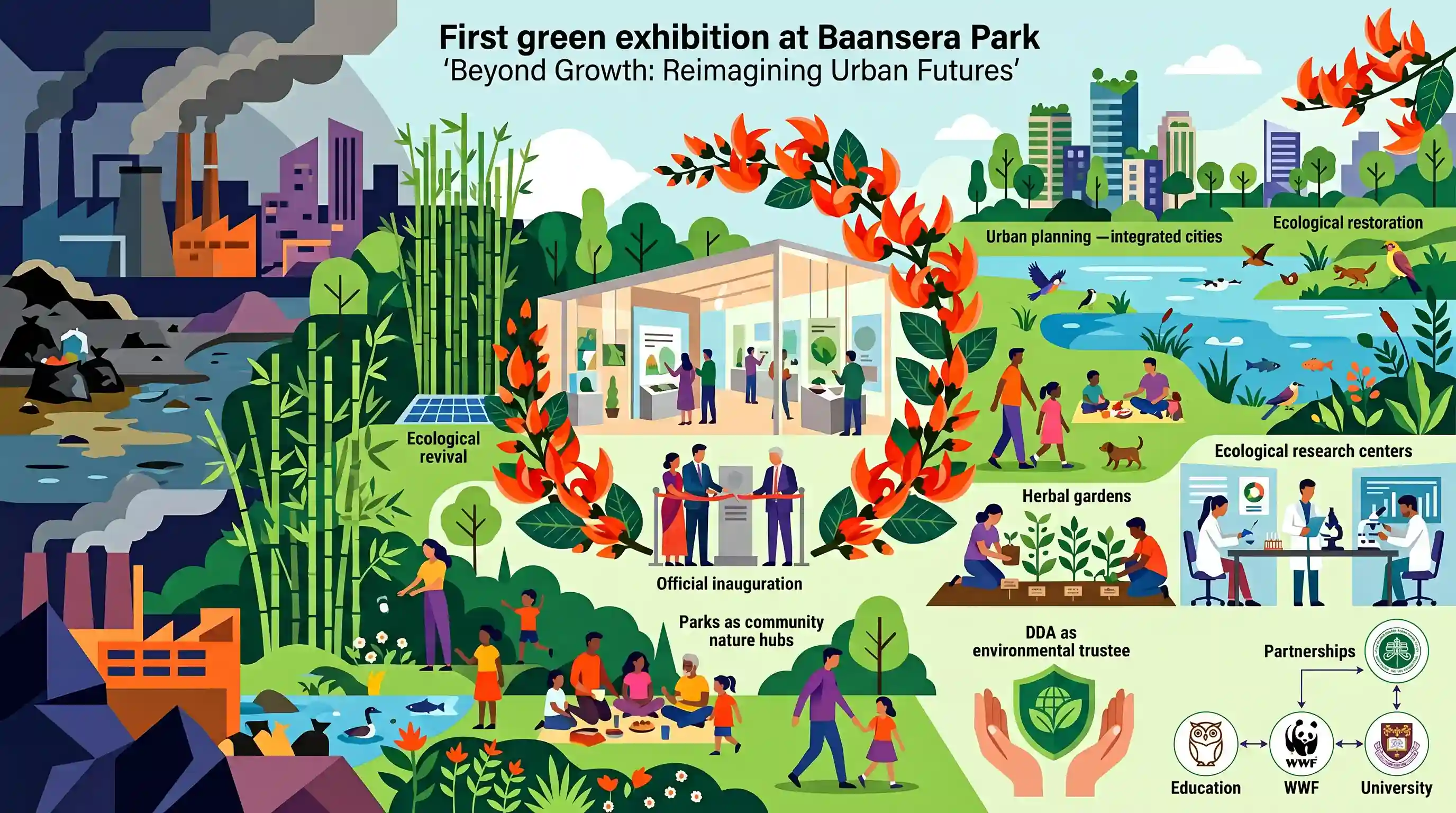
The Delhi Development Authority (DDA) launched its first green exhibition, themed 'Beyond Growth: Reimagining Urban Futures', at Baansera Park. Inaugurated by Lieutenant Governor V.K. Saxena, the expo highlighted the ecological revival of Baansera, a formerly polluted site, as a model for sustainable urban planning. Emphasizing its role as an "environmental trustee," the DDA announced partnerships with educational and environmental institutions, including WWF-India and Delhi University, to transform parks into community nature hubs, herbal gardens, and ecological research centers. The event also featured the inauguration of the annual flower festival, Palaash Mahotsav 2026.
Key Points
- The DDA hosted its inaugural green exhibition themed 'Beyond Growth: Reimagining Urban Futures' at Baansera Park to promote sustainable urban development.
- L-G V.K. Saxena highlighted the transformation of Baansera from a degraded, polluted site into an ecological asset as a model for environmental restoration.
- The DDA is shifting its governance model from merely being a master planner and developer to acting as an "environmental trustee" for the capital.
- Strategic partnerships were signed with WWF-India, Delhi University, and other institutions to create citizens' nature hubs, herbal gardens, and research centers in DDA parks.
- The annual flower festival, Palaash Mahotsav 2026, was launched across four venues to integrate ecologically sensitive public spaces into community life.
Important Terms
Delhi Development Authority (DDA)

A statutory body established under the Delhi Development Act, 1957, responsible for planning, land acquisition, and housing in the National Capital Territory, chaired ex-officio by the Lieutenant Governor.
UPSC context
GS II: Statutory bodies; GS I: Urbanization and related issues. Essential for understanding urban governance and metropolitan planning.
Palaash Mahotsav 2026
An annual flower festival organized by the DDA since 2023 to promote community engagement with urban green spaces and celebrate Delhi's floral heritage and seasonal blooms.
UPSC context
Current Affairs: Environmental governance and community participation. Tests knowledge of local environmental initiatives and urban conservation.
Ecological Restoration
The process of assisting the recovery of an ecosystem that has been degraded or destroyed, such as transforming polluted urban sites into resilient green parks or wetlands.
UPSC context
GS III: Conservation, environmental pollution, and degradation. Key for questions on sustainable urban development and nature-based solutions.
National Medicinal Plants Board (NMPB)
A body established in 2000 under the Ministry of AYUSH to coordinate conservation, cultivation, and sustainable management of India's medicinal plant resources across various sectors.
UPSC context
GS III: Biodiversity and Agriculture. Relevant for questions on traditional medicine (AYUSH), rural livelihoods, and sustainable resource use.
WWF-India
The Indian arm of the global NGO (est. 1969) focused on biodiversity conservation, reducing human impact on the environment, and promoting sustainable development through partnerships.
UPSC context
GS III: Environment and Conservation. Frequently cited in context of international conservation efforts and environmental education.
Prelims Trap
The mandate for the State to act as an "environmental trustee" is explicitly defined under the Environment (Protection) Act, 1986.
The Public Trust Doctrine is not statutory. It is a judicial innovation in India, adopted by the Supreme Court in the landmark M.C. Mehta v. Kamal Nath case (1997).
Static Concepts Connected
What is the Public Trust Doctrine in Indian Environmental Law?
- Origin: Rooted in Roman law, it dictates that natural resources like air, water, and forests are held in trust by the State for the public.
- Judicial backing: Formally adopted in India via the landmark M.C. Mehta v. Kamal Nath (1997) Supreme Court judgment.
- State as Trustee: The State acts merely as a trustee, not an absolute owner, preventing arbitrary private or commercial exploitation of critical ecology.
What are the ecological features of Bamboo and Palaash?
- Bamboo benefits: Bamboo grass releases roughly 30% more oxygen than equivalent trees, requires minimal water, and its dense roots rapidly stabilize floodplain soils.
- Palaash (Butea monosperma): Known as the 'Flame of the Forest', Butea monosperma is a native, drought-resistant deciduous tree that fixes soil nitrogen and supports lac insects.
Cross-Topic Patterns
Floodplain restoration & Urban Floods
Reviving Yamuna floodplains into ecological parks like Baansera directly connects to GS3 Disaster Management, serving as natural sponges against recurrent urban flooding.
Participatory Urban Governance
Shifting from top-down urban master planning to community nature hubs reflects the participatory governance ethos required under the 74th CAA for sustainable cities.

The 'Public Trust Doctrine' and ecological features of native flora (Palaash/Bamboo) are highly likely targets for GS1/GS3 Prelims statements in 2026.
Linked PYQs · 4
Linked PYQs · 4
- 2021MainsGS1
What are the environmental implications of the reclamation of water bodies into urban land use ? Explain with examples.
- 2015MainsGS1
Smart cities in India cannot sustain without smart villages. Discuss this statement in the backdrop of rural urban integration.
- 2024MainsGS2
Analyse the role of local bodies in providing good governance at local level and bring out the pros and cons merging the rural local bodies with the urban local bodies.
- 2016MainsGS2
Effectiveness of the government system at various levels and people's participation in the governance system are inter-dependent." Discuss their relationship in the context of India.
