Green Credit Programme Design Flaws and Greenwashing Concerns
Source:Indian Express ↗
Why It Matters
Highlights the critical debate between market-based climate solutions and genuine ecological restoration. It is vital for UPSC aspirants to understand the nuances of environmental governance, the implications of greenwashing, and the intersection of statutory obligations like CAMPA with new voluntary credit mechanisms.
Summary
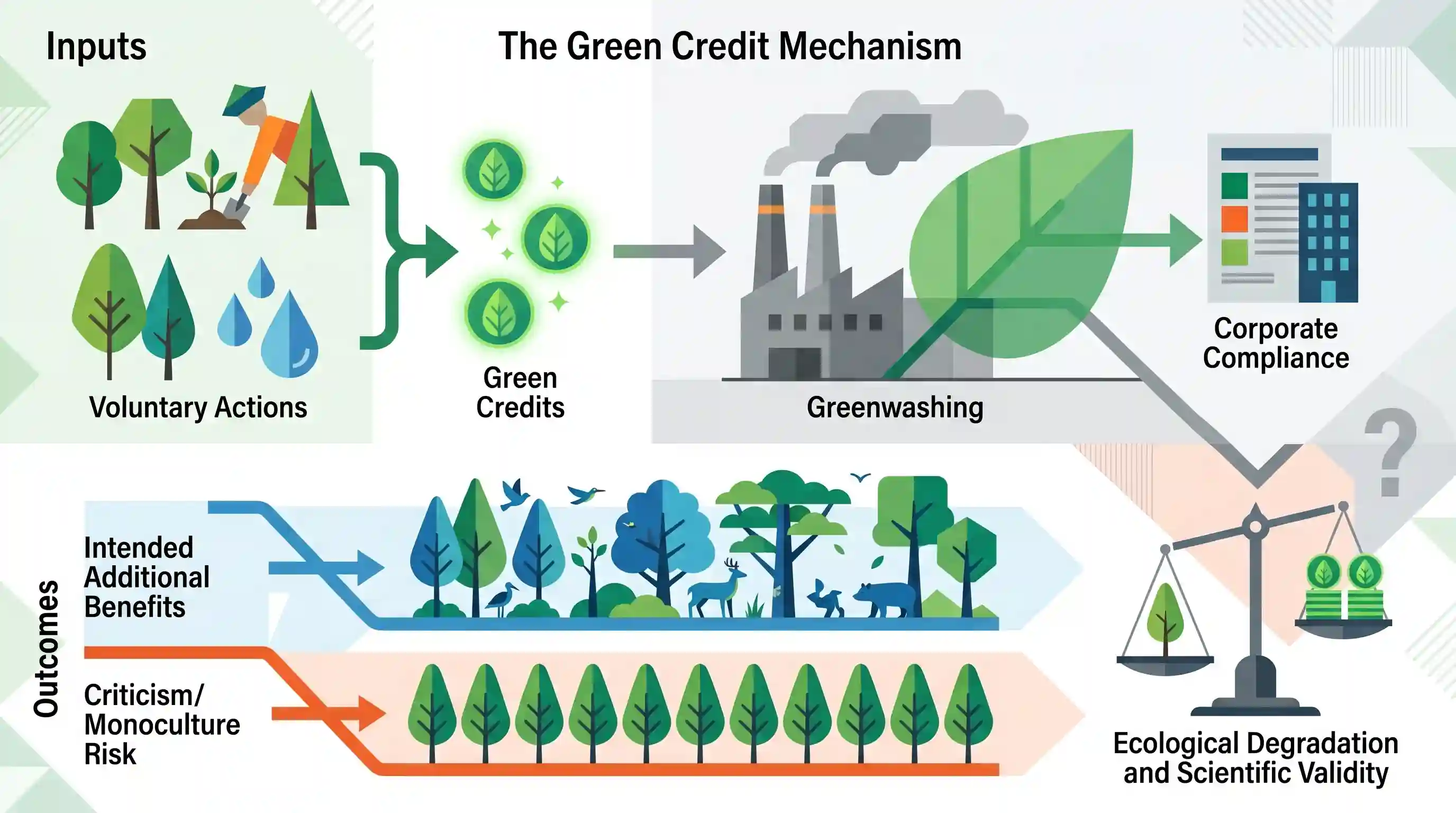
The Green Credit Programme (GCP), initiated by the Ministry of Environment, Forest and Climate Change (MoEFCC), seeks to create a market-based incentive structure for voluntary environmental actions such as tree plantation and water conservation. However, the scheme has faced substantial criticism for potentially enabling 'greenwashing'. Environmentalists argue that allowing green credits to double as compliance for mandatory compensatory afforestation defeats the purpose of generating 'additional' ecological benefits. Furthermore, an over-emphasis on mere tree-planting targets risks replacing complex, biodiverse ecosystems with monoculture plantations, raising concerns over long-term ecological degradation and the scientific validity of the credit valuation.
Key Points
- The Green Credit Programme (GCP) is a market-based mechanism launched by the MoEFCC under the Environment Protection Act, 1986 to incentivize voluntary environmental actions.
- It aims to issue tradable green credits for activities like tree plantation, water conservation, sustainable agriculture, and waste management.
- A major criticism is the risk of 'greenwashing', as guidelines suggested credits earned from tree plantation could be offset against statutory compensatory afforestation requirements, removing the 'additionality' factor.
- Ecologists warn that treating complex ecosystems merely as tree-planting targets may lead to the clearing of natural landscapes for fast-growing monoculture plantations, harming local biodiversity.
- There are challenges in establishing scientific equivalence across diverse environmental actions and ensuring accurate, transparent monitoring to prevent double counting.
Important Terms
Green Credit Programme (GCP)

A market-based mechanism launched by MoEFCC in 2023 to incentivize voluntary environmental actions (like tree plantation and water conservation) through tradable 'Green Credits' under the 'LiFE' movement.
UPSC context
GS Paper III: Environment/Climate Change; tests understanding of market-based incentive structures for sustainable development and conservation.
Environment (Protection) Act, 1986
The umbrella legislation in India that empowers the Central Government to protect and improve environmental quality. The Green Credit Rules, 2023, were notified under this Act.
UPSC context
GS Paper III: Environmental Governance; tests knowledge of the legal framework and constitutional provisions for environmental protection.
Compensatory Afforestation Fund (CAF) Act, 2016
Legislation providing a framework to manage funds collected for forest land diversion. These funds support compensatory afforestation, which critics argue is being problematically linked with the Green Credit Programme.
UPSC context
GS Paper III: Environment; essential for understanding the management of 'Net Present Value' (NPV) and afforestation mandates in India.
Indian Council of Forestry Research and Education (ICFRE)
An autonomous body under the MoEFCC designated as the 'Administrator' for the GCP, responsible for registration, verification, and issuance of Green Credit Certificates.
UPSC context
GS Paper II: Statutory/Autonomous Bodies; tests awareness of institutional roles in implementing national environmental schemes.
Ministry of Environment, Forest and Climate Change (MoEFCC)
The nodal ministry of the Union Government for planning, promotion, and coordination of India's environmental and forestry programs, including the GCP and climate change policies.
UPSC context
GS Paper II: Governance; tests knowledge of executive bodies responsible for policy formulation and environmental administration.
Greenwashing
The practice of making deceptive or exaggerated claims about environmental sustainability. In GCP, this refers to using 'voluntary' actions to fulfill mandatory legal obligations.
UPSC context
GS Paper III: Environment/Ethics; tests the ability to critically analyze the integrity and ecological 'additionality' of conservation policies.
Prelims Trap
GCP exclusively trades carbon certificates and is notified under the Forest (Conservation) Act.
The GCP goes beyond carbon, encompassing water, waste, and mangroves. Furthermore, it was notified under the Environment (Protection) Act, 1986, not the FCA.
Static Concepts Connected
What is the statutory framework for Compensatory Afforestation in India?
- CAF Act 2016: Established under the Compensatory Afforestation Fund (CAF) Act, 2016 to manage funds collected for diverting forest land for non-forest purposes.
- Net Present Value: User agencies must pay the NPV of the diverted forest, which quantifies the loss of ecological services, wildlife habitat, and timber.
- Fund devolution: A major portion (90%) of collected funds is transferred to states, while 10% is retained by the Centre for monitoring and research.
What is 'Additionality' in the context of environmental markets?
- Core principle: It dictates that environmental benefits must be 'net-new'—occurring only because of the market incentive, not business-as-usual.
- Risk of Greenwashing: If voluntary green credits are used to offset mandatory, statutory afforestation obligations, the additionality factor is lost, leading to greenwashing.
Cross-Topic Patterns
Green Credits, ESG, and Global Trade
The push for tradable environmental credits aligns with SEBI's mandate for ESG reporting (BRSR), helping Indian industries present green credentials amidst global trade mechanisms like the EU's Carbon Border Adjustment Mechanism (CBAM).
Monoculture Plantations vs. Natural Ecosystems
Afforestation schemes often fail ecologically because fast-growing monoculture plantations deplete groundwater and lack the trophic complexity of natural forest ecosystems, linking GCP to static biodiversity concepts.

Expect a 2026 Prelims question comparing Carbon Markets (Energy Conservation Act) with Green Credits (EPA 1986) focusing on additionality.
Linked PYQs · 4
Linked PYQs · 4
- 2022PrelimsGS1
Which one of the following best describes the term "greenwashing"?
- 2023PrelimsGS1
Consider the following statements: Statement-I: Carbon markets are likely to be one of the most widespread tools in the fight against climate change. Statement-II: Carbon markets transfer resources from the private sector to the State. Which one of the following is correct in respect of the above statements?
- 2019PrelimsGS1
Consider the following statements : 1. As per law, the Compensatory Afforestation Fund Management and Planning Authority exists at both National and State levels. 2. People's participation is mandatory in the compensatory afforestation programmes carried out under the Compensatory Afforestation Fund Act, 2016. Which of the statements given above is/are correct?
- 2022MainsGS3
Discuss global warming and mention its effects on the global climate. Explain the control measures to bring down the level of greenhouse gases which cause global warming, in the light of the Kyoto Protocol, 1997.
