Ecological Concerns Raised Over Greater Nicobar Infrastructure Project
Source:The Hindu ↗
Why It Matters
The Great Nicobar Project is a prime case study for the classic UPSC dilemma of balancing strategic/economic infrastructure with ecological conservation and indigenous rights. It is highly relevant for GS3 topics on EIA, environmental degradation, and coastal security, as well as GS1/GS2 topics on geography and tribal welfare.
Summary
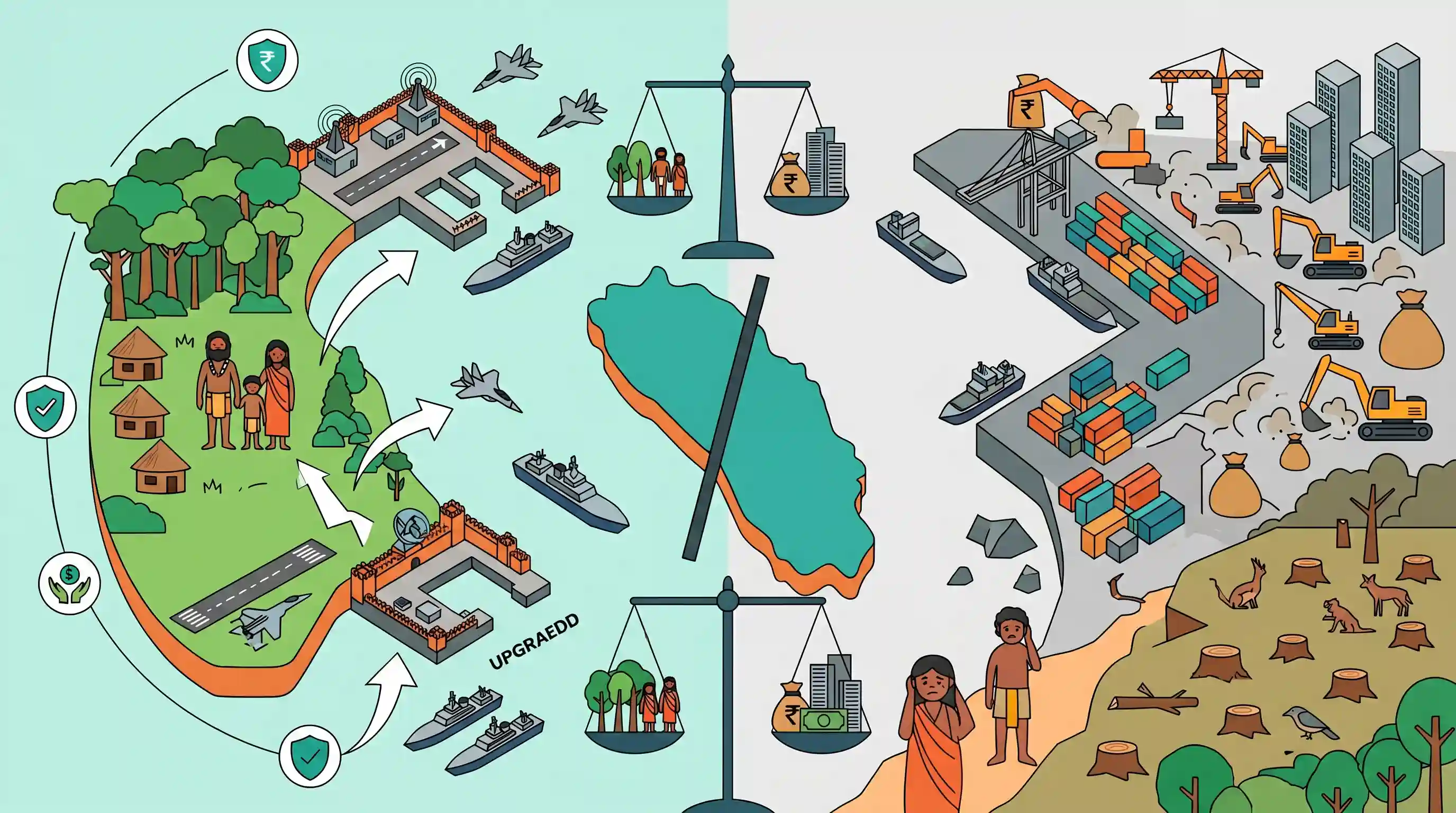
Congress general secretary Jairam Ramesh has strongly opposed the ₹72,000 crore Great Nicobar Island infrastructure project, calling it a "recipe for ecological disaster" rather than a strategic necessity. In a letter to Defence Minister Rajnath Singh, Ramesh contested the justification that the international transshipment port and massive township are essential for defence. He argued that military capabilities in the critical Bay of Bengal region can be fortified by directly upgrading existing Andaman and Nicobar Command facilities—such as INS Baaz, INS Kardip, and Car Nicobar Air Force Station—without necessitating the destruction of primary forests or threatening vulnerable tribal populations like the Shompen.
Key Points
- Congress leader Jairam Ramesh has urged the Defence Minister to rethink the ₹72,000 crore Great Nicobar Island (GNI) project, describing it as an impending ecological disaster.
- Ramesh argues that the proposed transshipment port and greenfield township are purely commercial and do not directly enhance India's military or strategic capabilities.
- He suggested that India's strategic needs can be better met by upgrading existing Andaman and Nicobar Command infrastructure, such as INS Baaz at Campbell Bay and other naval/air assets, without causing massive deforestation.
- The GNI project faces heavy criticism for its potential impact on a fragile ecosystem and indigenous communities like the Shompen and Nicobarese.
Important Terms
Great Nicobar Island (GNI) Project

A ₹72,000 crore NITI Aayog-led initiative to build a transshipment port, international airport, power plant, and township on Great Nicobar to enhance India's maritime and strategic footprint.
UPSC context
GS Paper III: Infrastructure and Environment. Tests balancing strategic development with ecological preservation and tribal rights.
Particularly Vulnerable Tribal Groups (PVTGs)
A classification for the most disadvantaged tribal communities characterized by pre-agricultural technology, low literacy, economic backwardness, and a stagnant or declining population. There are 75 recognized groups.
UPSC context
GS Paper II: Governance and Social Justice. Tests knowledge of welfare schemes and constitutional protections for marginalized groups.
Shompen
An isolated, semi-nomadic PVTG residing in the dense rainforests of Great Nicobar. They are hunter-gatherers with distinct Mongoloid features and a unique Austroasiatic language.
UPSC context
GS Paper I: Geography and Society. Tests understanding of indigenous populations and impacts of development on sensitive habitats.
Andaman and Nicobar Command (ANC)
Established in 2001, it is India’s first and only tri-service theatre command, integrating the Army, Navy, Air Force, and Coast Guard to safeguard strategic interests in the Indo-Pacific.
UPSC context
GS Paper III: Internal Security. Tests awareness of India's maritime security architecture and joint military commands.
International Container Transshipment Port (ICTP)
A proposed deep-sea port at Galathea Bay, Great Nicobar, recently notified as India’s 13th major port. It aims to capture global trade passing through the Malacca Strait.
UPSC context
GS Paper III: Economy and Infrastructure. Tests understanding of maritime trade, logistics, and reducing dependency on foreign transshipment hubs.
Prelims Trap
"The Shompen tribe of Great Nicobar Island is a Negrito Particularly Vulnerable Tribal Group (PVTG) living as nomadic hunter-gatherers."
Shompen and Nicobarese belong to the Mongoloid racial group. The Negrito PVTGs (Jarawa, Sentinelese, Onge, Great Andamanese) are confined to the Andaman Islands.
Static Concepts Connected
What are the key ecological features and protected areas of Great Nicobar Island?
- Galathea Bay: Located on the island's southern coast, it is India's most crucial nesting site for globally endangered Giant Leatherback turtles.
- Biosphere Reserve: The island hosts the Great Nicobar Biosphere Reserve, which includes both Galathea National Park and Campbell Bay National Park.
- High Endemism: The dense tropical evergreen forests harbor unique species like the Nicobar Megapode, Nicobar Macaque, and saltwater crocodiles.
Why is the Six Degree Channel critical for India's maritime and strategic security?
- Geographic Location: Also known as the Great Channel, it separates Great Nicobar Island from Banda Aceh in Sumatra, Indonesia.
- Malacca Strait Access: It directly commands the western approach to the Malacca Strait, one of the world's busiest chokepoints for global oil and trade transit.
- Surveillance Outpost: Bases like INS Baaz at Campbell Bay allow India to monitor passing merchant and naval vessels, ensuring secure Sea Lines of Communication (SLOCs).
Cross-Topic Patterns
CAMPA anomalies & EIA loopholes
Diverting tropical rainforests in Nicobar while planning compensatory afforestation in dry Haryana exposes severe ecological mismatch and structural flaws in India's CAMPA regulations.
A&N Tri-service Command vs Malacca Dilemma
The strategic push to build dual-use facilities in India's only tri-service command directly counters China's "Malacca Dilemma" and its expanding naval footprint in the Indian Ocean Region.

Expect a multi-statement Prelims question mixing A&N mapping (Six Degree Channel), PVTG profiling (Shompen/Mongoloid), and Galathea Bay.
Linked PYQs · 5
Linked PYQs · 5
- 2024MainsGS3
What role do environmental NGOs and activists play in influencing Environmental Impact Assessment (EIA) outcomes for major projects in India? Cite four examples with all important details.
- 2019MainsGS3
Define the concept of carrying capacity of an ecosystem as relevant to an environment. Explain how understanding this concept is vital while planning for sustainable development of a region.
- 2014MainsGS3
Environmental Impact Assessment studies are increasingly undertaken before a project is cleared by the Government. Discuss the environmental impacts of coal-fired thermal plants located at coal pitheads.
- 2025MainsGS3
Why is maritime security vital to protect India's sea trade? Discuss maritime and coastal security challenges and the way forward.
- 2022MainsGS3
What are the maritime security challenges in India ? Discuss the organisational, technical and procedural initiatives taken to improve the maritime security.
