Great Nicobar Infrastructure Project Aims to Boost Logistics Hub
Source:The Hindu ↗
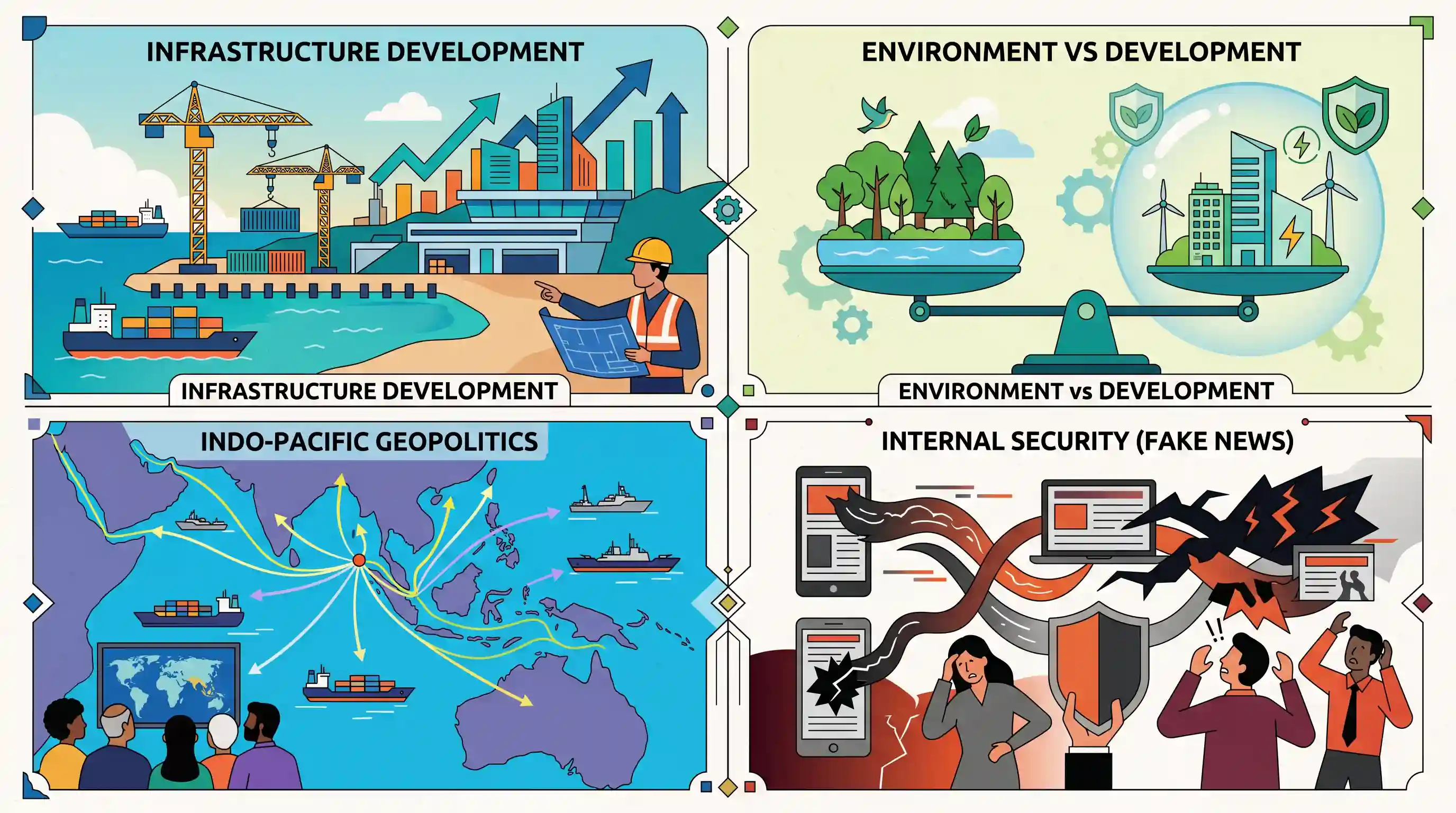
Why It Matters
The Great Nicobar project is a highly debated multi-crore infrastructure initiative facing intense scrutiny over its environmental impact on pristine ecosystems and indigenous tribes. Understanding its strategic rationale (countering maritime threats, boosting logistics in the Indo-Pacific) versus ecological costs is critical for GS-3 (Infrastructure and Environment) and GS-2 (International Relations).
Summary
Union Minister Kiren Rijiju defended the Great Nicobar development project, stating it will significantly boost India's economic growth and establish the region as a major maritime and logistics hub in the Indo-Pacific. Addressing environmental concerns, he argued that economic progress and ecological preservation can coexist, pointing to the project's embedded environmental safeguards. Additionally, he highlighted the government's handling of fuel prices despite the West Asia crisis and cautioned against the rising threat of fake news undermining democracy.
Key Points
- Union Minister Kiren Rijiju emphasized that the Great Nicobar project is crucial for India's economic growth and will ensure supply-chain independence.
- The project aims to transform the island into a major maritime and logistics hub in the Indo-Pacific region.
- Rijiju stressed that economic advancement and environmental protection are not mutually exclusive, highlighting the integration of environmental safeguards in the project's planning.
- He also noted the government's success in buffering India against fuel price hikes amidst the West Asia conflict and addressed the growing internal security challenge posed by fake news.
Important Terms
Great Nicobar Project

An ₹81,000-crore mega-infrastructure plan involving an international transshipment port, greenfield airport, power plant, and township on India's southernmost island to enhance maritime and strategic presence.
UPSC context
GS-III (Infrastructure, Environment); tests development-versus-environment debates and strategic maritime planning.
International Container Transshipment Terminal (ICTT)
A deep-water terminal at Galathea Bay designed to capture global trade traffic, reducing India's dependence on foreign hubs like Singapore or Colombo.
UPSC context
GS-III (Economic Development); crucial for India’s "Maritime Vision 2030" and logistical efficiency.
Galathea Bay
Located on Great Nicobar Island, it is the site for the ICTT and a critical nesting ground for the giant Leatherback sea turtle.
UPSC context
GS-III (Environment); illustrates conflicts between mega-projects and biodiverse hotspots.
Indo-Pacific
A geopolitical maritime space connecting the Indian and Pacific Oceans, vital for India's Act East and SAGAR policies to ensure freedom of navigation.
UPSC context
GS-II (International Relations); central to maritime security, trade routes, and regional power dynamics.
Shompen Tribe
An isolated, semi-nomadic Particularly Vulnerable Tribal Group (PVTG) in Great Nicobar whose ancestral lands and culture face potential impact from development projects.
UPSC context
GS-II (Social Justice/Vulnerable Sections); relates to tribal rights, Forest Rights Act, and anthropological preservation.
Particularly Vulnerable Tribal Groups (PVTGs)
A sub-classification of Scheduled Tribes characterized by primitive traits, geographical isolation, low literacy, and stagnant/declining populations, requiring special protection.
UPSC context
GS-II (Governance/Vulnerable Sections); frequently tested in Prelims and Mains regarding welfare policies.
Misinformation/Fake News
Fabricated information spread deliberately to manipulate public perception or threaten national security, identified as a challenge to democratic integrity and social order.
UPSC context
GS-III (Internal Security); involves digital literacy, social media regulation, and stability.
Prelims Trap
"Great Nicobar is separated from Sumatra (Indonesia) by the Ten Degree Channel."
The Ten Degree Channel separates the Andaman Islands from the Nicobar Islands. Great Nicobar and Sumatra are separated by the Six Degree Channel (Great Channel).
Static Concepts Connected
What are the key geographical and ecological features of Great Nicobar?
- Strategic Location: It is the southernmost Indian island, closer to Sumatra than the mainland, and separated from Indonesia by the Six Degree Channel (Great Channel).
- Protected Areas: Encompasses the Great Nicobar Biosphere Reserve, which includes Galathea National Park and Campbell Bay National Park.
- Endemic Wildlife: Galathea Bay is a globally significant nesting site for the vulnerable Giant Leatherback Sea Turtle. It also hosts the endemic Nicobar Megapode.
Which indigenous tribal communities inhabit the Great Nicobar Island?
- The Shompen: A Particularly Vulnerable Tribal Group (PVTG) living in the dense interior forests. They are semi-nomadic hunter-gatherers whose reserves face denotification due to the project.
- The Nicobarese: A Scheduled Tribe, but not a PVTG, traditionally residing along the coastal areas. They are mostly horticulturalists and pig-herders.
Cross-Topic Patterns
Malacca Dilemma & Maritime Logistics
The Galathea Bay transshipment port directly addresses India's strategic need to control chokepoints near the Malacca Strait, connecting maritime infrastructure with Indo-Pacific geopolitics and countering China's naval presence.
Mega-Infrastructure vs PVTG Rights
Links NITI Aayog's infrastructure push with indigenous rights, requiring a deep understanding of the Forest Conservation Act amendments, Compensatory Afforestation protocols, and tribal protections for PVTGs.

Great Nicobar is ripe for a 2026 multi-statement question mapping Galathea Bay ecology, Shompen PVTG status, and the Six Degree Channel.
Linked PYQs · 3
Linked PYQs · 3
- 2024MainsGS3
What role do environmental NGOs and activists play in influencing Environmental Impact Assessment (EIA) outcomes for major projects in India? Cite four examples with all important details.
- 2020MainsGS2
What is the significance of Indo-US defence deals over Indo-Russian defence deals? Discuss with reference to stability in the Indo-Pacific region.
- 2017PrelimsGS1
Which of the following is geographically closest to Great Nicobar?
