Calcutta High Court Hears Plea on Great Nicobar Tribal Rights
Source:Indian Express ↗
Why It Matters
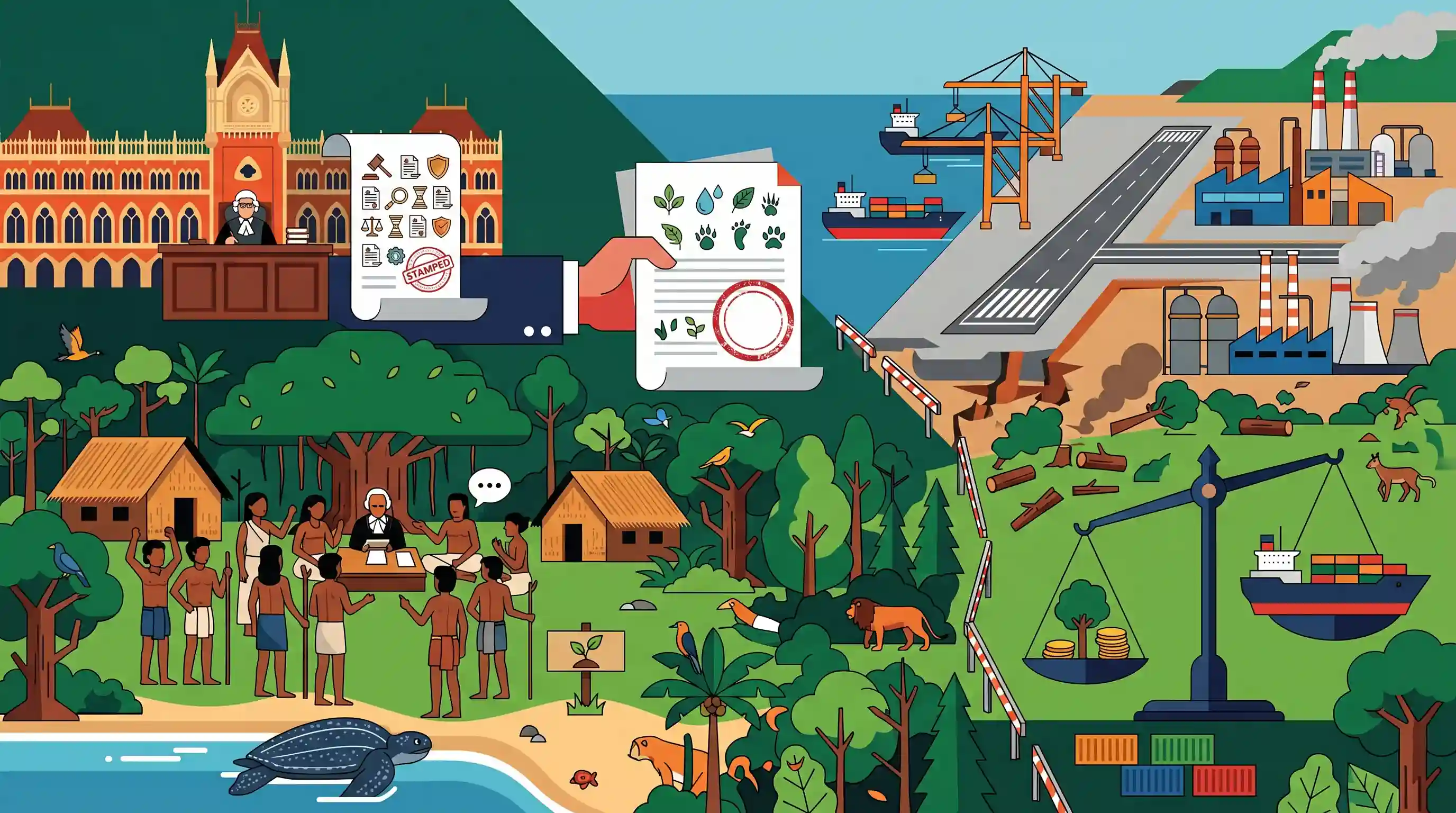
The issue lies at the intersection of mega-infrastructure development, environmental conservation, and the statutory rights of tribal communities. It highlights the practical challenges of implementing the Forest Rights Act (FRA) and protecting Particularly Vulnerable Tribal Groups (PVTGs) amidst rapid economic expansion.
Summary
The Calcutta High Court is hearing a Public Interest Litigation (PIL) challenging the environmental and forest clearances granted to the Rs 81,000-crore Great Nicobar mega infrastructure project. The petition alleges serious violations of the Forest Rights Act (FRA), 2006, claiming that the mandatory consent of the local Gram Sabha was not obtained. The massive diversion of 130 sq km of forest land has sparked concerns about its devastating impact on local ecology, including Galathea National Park, and the displacement of indigenous populations such as the Nicobarese and the Shompen, a Particularly Vulnerable Tribal Group (PVTG).
Key Points
- The Great Nicobar project is an Rs 81,000-crore mega infrastructure initiative involving a transshipment port, airport, power plant, and township, requiring the diversion of 130 sq km of primary forest.
- A PIL filed in the Calcutta High Court challenges the project's clearances, alleging severe violations of the Forest Rights Act (FRA), 2006.
- The project threatens the ancestral lands and survival of the indigenous Nicobarese and the Shompen, a semi-nomadic Particularly Vulnerable Tribal Group (PVTG).
- Petitioners argue that the mandatory free, prior, and informed consent of the local Gram Sabha was bypassed, and tribal communities were not given adequate time to file claims for their Recognition of Forest Rights (RoFR).
- Conservationists warn of the irreversible ecological damage the project will cause to the island's unique biodiversity, including the Galathea and Campbell Bay National Parks.
Important Terms
Forest Rights Act (FRA), 2006

A landmark 2006 law recognizing the customary land and resource rights of forest-dwelling Scheduled Tribes and traditional forest dwellers, aimed at rectifying 'historical injustices' in forest governance.
UPSC context
GS Paper II (Social Justice) & Paper III (Environment). Tests knowledge of tribal welfare and legal frameworks for resource management.
Gram Sabha
A village-level assembly consisting of all persons on the electoral rolls. Under the FRA, it is the primary authority to initiate rights claims and provide mandatory 'prior informed consent' for forest land diversion.
UPSC context
GS Paper II (Panchayati Raj) & Paper III (Environment). Tests decentralization and community-led conservation mandates.
Particularly Vulnerable Tribal Group (PVTG)
A sub-classification of Scheduled Tribes identified by the Dhebar Commission as highly vulnerable due to stagnant populations, low literacy, pre-agricultural technology, and subsistence-level economies (e.g., the Shompen).
UPSC context
GS Paper II (Social Justice/Vulnerable Sections). High-frequency topic regarding socio-economic indicators and targeted protection schemes (e.g., PM-JANMAN).
National Commission for Scheduled Tribes (NCST)
A constitutional body established under Article 338A to safeguard the rights and interests of Scheduled Tribes and to advise on the socio-economic development of STs.
UPSC context
GS Paper II (Constitutional Bodies). Tests oversight mechanisms for tribal interests and executive accountability.
Andaman and Nicobar Islands Integrated Development Corporation (ANIIDCO)
A government-owned corporation established in 1988 to promote economic development in the Andaman and Nicobar Islands; it is the project proponent for the Great Nicobar mega project.
UPSC context
GS Paper III (Infrastructure/Economy). Case study on government agencies balancing strategic infrastructure with ecological sensitivities.
Ministry of Environment, Forest and Climate Change (MoEFCC)
The nodal central ministry for formulating and overseeing India's environmental, forest, and climate policies, responsible for granting environmental and forest clearances to large-scale infrastructure projects.
UPSC context
GS Paper III (Environment/Ecology). Relevant for the administrative process of Environmental Impact Assessments (EIA).
Prelims Trap
"The Ministry of Tribal Affairs initiates the process for determining forest rights."
Under the FRA 2006, the Gram Sabha (not the MoTA or Forest Department) is the designated statutory authority to initiate the process of determining forest rights.
Static Concepts Connected
What is the statutory role of the Gram Sabha under FRA, 2006?
- Initiation: It is the designated authority to initiate the process for determining the nature and extent of Individual Forest Rights (IFR) and Community Forest Rights (CFR).
- Resolution: It receives claims, consolidates them, and passes a resolution to forward them to the Sub-Divisional Level Committee (SDLC).
- Mandatory consent: Its free, prior, and informed consent is legally required before diverting forest land for mega-development projects or resettling populations.
What are the defining ecological features of Great Nicobar?
- Protected Areas: It encompasses Galathea National Park and Campbell Bay National Park, separated by a crucial 12-km forest buffer zone.
- Endemic fauna: It is a critical habitat for endemic and endangered fauna, including the Nicobar megapode, crab-eating macaque, and nesting giant leatherback sea turtles.
- Indigenous groups: It is the ancestral home to the Shompen, a semi-nomadic Particularly Vulnerable Tribal Group (PVTG) with Mongoloid ancestry, distinguishing them from Negrito Andamanese tribes.
Cross-Topic Patterns
Infrastructure vs PVTG Rights
The tension between strategic maritime assets (transshipment ports) in the Indian Ocean and existential threats to PVTGs directly links infrastructure economics to tribal welfare and environmental ethics.
UT Judiciary Mapping
The PIL being heard in the Calcutta High Court reinforces static polity concepts (Article 241), as the Andaman & Nicobar Islands fall under its territorial jurisdiction.

Expect a 2026 multi-statement Prelims question merging Shompen (Mongoloid) ancestry, Galathea's ecology, and Gram Sabha's FRA powers.
Linked PYQs · 5
Linked PYQs · 5
- 2021PrelimsGS1
At the national level, which ministry is the nodal agency to ensure effective implementation of the Scheduled Tribes and Other Traditional Forest Dwellers (Recognition of Forest Rights) Act, 2006?
- 2013PrelimsGS1
Under the Scheduled Tribes and Other Traditional Forest Dwellers (Recognition of Forest Rights) Act, 2006, who shall be the authority to initiate the process for determining the nature and extent of individual or community forest rights or both?
- 2019PrelimsGS1
Consider the following statements about Particularly Vulnerable Tribal Groups (PVTGs) in India : 1. PVTGs reside in 18 States and one Union Territory. 2. A stagnant or declining population is one of the criteria for determining PVTG status. 3. There are 95 PVTGS officially notified in the country so far. 4. Irular and Konda Reddi tribes are included in the list of PVTGs. Which of the statements given above are correct?
- 2009PrelimsGS1
In which one of the following places is the Shompen tribe found?
- 2014MainsGS3
Environmental Impact Assessment studies are increasingly undertaken before a project is cleared by the Government. Discuss the environmental impacts of coal-fired thermal plants located at coal pitheads.
