Great Nicobar Project Faces Judicial Scrutiny via PILs
Source:Indian Express ↗
Why It Matters
The case exemplifies the intersection of environmental governance, judicial review of strategic infrastructure projects, and the evolving role of PILs in challenging executive clearances for projects in ecologically fragile regions like the Great Nicobar Island.
Summary
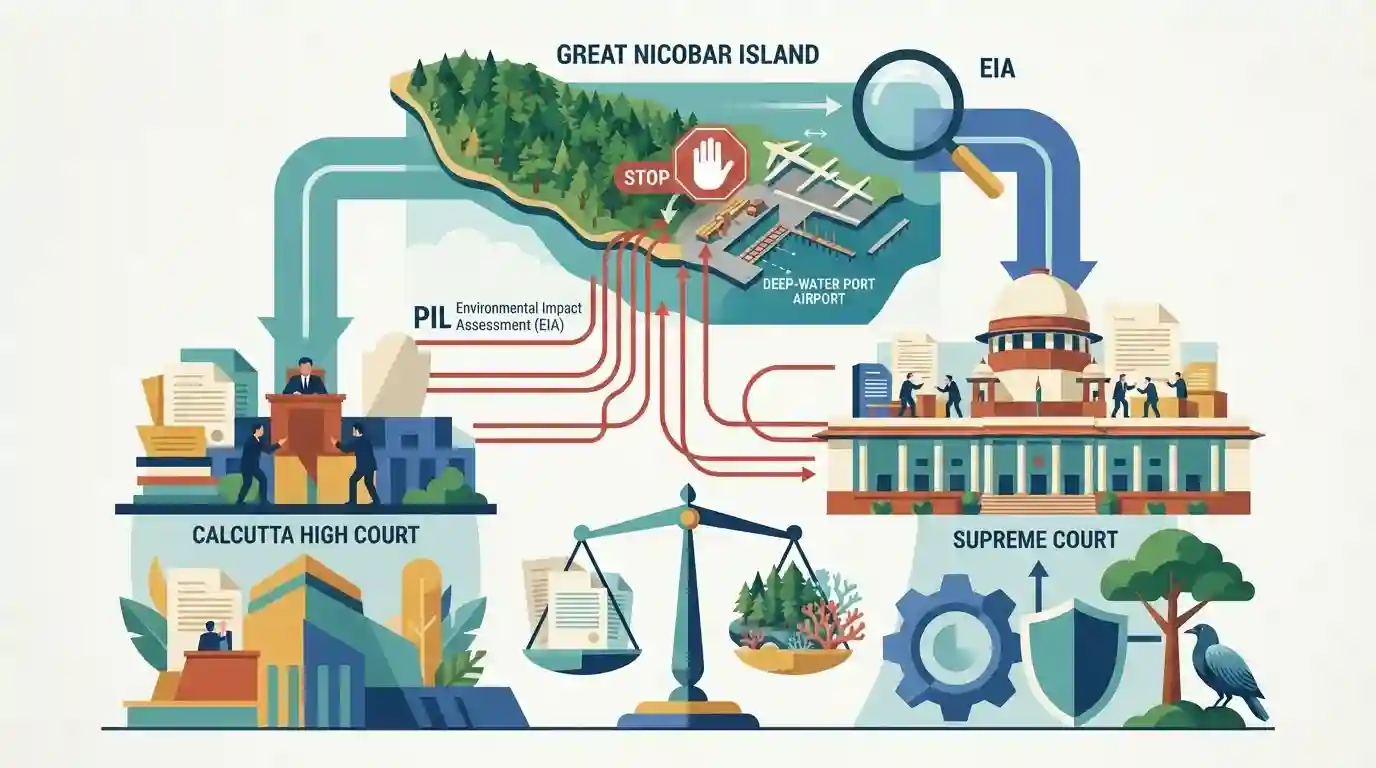
Legal challenges to the ecologically controversial Great Nicobar Project have unfolded across multiple judicial forums, including the Supreme Court and the Calcutta High Court, via Public Interest Litigations (PILs). The case brings to light critical issues regarding environmental governance, judicial jurisdiction, forum shopping, and the balance between national security/infrastructure development and environmental protection in sensitive island ecosystems.
Key Points
- Legal battles surrounding the massive Great Nicobar Project have involved both the Supreme Court and the Calcutta High Court through Public Interest Litigations (PILs).
- Questions have been raised regarding forum shopping, jurisdiction, and the appropriate judicial forums for challenging large-scale infrastructure and environmental clearances in ecologically sensitive areas.
- The project has faced intense scrutiny from environmentalists and legal experts due to its potential impact on biodiversity, tribal welfare, and fragile ecosystems in the Andaman and Nicobar Islands.
- The Supreme Court's intervention highlights ongoing tensions between large-scale strategic infrastructure development and environmental jurisprudence in India.
Important Terms
Great Nicobar Project

A massive ₹72,000+ crore infrastructure and development scheme on Great Nicobar Island comprising a transhipment port, airport, and township, facing intense legal scrutiny over ecological degradation and tribal rights.
UPSC context
UPSC Mains GS Paper III (Environment, Infrastructure & Security); tests the balance between strategic development and environmental conservation/indigenous rights.
Public Interest Litigation (PIL)
A legal mechanism allowing individuals or groups to approach courts for the protection of public interest or enforcement of fundamental rights of marginalized or vulnerable populations, relaxing strict locus standi rules.
UPSC context
UPSC Mains GS Paper II (Polity & Governance); tests judicial activism, access to justice, and locus standi relaxation.
Supreme Court
India's apex judicial body possessing original, appellate, and writ jurisdiction, which recently upheld the maintainability of environmental PILs challenging major infrastructure projects like the Great Nicobar development.
UPSC context
UPSC Mains GS Paper II (Indian Constitution & Judiciary); tests the apex court's role in judicial review and balancing national security with rights.
Calcutta High Court
A constitutional court exercising writ jurisdiction that entertained PILs against the Great Nicobar Project, ruling that national importance does not exempt projects from judicial scrutiny.
UPSC context
UPSC Prelims/Mains; tests the scope of High Court jurisdiction under Article 226 and territorial/subject-matter maintainability in environmental litigation.
Prelims Trap
Once the National Green Tribunal clears a project, its orders cannot be challenged through Public Interest Litigations in High Courts or the Supreme Court.
Aspirants often assume the National Green Tribunal is the final appellate authority with bar on High Court or Supreme Court jurisdiction, but constitutional courts retain writ jurisdiction under Articles 32 and 226.
Static Concepts Connected
What are the key provisions and evolution of Public Interest Litigation (PIL) in India?
- Relaxed Locus Standi: Origin in the late 1970s (Justice P.N. Bhagwati, Justice V.R. Krishna Iyer) relaxing the strict rule of locus standi.
- Enforcement of Rights: Allows any public-spirited individual or organization to file petitions for the enforcement of constitutional and legal rights of marginalized groups.
- Epistolary Jurisdiction: Epistolary jurisdiction permits the Supreme Court or High Courts to treat letters, telegrams, and newspaper reports as writ petitions.
What is the statutory framework of the National Green Tribunal (NGT) under Indian law?
- Statutory Basis: Established under the National Green Tribunal Act, 2010, for effective and expeditious disposal of cases relating to environmental protection.
- Time-Bound Disposal: Mandated to dispose of applications or appeals finally within 6 months of filing.
- Natural Justice: Civil Procedure Code, 1908 is not binding; the Tribunal is guided by principles of natural justice.
Cross-Topic Patterns
Great Nicobar Project + Forest Rights Act
Mega-infrastructure in island territories tests the limits of statutory environmental clearance versus constitutional protections for PVTGs under the Forest Rights Act.
NGT Jurisdiction + Constitutional Writ Remedies
The overlap of NGT clearances with Supreme Court and High Court PILs highlights systemic tensions between specialized green tribunals and constitutional writ jurisdiction.

Great Nicobar Project + EIA clearance loopholes + NGT vs Supreme Court jurisdiction is a prime candidate for a Mains GS-3/GS-2 question.
Linked PYQs · 2
Linked PYQs · 2
- 2024MainsGS3
What role do environmental NGOs and activists play in influencing Environmental Impact Assessment (EIA) outcomes for major projects in India? Cite four examples with all important details.
- 2024MainsGS2
Explain the reasons for the growth of public interest litigation in India. As a result of it, has the Indian Supreme Court emerged as the world's most powerful judiciary ?
