Ecological Concerns Over Great Nicobar Mega Infrastructure Project
Source:The Hindu ↗
Why It Matters
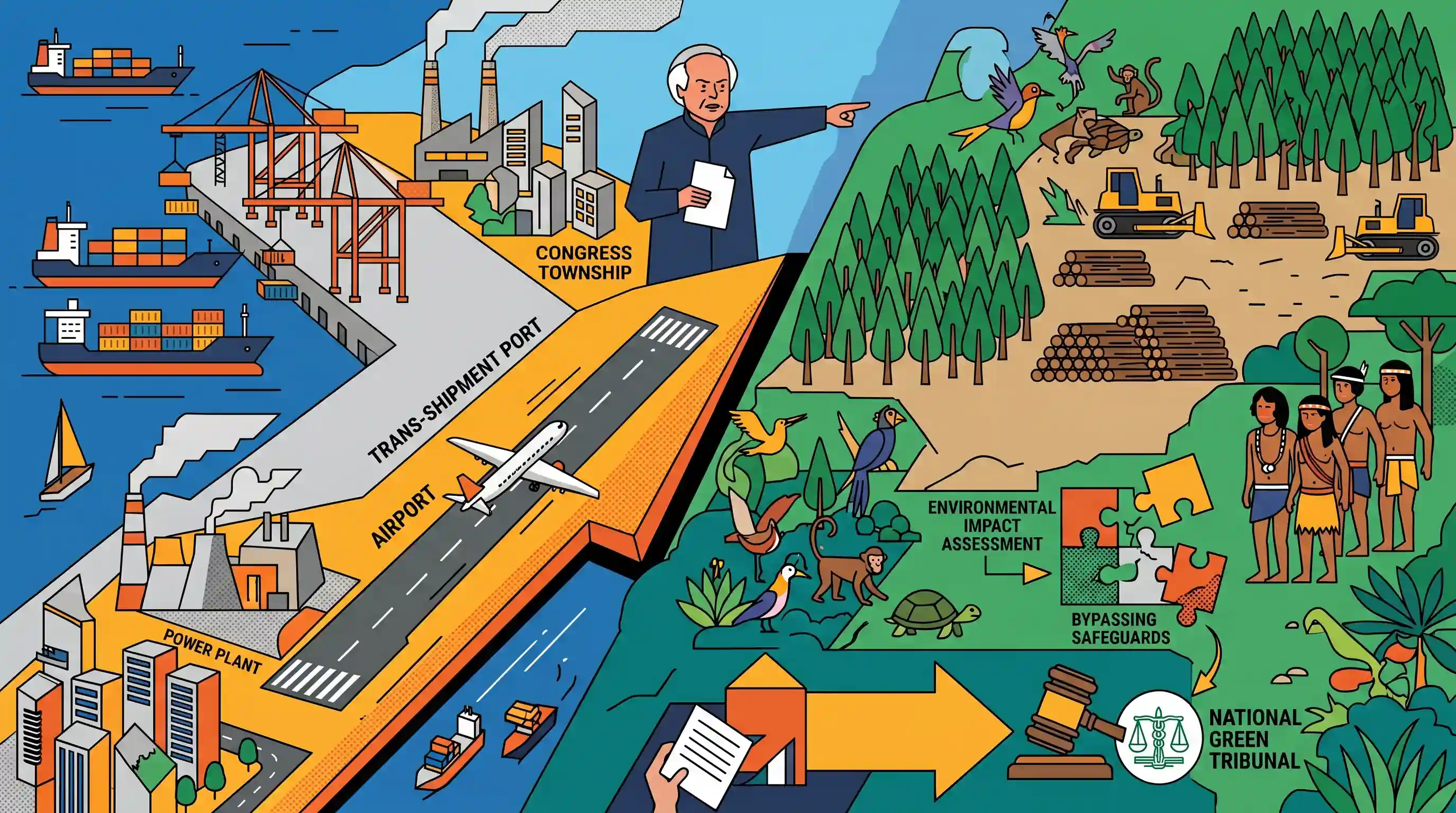
This article serves as a perfect case study for the persistent 'Development vs Environment' debate in GS-3. The proposed mega-project at Great Nicobar encapsulates the complexities of balancing strategic maritime infrastructure with the conservation of pristine rainforest ecosystems and the protection of vulnerable indigenous groups (Particularly Vulnerable Tribal Groups - PVTGs).
Summary
Concerns have been raised regarding the lack of transparency and potential ecological damage associated with the ₹72,000-crore Great Nicobar Island mega project. Congress leader Jairam Ramesh has formally questioned the Ministry of Environment, Forest and Climate Change (MoEFCC) over inadequate environmental safeguards and the dismissal of concerns regarding the indigenous Shompen tribe and fragile ecology. The project, which involves clearing nearly a million trees for an international trans-shipment port, airport, power plant, and township, underscores the complex trade-offs between India's strategic maritime infrastructure and environmental conservation in ecologically sensitive zones. The National Green Tribunal (NGT) previously declined to block the project, citing its strategic national importance.
Key Points
- The ₹72,000-crore Great Nicobar mega infrastructure project faces scrutiny over ecological damage, particularly concerning the felling of almost a million trees and the impact on indigenous communities like the Shompen and Nicobarese.
- Congress general secretary Jairam Ramesh has accused Environment Minister Bhupender Yadav of evading questions regarding the project's environmental safeguards and transparency in clearances.
- The project includes an international container trans-shipment terminal, a military-civil airport, a power plant, and a township, highlighting the tension between strategic/economic imperatives and ecological conservation.
- The National Green Tribunal (NGT) cleared the project without interfering with the environmental clearance, citing 'strategic and national importance,' but formed a High-Powered Committee to monitor safeguards.
Important Terms
Environmental Impact Assessment (EIA)

A statutory process to evaluate the potential environmental, social, and economic consequences of a proposed project before granting approval.
UPSC context
GS-III: Essential for the 'Development vs. Environment' debate and regulatory clearances.
National Green Tribunal (NGT)
A specialized statutory body established in 2010 for the effective and expeditious disposal of cases relating to environmental protection and conservation.
UPSC context
GS-II: Statutory Bodies; GS-III: Judicial role in enforcing environmental laws.
Forest (Conservation) Act, 1980
A central law regulating the diversion of forest land for non-forestry purposes, requiring prior approval from the Union Government.
UPSC context
GS-III: Key legislation for biodiversity and forest governance; recently amended (2023).
Ministry of Environment, Forest and Climate Change (MoEFCC)
The nodal agency of the Central Government for planning, promoting, and overseeing the implementation of India's environmental and forestry policies.
UPSC context
GS-II: Government Policies; Nodal ministry for international environmental commitments (UNFCCC).
High-Powered Committee (HPC)
A body constituted by the NGT in 2023 to review ecological concerns and deficiencies in the Great Nicobar project's environmental clearance.
UPSC context
GS-III: Illustrates judicial oversight and expert-led review in mega-infrastructure projects.
Andaman and Nicobar Islands Integrated Development Corporation (ANIIDCO)
The project proponent and quasi-government agency responsible for implementing the ₹72,000-crore mega infrastructure project in Great Nicobar.
UPSC context
GS-III: Infrastructure development; tests understanding of project execution and institutional accountability.
Prelims Trap
The NGT has an absolute mandate to block any project that involves large-scale deforestation in a declared Biosphere Reserve.
The NGT is guided by the principle of sustainable development and frequently clears projects deemed of 'strategic and national importance' subject to specific monitoring mechanisms.
Static Concepts Connected
What are the key ecological features of the Great Nicobar Biosphere Reserve?
- Location: It is the southernmost island of the A&N archipelago, separated from Sumatra (Indonesia) by the Great Channel (Six Degree Channel).
- Protected Areas: It encompasses Campbell Bay and Galathea National Parks and falls under the Sundaland biodiversity hotspot.
- Key Fauna: It is a critical nesting site for the Giant Leatherback turtle, Nicobar megapode, and the salt-water crocodile.
Who are the Shompen and how do they differ from other A&N tribes?
- PVTG Status: They are a Particularly Vulnerable Tribal Group (PVTG) of semi-nomadic hunter-gatherers residing deep in the interior forests of Great Nicobar Island.
- Ethnic Lineage: Unlike the Negrito tribes (Jarawa, Sentinelese, Onge, Great Andamanese) of the Andaman Islands, the Shompen (along with the Nicobarese) possess distinct Mongoloid features.
Cross-Topic Patterns
EIA Exemptions & Strategic Projects
The Great Nicobar project underscores how 'strategic and national importance' exemptions in environmental and forest laws are increasingly utilized to expedite clearances, bypassing standard, lengthy Environmental Impact Assessment (EIA) procedures.
Maritime Security vs. Island Conservation
The Galathea Bay port aims to capture cargo traffic near the Malacca Strait, showing how India's Indo-Pacific maritime strategy and defense imperatives intersect directly with fragile island ecologies.

Expect a geography mapping question on the Six Degree Channel, Galathea Bay, and Campbell Bay linked to the Sundaland hotspot in 2026.
Linked PYQs · 4
Linked PYQs · 4
- 2024MainsGS3
What role do environmental NGOs and activists play in influencing Environmental Impact Assessment (EIA) outcomes for major projects in India? Cite four examples with all important details.
- 2014MainsGS3
Environmental Impact Assessment studies are increasingly undertaken before a project is cleared by the Government. Discuss the environmental impacts of coal-fired thermal plants located at coal pitheads.
- 2020MainsGS3
How does the draft Environment Impact Assessment (EIA) Notification, 2020 differ from the existing EIA Notification, 2006?
- 2023PrelimsGS1
Consider the following pairs: Port Well known as 1. Kamarajar Port: First major port in India registered as a company 2. Mundra Port: Largest privately owned port in India 3. Visakhapatnam Port: Largest container port in India How many of the above pairs are correctly matched?
