Great Nicobar Mega Project Environmental Clearance Controversy
Source:Indian Express ↗
Why It Matters
The Great Nicobar Project exemplifies the classic 'Environment vs. Development' dilemma and highlights the integration of strategic national security imperatives with environmental governance. It is highly relevant for GS3 (EIA, coastal regulations, and infrastructure) and GS2 (RTI Act exemptions and transparency).
Summary
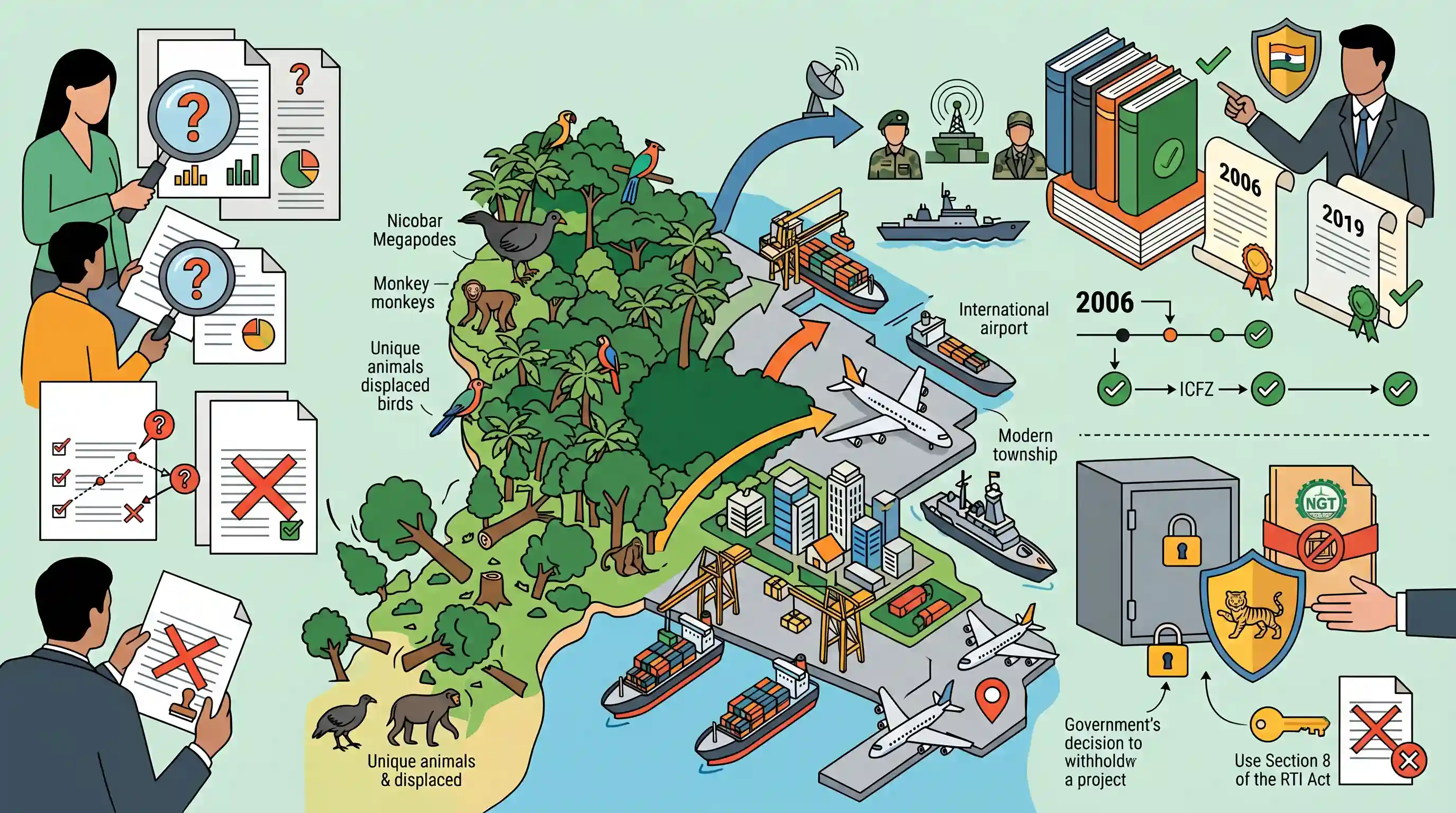
Environment Minister Bhupender Yadav has rebuffed allegations by Congress leader Jairam Ramesh regarding the environmental clearance of the Great Nicobar Island mega-project. While Ramesh argued the clearances relied on flawed and inadequate ecological data, Yadav maintained that the appraisal strictly adhered to the Environment Impact Assessment (EIA) Notification, 2006, and Island Coastal Regulation Zone (ICRZ) Notification, 2019. The ₹72,000-crore strategic infrastructure initiative—involving a transshipment port, an airport, and a township—necessitates large-scale forest felling. Citing the project's strategic and defense importance, Yadav also defended the government's decision to withhold an NGT-mandated High-Powered Committee report under Section 8 of the RTI Act.
Key Points
- Union Environment Minister Bhupender Yadav defended the environmental clearance granted to the ₹72,000-crore Great Nicobar Island (GNI) mega-project, asserting it followed all statutory provisions.
- Congress MP Jairam Ramesh alleged that clearances were based on inadequate baseline data, ignoring the island's ecological and geological sensitivities, and demanded transparency.
- The massive infrastructure project includes a transshipment port, an international airport, power infrastructure, and a greenfield coastal city, requiring the felling of over 13,000 hectares of dense tropical forest.
- Yadav justified withholding the High-Powered Committee (HPC) report, mandated by the NGT to review the project, under Section 8(1)(a) of the RTI Act, citing strategic, defense, and national security interests.
- The Environment Ministry maintained that the project appraisal relied on comprehensive studies by leading institutions like ZSI, BSI, SACON, and WII, complying with EIA and ICRZ norms.
Important Terms
Environment Impact Assessment (EIA) Notification, 2006

A statutory framework under the Environment (Protection) Act, 1986, mandating that developmental projects undergo environmental clearance through stages like scoping and appraisal to assess ecological impact.
UPSC context
GS-III (Environment); tests regulatory mechanisms balancing industrial development with ecological sustainability and public consultation processes.
Island Coastal Regulation Zone (ICRZ) Notification, 2019
A regulatory framework for Indian islands that classifies coastal areas into zones to protect sensitive ecosystems while permitting sustainable development and strategic infrastructure near the coast.
UPSC context
GS-III (Environment) and GS-I (Geography); concerns coastal zone management and unique island ecology.
National Green Tribunal (NGT)
A specialized statutory judicial body established in 2010 for the effective and expeditious disposal of cases relating to environmental protection and conservation of forests.
UPSC context
GS-II/III (Statutory Bodies/Environment); vital for environmental justice and judicial oversight of infrastructure projects.
Right to Information (RTI) Act (Section 8)
A provision in the 2005 Act listing exemptions where information can be withheld, including matters affecting national sovereignty, security, or strategic interests of the State.
UPSC context
GS-II (Governance); tests the balance between transparency and the state's need for strategic confidentiality.
Zoological Survey of India (ZSI)
A premier statutory organization under the Ministry of Environment, Forest and Climate Change focused on animal taxonomy, faunal surveys, and conservation research across India.
UPSC context
GS-III (Biodiversity); relevant for institutional roles in providing scientific baseline data for environmental clearances.
Wildlife Institute of India (WII)
An autonomous institution under the MoEFCC that conducts wildlife research and provides scientific advice on managing the ecological impact of development on protected species.
UPSC context
GS-III (Environment); essential for studying impacts on endangered wildlife and designing mitigation strategies for mega-projects.
Prelims Trap
Environmental impact reports ordered by the National Green Tribunal cannot be withheld from public disclosure under the RTI Act.
Section 8(1)(a) of the RTI Act exempts information affecting strategic/security interests. The government legally invoked this to withhold the NGT-mandated committee report on Great Nicobar.
Static Concepts Connected
What are the key exemptions under Section 8(1)(a) of the RTI Act?
- Sovereignty & Security: Information prejudicing the sovereignty, integrity, security, strategic, scientific, or economic interests of the state.
- Foreign Relations: Information whose disclosure would prejudicially affect relations with a foreign state.
- Incitement: Information that would lead to incitement of an offence.
How does the ICRZ Notification 2019 regulate Andaman & Nicobar infrastructure?
- Zonal Categorization: Classifies island coastal stretches into ICRZ-I (eco-sensitive), II (developed), III (rural), and IV (water area) with specific regulations.
- Strategic Exemptions: Explicitly allows relaxations for defense, strategic, and public utility projects even in ecologically sensitive areas.
- NDZ Reduction: Reduced the No Development Zone (NDZ) to 20 meters for certain smaller islands to facilitate eco-tourism and infrastructure.
Cross-Topic Patterns
Great Nicobar + Indo-Pacific Security
The transshipment port at Galathea Bay leverages proximity to the Malacca Strait, linking domestic environmental clearances directly to India's broader Indo-Pacific maritime security and trade strategy.
Strategic Projects vs PVTG Rights
The felling of 13,000 hectares overlaps with the habitat of the Shompen tribe, highlighting the recurring Mains theme of balancing strategic infrastructure with the rights of PVTGs.

Great Nicobar's port, Malacca Strait proximity, ICRZ exemptions, and Shompen PVTG habitat will likely form a multi-statement prelims Q.
Linked PYQs · 4
Linked PYQs · 4
- 2024MainsGS3
What role do environmental NGOs and activists play in influencing Environmental Impact Assessment (EIA) outcomes for major projects in India? Cite four examples with all important details.
- 2014MainsGS3
Environmental Impact Assessment studies are increasingly undertaken before a project is cleared by the Government. Discuss the environmental impacts of coal-fired thermal plants located at coal pitheads.
- 2020MainsGS2
Recent amendments to the Right to Information Act will have profound impact on the autonomy and independence of the Information Commission". Discuss.
- 2009PrelimsGS1
In which one of the following places is the Shompen tribe found?
