Great Nicobar Infrastructure and Strategic Security Project
Source:Indian Express ↗
Why It Matters
The Great Nicobar Project encapsulates the classic UPSC theme of 'Environment vs. Development'. It touches upon multiple syllabus areas simultaneously: GS3 Infrastructure and Maritime Security, GS3 Environment (EIA), and GS1/GS2 issues regarding PVTGs (Shompen tribe).
Summary
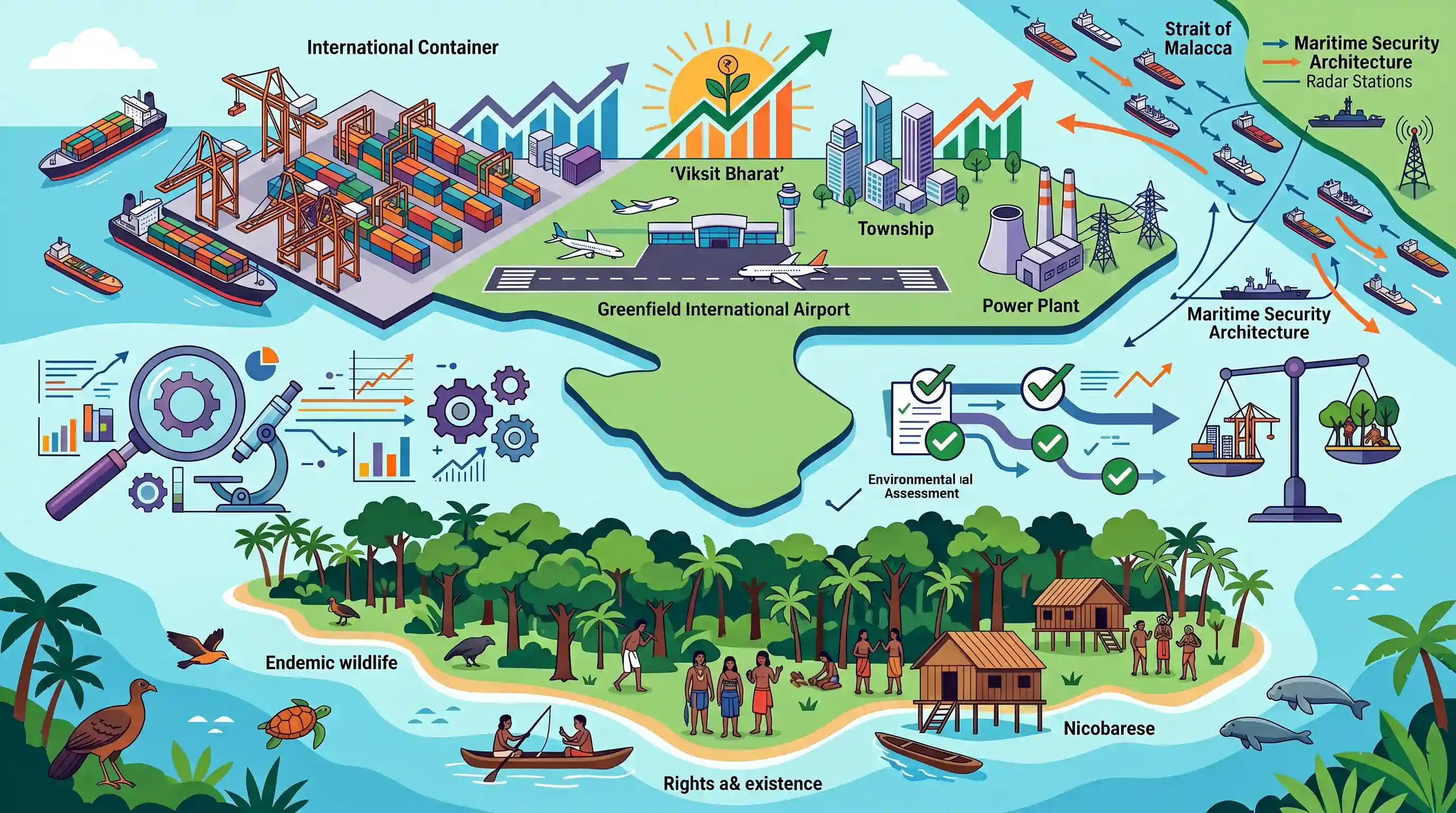
The Great Nicobar Island Development Project is envisioned as a foundational infrastructure initiative crucial to India's 'Viksit Bharat' agenda. Valued at roughly Rs 72,000 crore, the comprehensive plan features an International Container Transshipment Terminal, a greenfield international airport, a township, and a power plant. Geographically, its proximity to the Strait of Malacca—a vital global shipping choke point—amplifies its role in India's maritime security architecture and economic integration into global trade networks. However, the project also underscores the constant friction between strategic infrastructure expansion and ecological conservation, demanding robust Environmental Impact Assessments to protect biodiversity and safeguard the rights of indigenous communities like the Shompen and Nicobarese.
Key Points
- The Rs 72,000-crore Great Nicobar project encompasses a greenfield international airport, a power plant, a township, and an International Container Transshipment Terminal (ICTT).
- Situated near the Strait of Malacca, the project holds immense strategic value for India to bolster maritime security in the Indian Ocean and counter regional geopolitical challenges.
- The ICTT will position India within global supply chains, reduce dependence on foreign transshipment ports, and act as an economic catalyst for the 'Viksit Bharat' vision.
- Balancing infrastructure growth with ecological and social safeguards remains a massive challenge, as the island is home to vulnerable tribal groups like the Shompen and critical biodiversity hotspots.
Important Terms
Great Nicobar Island Development Project (GNIDP)

A ₹72,000-crore mega-infrastructure plan featuring an International Container Transshipment Terminal at Galathea Bay, a greenfield airport, and a township, aimed at transforming the island into a strategic maritime and economic hub.
UPSC context
GS Paper 3: Infrastructure and Security; GS Paper 1: Geography. Tests understanding of strategic development versus ecological conservation.
Viksit Bharat @ 2047
The Union Government's roadmap to transform India into a developed, self-reliant nation by its 100th year of independence, targeting a $30-40 trillion economy and high living standards.
UPSC context
GS Paper 2: Governance; GS Paper 3: Economic Development. Tests knowledge of long-term national planning and socio-economic goals.
Environmental Impact Assessment (EIA)
A statutory process under the Environment (Protection) Act, 1986, that evaluates the potential environmental, social, and economic impacts of proposed developmental projects before they are granted clearance.
UPSC context
GS Paper 3: Environment and Ecology. Tests understanding of regulatory frameworks for sustainable development and public participation.
Particularly Vulnerable Tribal Groups (PVTGs)
A government classification for the most disadvantaged sub-sections of Scheduled Tribes, identified by primitive traits, geographical isolation, low literacy, and stagnant or declining populations (75 groups notified).
UPSC context
GS Paper 2: Social Justice; GS Paper 1: Society. Tests awareness of marginalized communities and their constitutional/legal protections.
Shompen Tribe
A semi-nomadic, hunter-gatherer PVTG of Mongoloid descent native to the interior rainforests of Great Nicobar; they are among the most isolated tribes in India.
UPSC context
GS Paper 1: Geography/Society; GS Paper 2: Social Justice. Tests knowledge of indigenous rights and tribal culture in sensitive regions.
International Container Transshipment Terminal (ICTT)
A specialized deep-water port facility designed to handle large cargo vessels and facilitate the transfer of containers between different ships for regional distribution.
UPSC context
GS Paper 3: Infrastructure; GS Paper 2: International Relations. Tests understanding of maritime logistics and India's role in global trade.
Strait of Malacca
A narrow waterway between the Malay Peninsula and Sumatra, serving as the primary shipping channel between the Indian and Pacific Oceans and a critical global maritime choke point.
UPSC context
GS Paper 1: World Geography; GS Paper 2: IR/Security. Tests knowledge of strategic maritime geography and the "Indo-Pacific" construct.
Prelims Trap
"Both Shompen and Nicobarese tribes of Great Nicobar are classified as Particularly Vulnerable Tribal Groups (PVTGs)."
Only five tribes in A&N are PVTGs: Shompen, Great Andamanese, Jarawa, Onge, and Sentinelese. The Nicobarese are a Scheduled Tribe, but not a PVTG.
Static Concepts Connected
What are the criteria for declaring a community as a PVTG?
- Low Tech: A pre-agricultural level of technology.
- Stagnant Population: A stagnant or declining population growth rate over recent censuses.
- Low Literacy: Extremely low levels of literacy compared to other tribal groups.
- Subsistence Economy: A subsistence level of economy (e.g., hunting, gathering).
Which key channels dictate the maritime geography of the Andaman & Nicobar archipelago?
- Ten Degree Channel: Separates the Andaman Islands in the north from the Nicobar Islands in the south.
- Six Degree Channel: Separates Great Nicobar Island from Sumatra (Indonesia), acting as the gateway to the Strait of Malacca.
- Duncan Passage: Separates South Andaman and Little Andaman islands.
Cross-Topic Patterns
Port-led Development & Global Supply Chains
The Great Nicobar ICTT aligns with Sagarmala's goal to reduce logistics costs by capturing transshipment cargo currently lost to foreign hubs like Colombo and Singapore.
Border Infrastructure vs Forest Clearances
Connect this to recent Forest Conservation Act amendments exempting strategic border projects from strict clearances, highlighting the ongoing tension between national security and ecological preservation.

Expect a multi-statement prelims question combining Great Nicobar's geography, PVTGs (Shompen), and Galathea Bay's Leatherback turtles.
Linked PYQs · 5
Linked PYQs · 5
- 2025MainsGS3
Why is maritime security vital to protect India's sea trade? Discuss maritime and coastal security challenges and the way forward.
- 2022MainsGS3
What are the maritime security challenges in India ? Discuss the organisational, technical and procedural initiatives taken to improve the maritime security.
- 2024MainsGS3
What role do environmental NGOs and activists play in influencing Environmental Impact Assessment (EIA) outcomes for major projects in India? Cite four examples with all important details.
- 2021MainsGS3
“Investment in infrastructure is essential for more rapid and inclusive economic growth.” Discuss in the light of India's experience.
- 2009PrelimsGS1
In which one of the following places is the Shompen tribe found?
