Great Indian Bustard Habitat Threats and Protection
Source:Indian Express ↗
কেন এটি গুরুত্বপূর্ণ
The Great Indian Bustard is a flagship species for India's arid grasslands. Understanding threats like power line collisions and conservation frameworks like captive breeding and rewilding is vital for UPSC aspirants dealing with environment and wildlife management questions.
সারসংক্ষেপ
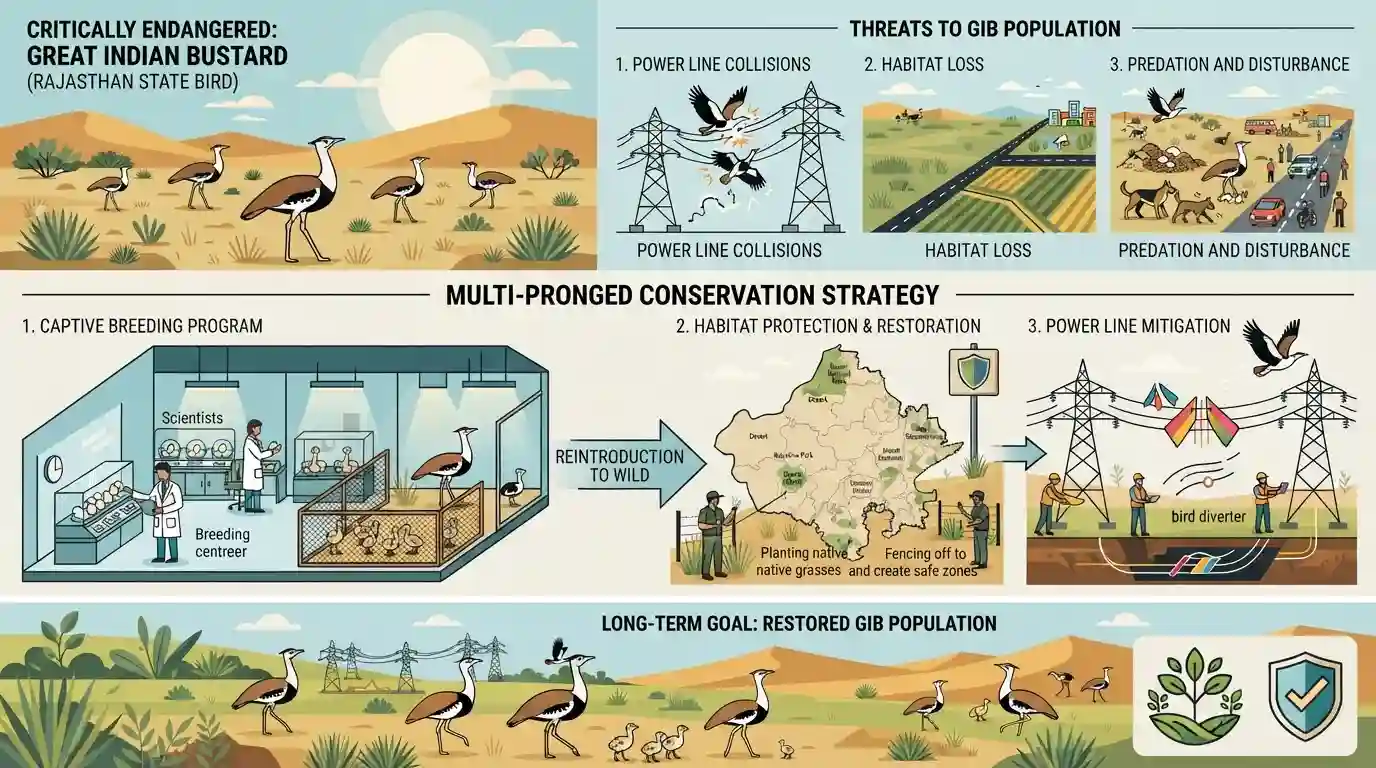
An overview of the Great Indian Bustard (GIB) rewilding and conservation project in Rajasthan, highlighting the threats faced by India's critically endangered state bird of Rajasthan, including power line collisions, and the multi-pronged conservation strategy involving captive breeding and habitat protection.
মূল বিষয়
- The Great Indian Bustard (GIB) is one of the most critically endangered bird species globally, with its core population concentrated in Rajasthan.
- A new rewilding and conservation project has been launched in Rajasthan to save the GIB from the brink of extinction through captive breeding, habitat management, and addressing threats like high-tension power lines.
- Key threats include collision with overhead transmission lines, habitat degradation, feral dogs, and agricultural expansion in arid grasslands.
- Conservation measures involve undergrounding power cables where feasible, installing bird deflectors, and intensive monitoring by wildlife authorities.
গুরুত্বপূর্ণ শব্দ
Supreme Court of India

The apex court of India, which has issued landmark orders regarding the protection of critically endangered species like the Great Indian Bustard and the undergrounding of power lines in priority habitats.
UPSC context
GS Paper II (Polity and Governance - Judiciary) and GS Paper III (Environment). Tests understanding of judicial activism, public interest litigation, and environmental jurisprudence.
Wildlife Institute of India (WII)
An autonomous institution under the Ministry of Environment, Forest and Climate Change that provides scientific advice and research for wildlife conservation, actively involved in Project GIB's captive breeding and rewilding.
UPSC context
GS Paper III (Environment and Biodiversity). Tests knowledge of premier conservation research bodies, species recovery programs, and scientific management of endangered fauna.
Wild Life (Protection) Act 1972
India's principal legislation for the protection of wild animals, birds, and plants, providing the legal framework for establishing protected areas and safeguarding endangered species like the Great Indian Bustard.
UPSC context
GS Paper III (Environment and Biodiversity, Wildlife Conservation). Essential statutory framework tested frequently in Prelims and Mains regarding conservation schedules and legal protections.
প্রিলিমস ফাঁদ
The Great Indian Bustard is exclusively conserved through in-situ protected area designation across all arid grassland habitats pan-India.
Aspirants often assume all critically endangered species have mandatory captive breeding protocols established nationwide, but GIB captive breeding is highly localized in specialized WII facilities in Rajasthan.
সংযুক্ত স্থির ধারণা
What are the key legal classifications and conservation provisions for the Great Indian Bustard in India?
- Legal Protection: Listed under Schedule I of the Wild Life (Protection) Act, 1972, providing it with the highest degree of legal protection against hunting and trade.
- IUCN Status: Classified as 'Critically Endangered' on the IUCN Red List, driven by rapid population decline due to habitat loss and fragmentation.
- CITES Listing: Included in Appendix I of the Convention on International Trade in Endangered Species of Wild Fauna and Flora (CITES).
- Core Habitat: Protected primarily within the Desert National Park in Rajasthan, which represents its key breeding stronghold and natural habitat.
আন্তঃবিষয় প্যাটার্ন
Renewable Energy vs. Arid Biodiversity Conservation
Renewable energy expansion in arid ecosystems directly conflicts with flagship species conservation, testing India's balance between net-zero targets and biodiversity commitments under the CBD.
Judicial Mandates vs. Infrastructure Execution
Supreme Court judicial interventions in wildlife conservation frequently clash with infrastructure timelines, raising questions on executive-judiciary separation in environmental governance.

GIB habitat, IUCN status, Wildlife Act Schedule I, and power-line collision mitigation make a prime multi-statement prelims question.
সংযুক্ত PYQ · 1
সংযুক্ত PYQ · 1
- 2020PrelimsGS1
With reference to India's Desert National Park, which of the following statements are correct? 1. It is spread over two districts. 2. There is no human habitation inside the Park. 3. It is one of the natural habitats of Great Indian Bustard. Select the correct answer using the code given below:
