Great Indian Bustard Habitat and Limestone Mining Clearances
Source:Indian Express ↗
Why It Matters
It highlights the critical conflict between industrial mineral mining and the conservation of critically endangered species like the Great Indian Bustard, testing India's environmental governance and judicial frameworks.
Summary
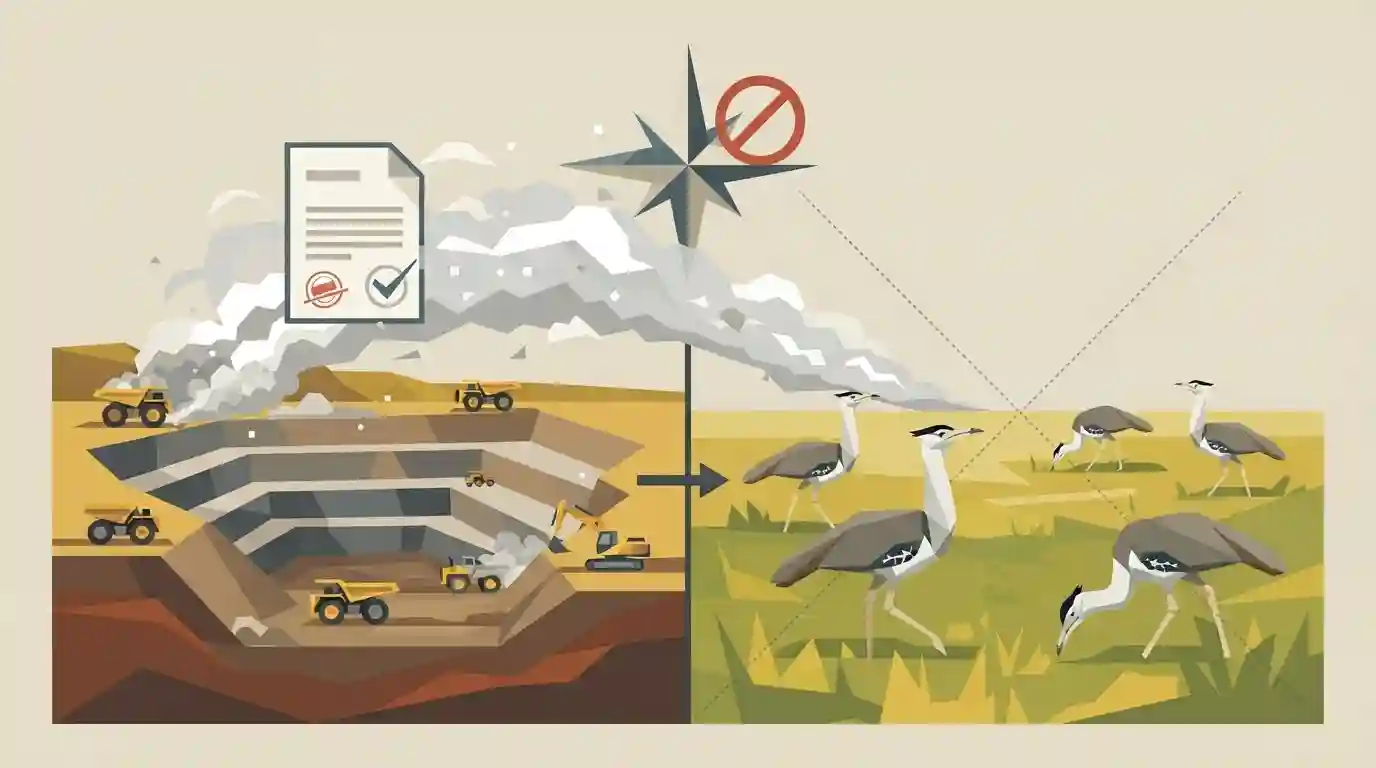
The clearance granted to a limestone mine in Rajasthan has sparked debates over the conservation of the Great Indian Bustard (GIB), highlighting the ongoing tension between industrial development, mineral exploitation, and the protection of critically endangered wildlife habitats.
Key Points
- Limestone mine clearance in Rajasthan has raised significant concerns regarding the habitat of the critically endangered Great Indian Bustard (GIB).
- The GIB faces severe survival threats due to habitat fragmentation, industrial activities, and infrastructure projects like power lines and mining.
- Balancing economic development (such as mineral extraction and mining) with critical wildlife conservation remains a key policy and judicial challenge in India.
- Environmental clearances and protective measures around sensitive wildlife zones are under intense scrutiny by conservationists and courts.
Important Terms
Wild Life (Protection) Act, 1972

A landmark legislation providing a legal framework for the protection of wild animals, birds, and plants, and managing sanctuaries and national parks across India.
UPSC context
UPSC Prelims & Mains (GS Paper III: Conservation and Environment). Tests statutory frameworks for wildlife protection and endangered species management.
Supreme Court of India
The apex judicial authority in India responsible for constitutional interpretation, environmental jurisprudence, and issuing binding directives on wildlife conservation and balancing development.
UPSC context
UPSC Mains (GS Paper II: Polity & Constitution) and GS Paper III (Environment). Tests judicial activism and balancing developmental projects with environmental protection.
National Board for Wildlife
A statutory body chaired by the Prime Minister of India, responsible for framing wildlife conservation policies and reviewing projects in or near wildlife sanctuaries and national parks.
UPSC context
UPSC Prelims & Mains (GS Paper III). Tests institutional mechanisms for wildlife governance, statutory bodies, and environmental clearance processes.
Rajasthan government
The sub-national administrative authority in western India responsible for state-level resource allocation, mining leases, and implementing wildlife protection measures for species like the Great Indian Bustard.
UPSC context
UPSC Mains (GS Paper III: Environment & Governance). Tests federal dynamics, regional development pressures, and state-level implementation of wildlife conservation laws.
Prelims Trap
The Great Indian Bustard is listed under Schedule II of the Wild Life (Protection) Act, 1972.
Aspirants often assume the GIB is protected under Schedule V (vermin) or Schedule II instead of its actual highest-protection status.
Static Concepts Connected
What are the key legal provisions and conservation status of the Great Indian Bustard in India?
- Legal Status: It is listed under Schedule I of the Wild Life (Protection) Act, 1972, affording it the highest degree of legal protection.
- IUCN Status: Classified as Critically Endangered on the IUCN Red List, with its remaining viable population largely restricted to Rajasthan.
- Key Habitat: The Desert National Park in Rajasthan is its primary natural habitat and stronghold, characterized by arid thorn forests and grasslands.
- Primary Threats: Major threats include collision with overhead high-voltage transmission lines, habitat fragmentation, and stray dogs.
Cross-Topic Patterns
Mining Clearances vs. Judicial Conservation Mandates
Industrial infrastructure and mining clearances often clash directly with the judiciary's mandate to protect critical wildlife habitats under the Public Trust Doctrine.
Grassland Ecosystems vs. Forest-Centric Conservation Policies
The GIB's reliance on open arid grasslands illustrates the systemic oversight of non-forest ecosystems in national conservation planning compared to dense forest targets.

Expect a statement-based question pairing Wild Life Act schedules with Supreme Court rulings on transmission lines and mining in GIB habitats.
Linked PYQs · 2
Linked PYQs · 2
- 2020PrelimsGS1
With reference to India's Desert National Park, which of the following statements are correct? 1. It is spread over two districts. 2. There is no human habitation inside the Park. 3. It is one of the natural habitats of Great Indian Bustard. Select the correct answer using the code given below:
- 2025MainsGS3
Mineral resources are fundamental to the country's economy and these are exploited by mining. Why is mining considered an environmental hazard? Explain the remedial measures required to reduce the environmental hazard due to mining.
