AP Great Green Wall Initiative for Coastal Protection
Source:The Hindu ↗
Why It Matters
The initiative demonstrates a major state-level nature-based solution (NbS) for disaster risk reduction and climate change adaptation. It is highly relevant for Prelims questions on coastal landforms, cyclonic impacts, and the ecological roles of specific flora (like mangroves and palmyra) in preventing soil erosion.
Summary
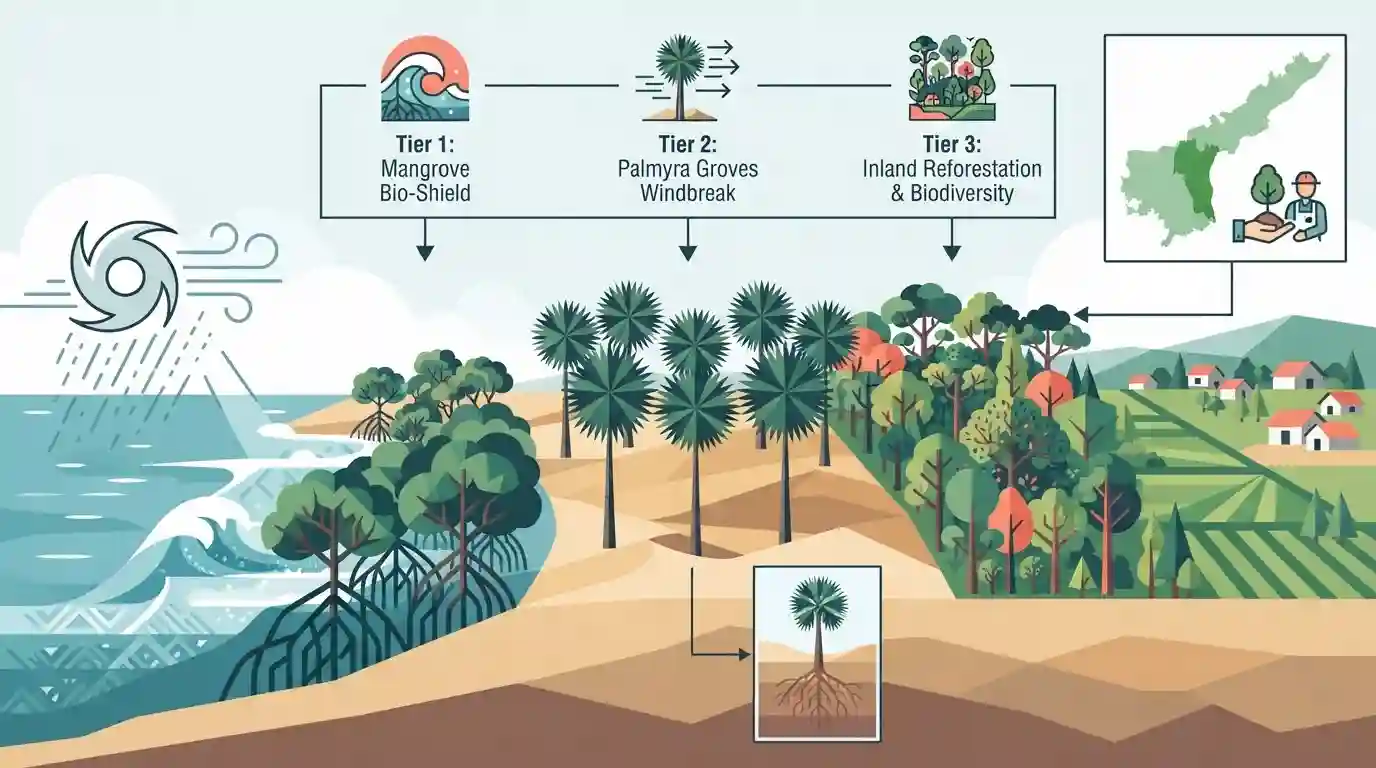
The Andhra Pradesh government has launched the 'Great Green Wall' initiative, a massive plantation drive aimed at creating a natural shield along its coast to combat cyclones and coastal erosion. Spearheaded by Deputy Chief Minister K. Pawan Kalyan, the project features a three-tier coastal green cover strategy, utilizing mangroves as the first tier and extensive palmyra groves on 5,499 hectares as the second tier. Palmyra's resilience to salinity and strong winds, along with its soil-binding roots, makes it an ideal natural windbreak. The initiative aligns with the state's broader goal to achieve a 50% green cover, restore degraded ecosystems, and enhance coastal biodiversity with the help of local communities and government departments.
Key Points
- Andhra Pradesh has launched the 'Great Green Wall' initiative to build a natural protective barrier along its coastline to mitigate cyclones and extreme weather events.
- The strategy involves a three-tier plan where mangroves form the first tier and palmyra groves act as the second tier (windbreak), with a third layer planned for broader coastal green cover.
- The state aims to plant nearly 55 lakh palmyra seeds across 5,499 hectares; palmyra is selected for its deep root system, ability to withstand salinity, and efficacy in checking coastal erosion.
- The initiative is part of a broader objective to achieve 50% green cover in the state, restore degraded ecosystems, and conserve coastal biodiversity.
Important Terms
Great Green Wall of Andhra Pradesh

A monumental coastal afforestation initiative spearheaded by the AP government, creating a multi-layered natural barrier to protect the state's coastline from devastating cyclones and soil erosion.
UPSC context
Highly relevant for APPSC Geography and Disaster Management, testing proactive, nature-based climate resilience strategies.
Three-tier coastal green cover
A layered ecological defense strategy deployed in AP's coastal districts, utilizing mangroves as the primary tier, palmyra groves as the second windbreak, and a broader green canopy inland.
UPSC context
Tests Biodiversity Conservation and Coastal Management in APPSC, focusing on structured environmental planning against extreme weather.
Palmyra Groves
Plantations of AP's state tree forming the second tier of the Great Green Wall. They are chosen for their cyclone-resistant trunks, high salinity tolerance, and deep soil-binding roots.
UPSC context
Crucial for AP Geography and Environment, highlighting the ecological utility of native flora in coastal erosion prevention.
Andhra Pradesh Forest Department
The nodal state agency spearheading the Great Green Wall project, responsible for collecting millions of palmyra seeds, overseeing scientific coastal plantations, and monitoring ecological restoration.
UPSC context
Relevant for AP State Administration and Environment topics, identifying key agencies executing state climate action policies.
Panchayat Raj and Revenue Departments
State administrative departments collaborating on the Great Green Wall by mobilizing rural communities, engaging students, and facilitating grassroots land allocation for the massive seed plantation drives.
UPSC context
Tests knowledge of rural governance and inter-departmental convergence in executing state-level environmental and disaster resilience programs.
Prelims Trap
India's 'Great Green Wall' initiatives are exclusively designed to combat desertification and land degradation in arid regions.
While the Aravalli Green Wall targets desertification, AP's newly launched 'Great Green Wall' uses mangroves and palmyra as a coastal bio-shield against cyclones and erosion.
Static Concepts Connected
How do Mangroves and Palmyra act as effective coastal bio-shields?
- Root architecture: Mangroves use complex stilt roots to dissipate wave energy, while Palmyra palms have deep, fibrous roots that bind soil to prevent coastal erosion.
- Windbreak function: Their structural resilience, thick trunks, and canopy placement reduce the velocity of cyclonic winds, protecting inland settlements and agricultural fields.
- Salinity tolerance: Both species can survive and thrive in high-salinity coastal soils where conventional plantation species fail, ensuring perennial protection.
Why is the Bay of Bengal highly prone to tropical cyclones?
- High SST: The Bay of Bengal remains warmer than the Arabian Sea, providing the immense latent heat of condensation necessary to fuel tropical storm systems.
- Ocean stratification: Massive freshwater influx from major rivers lowers surface salinity, inhibiting vertical mixing of cooler deep waters and keeping the surface anomalously warm.
- Pacific remnants: Remnant low-pressure systems and typhoons originating in the Pacific Ocean (South China Sea) frequently cross over landmasses into the Bay of Bengal to re-intensify.
Cross-Topic Patterns
Nature-Based Solutions (NbS) for DRR
The AP Great Green Wall is a prime example of Ecosystem-based Disaster Risk Reduction (Eco-DRR), shifting away from concrete sea walls to biological shields in line with the Sendai Framework.
AP State targets & Green Cover
Ties AP’s specific 50% green cover mandate to tangible disaster mitigation, highly relevant for APPSC mains answers on sustainable state development and climate resilience.

Multi-statement questions will likely mix AP's Great Green Wall (coastal bio-shield) with Aravalli or African desertification green walls.
Linked PYQs · 4
Linked PYQs · 4
- 2024APPSC_PRELIMSGS1
Identify the incorrect statement:
- 2024APPSC_PRELIMSGS1
Identify the incorrect statement on extra-tropical cyclones:
- 2023APPSC_PRELIMSGS1
According to the Indian Forest Act, 1927, which of the following is the most appropriate sequence which shows the degree of protection between different forest types ?
- 2023APPSC_PRELIMSGS1
The greatest variety (diversity) of animal and plant species can be found in
