GRAP Stage 2 implementation and air pollution rules in Delhi
Source:The Hindu ↗
Why It Matters
Understanding the operational mechanisms, triggers, and enforcement challenges of the Graded Response Action Plan (GRAP) is essential for aspirants analyzing urban air quality management, emergency response protocols, and environmental governance in India's metropolitan regions.
Summary
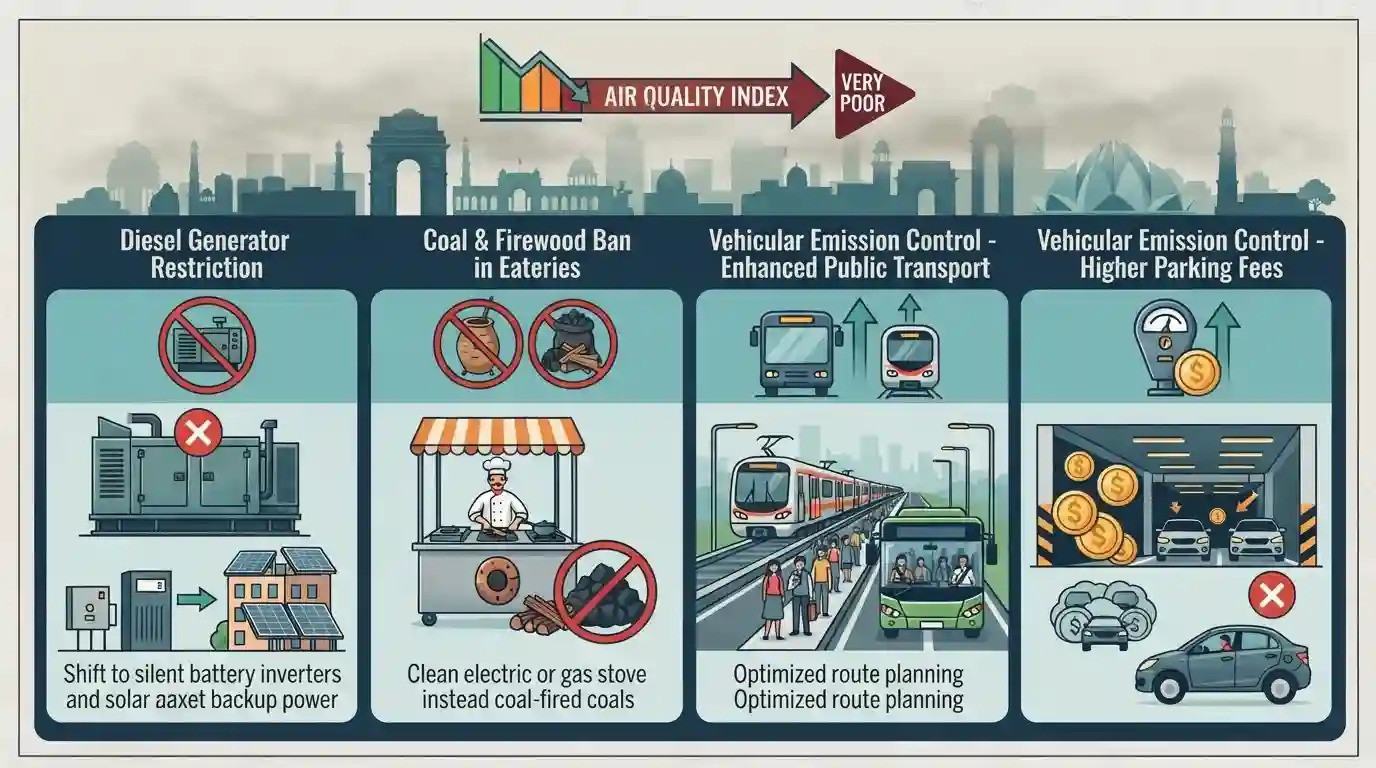
The article outlines the specific restrictions, bans, and allowed activities under Stage 2 of the Graded Response Action Plan (GRAP) implemented in Delhi-NCR as air quality plummets to the 'Very Poor' category. GRAP Stage 2 focuses on curbing localized pollution sources such as diesel generator usage, coal and firewood burning in eateries, and vehicular emissions through enhanced public transport services and higher parking fees, serving as a critical operational framework for urban environmental governance.
Key Points
- GRAP Stage 2 is triggered when the Air Quality Index (AQI) enters the 'Very Poor' category (301-400), aiming to arrest further deterioration of air quality.
- Key restrictions under GRAP Stage 2 include a ban on the use of coal and firewood in hotels, restaurants, and open eateries, as well as a ban on diesel generator sets except for emergency and essential services.
- Additional measures involve increased parking fees to discourage private vehicle usage, enhanced frequency of compressed natural gas (CNG) and electric buses and metro services, and strict dust mitigation measures at construction sites.
- Implementation and monitoring are overseen by the Commission for Air Quality Management (CAQM) in coordination with local municipal and state authorities across the NCR.
Important Terms
Graded Response Action Plan (GRAP)

A dynamic, emergency-response framework activated in Delhi-NCR to combat air pollution by enforcing staged restrictions based on worsening Air Quality Index (AQI) thresholds.
UPSC context
Mains Paper III (Environment): Tests understanding of urban environmental governance, pollution control policies, and emergency mitigation strategies.
Commission for Air Quality Management (CAQM)
A statutory body established to coordinate, monitor, and regulate air quality management strategies across Delhi-NCR and adjoining areas, replacing fragmented administrative committees.
UPSC context
Prelims & Mains Paper II/III: Tests statutory institutional frameworks, cooperative federalism, and air quality governance in northern India.
National Clean Air Programme (NCAP)
India's flagship national strategy launched by MoEFCC to reduce particulate matter pollution across targeted non-attainment cities through comprehensive multi-sectoral interventions.
UPSC context
Prelims & Mains Paper III: Evaluates national-level environmental policies, budgetary allocations, and urban air quality targets.
Central Pollution Control Board (CPCB)
A statutory apex organization under the Water and Air Acts responsible for planning pollution standards, monitoring air/water quality, and advising the central government.
UPSC context
Prelims & Mains Paper III: Tests statutory environmental bodies, enforcement mechanisms, and scientific monitoring of environmental standards in India.
Prelims Trap
The Graded Response Action Plan (GRAP) for Delhi-NCR is enforced directly by the Central Pollution Control Board (CPCB) as a nationwide statutory framework.
Aspirants often assume GRAP is enforced directly by the CPCB or MoEFCC nationwide, whereas its operational enforcement in the NCR is specifically managed by the statutory CAQM.
Static Concepts Connected
What is the statutory framework and institutional structure of the Commission for Air Quality Management (CAQM)?
- Creation: Statutory Body established under the Commission for Air Quality Management in National Capital Region and Adjoining Areas Act, 2021.
- Mandate: Replaced the older Environment Pollution (Prevention and Control) Authority (EPCA) to streamline air quality management across Delhi-NCR and adjoining areas.
- Powers: Has overarching powers to issue directions, entertain complaints, and coordinate state-level enforcement for pollution control.
Cross-Topic Patterns
CAQM statutory powers vs. cooperative federalism
Urban air pollution frameworks link environment protection with federal cooperative governance, testing the statutory authority of bodies like the CAQM over state municipal administrations.

Expect a statement-based prelims question on the statutory origins of CAQM and AQI thresholds triggering specific GRAP stages (I-IV).
Linked PYQs · 3
Linked PYQs · 3
- 2020MainsGS3
What are the key features of the National Clean Air Programme (NCAP) initiated by the Government of India?
- 2021MainsGS3
Describe the key points of the revised Global Air Quality Guidelines (AQGs) recently released by the World Health Organisation (WHO). How are these different from its last update in 2005? What changes in India's National Clean Air Programme are required to achieve these revised standards?
- 2016PrelimsGS1
In the cities of our country, which among the following atmospheric gases are normally considered in calculating the value of Air Quality Index? 1. Carbon dioxide 2. Carbon monoxide 3. Nitrogen dioxide 4. Sulfur dioxide 5. Methane Select the correct answer using the code given below.
