CAQM Revokes GRAP Stage Two Restrictions in Delhi NCR
Source:The Hindu ↗
Why It Matters
Delhi's air pollution crisis and the statutory mechanisms to counter it (such as GRAP and CAQM) are highly recurring themes in UPSC Mains GS3 and Prelims. Aspirants must clearly understand how AQI is measured by the CPCB and the specific staged interventions triggered under GRAP to evaluate the effectiveness of urban environmental policies.
Summary
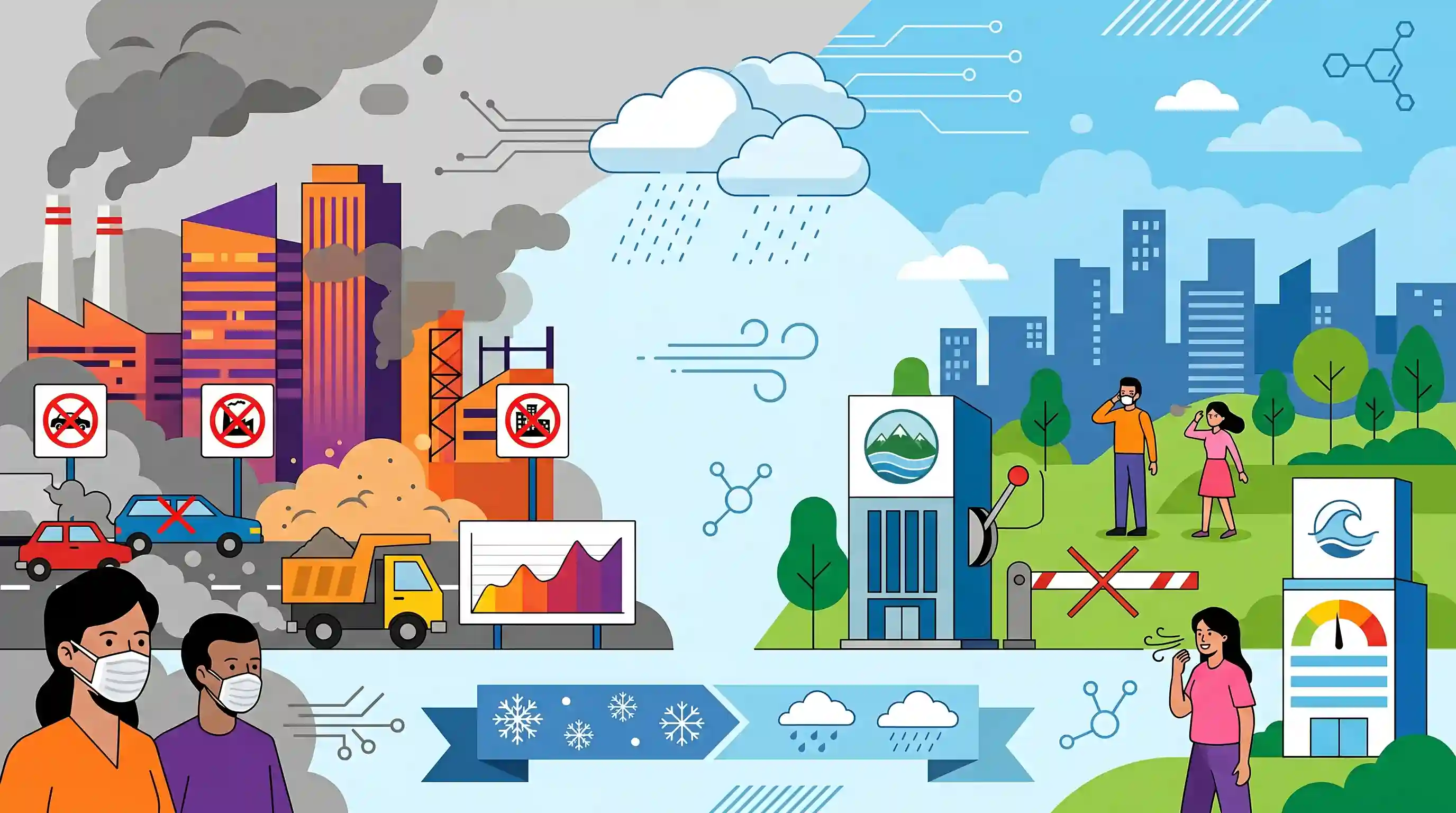
The Commission for Air Quality Management (CAQM) has revoked Stage-II restrictions under the Graded Response Action Plan (GRAP) in Delhi-NCR following a notable improvement in the region's air quality. Favorable meteorological conditions, including light rain, helped bring the Air Quality Index (AQI) down to 214, which falls under the 'poor' category according to the Central Pollution Control Board (CPCB). GRAP Stage-I and Stage-II protocols had been continuously enforced since mid-October of the previous year to combat severe winter pollution.
Key Points
- The Commission for Air Quality Management (CAQM) revoked GRAP Stage-II restrictions in Delhi-NCR due to improved air quality.
- The Air Quality Index (AQI) dropped to 214, settling in the 'poor' category, aided by favorable meteorological conditions such as light rain.
- Stages I and II of GRAP had been active in the National Capital Region since October.
- The Central Pollution Control Board (CPCB) classifies AQI scores into six categories: good (0-50), satisfactory (51-100), moderate (101-200), poor (201-300), very poor (301-400), and severe (401-500).
Important Terms
Commission for Air Quality Management (CAQM)

A statutory body established in 2021 to coordinate, research, and monitor air quality specifically in the National Capital Region (NCR) and its adjoining states.
UPSC context
GS Paper 2 & 3: Tests knowledge of statutory bodies, federal coordination, and specialized environmental governance.
Graded Response Action Plan (GRAP)
An emergency framework for Delhi-NCR that mandates stage-wise actions (Stages I-IV) to combat air pollution based on current and forecast Air Quality Index (AQI) levels.
UPSC context
GS Paper 3 (Environment): Crucial for questions on urban pollution management and Supreme Court-led environmental initiatives.
Central Pollution Control Board (CPCB)
India's apex statutory organization (est. 1974) responsible for setting environmental standards and providing technical services to the Ministry of Environment, Forest and Climate Change.
UPSC context
GS Paper 2 & 3: Fundamental body for pollution control legislation (Air and Water Acts).
India Meteorological Department (IMD)
The principal government agency for meteorology and forecasting; it operationalizes air quality early warning systems and provides the meteorological data for pollution alerts.
UPSC context
GS Paper 1 (Geography) & GS 3: Important for weather patterns and disaster management frameworks.
Indian Institute of Tropical Meteorology (IITM)
An autonomous research institute under the Ministry of Earth Sciences that develops advanced forecasting models like SAFAR and Decision Support Systems for pollution management.
UPSC context
GS Paper 3 (Science & Tech): Tests research-governance linkages and technological interventions for climate and environment.
Prelims Trap
"The Central Pollution Control Board (CPCB) was established under the Air (Prevention and Control of Pollution) Act, 1981."
CPCB was constituted under the Water Act, 1974. It was later entrusted with powers under the Air Act, 1981, but was not established by it.
Static Concepts Connected
What are the statutory origins and roles of the CPCB?
- Original Mandate: It is a statutory organisation constituted under the Water (Prevention and Control of Pollution) Act, 1974.
- Added Powers: It was later entrusted with powers and functions under the Air (Prevention and Control of Pollution) Act, 1981.
- EPA Role: It provides technical assistance to the MoEFCC under the provisions of the Environment (Protection) Act, 1986.
Which pollutants are measured in the National Air Quality Index (AQI)?
- Eight Pollutants: It tracks eight specific pollutants: PM10, PM2.5, NO2, SO2, CO, O3, NH3, and Lead (Pb).
- Key Exclusions: Carbon Dioxide (CO2) and Methane (CH4) are excluded. They are greenhouse gases driving climate change, not local toxic air pollutants.
- Six Categories: The index classifies scores into six color-coded categories: good, satisfactory, moderate, poor, very poor, and severe.
Cross-Topic Patterns
NCAP vs GRAP regional jurisdictions
UPSC frequently tests policy scopes. GRAP is an emergency response exclusive to Delhi-NCR, whereas the National Clean Air Programme (NCAP) is a long-term strategy for 130+ non-attainment cities nationwide.
Meteorology and winter temperature inversion
The persistence of poor AQI connects to static geography concepts: winter temperature inversion, subsidence of cold air, and north-westerly winds trapping local and stubble-burning emissions.
Judicial activism to statutory permanence
CAQM replaced the Supreme Court-mandated EPCA, showcasing a legislative shift from judicial ad-hoc committees to permanent statutory bodies for targeted regional environmental issues.

Expect a 2026 Prelims MCQ combining CPCB's statutory origin (Water Act), AQI pollutant lists, and CAQM's specific NCR jurisdiction.
Linked PYQs · 3
Linked PYQs · 3
- 2021MainsGS3
Describe the key points of the revised Global Air Quality Guidelines (AQGs) recently released by the World Health Organisation (WHO). How are these different from its last update in 2005? What changes in India's National Clean Air Programme are required to achieve these revised standards?
- 2016PrelimsGS1
In the cities of our country, which among the following atmospheric gases are normally considered in calculating the value of Air Quality Index? 1. Carbon dioxide 2. Carbon monoxide 3. Nitrogen dioxide 4. Sulfur dioxide 5. Methane Select the correct answer using the code given below.
- 2020MainsGS3
What are the key features of the National Clean Air Programme (NCAP) initiated by the Government of India?
