PM ABHIM Implementation and Public Health Infrastructure Growth
Source:Indian Express ↗
Why It Matters
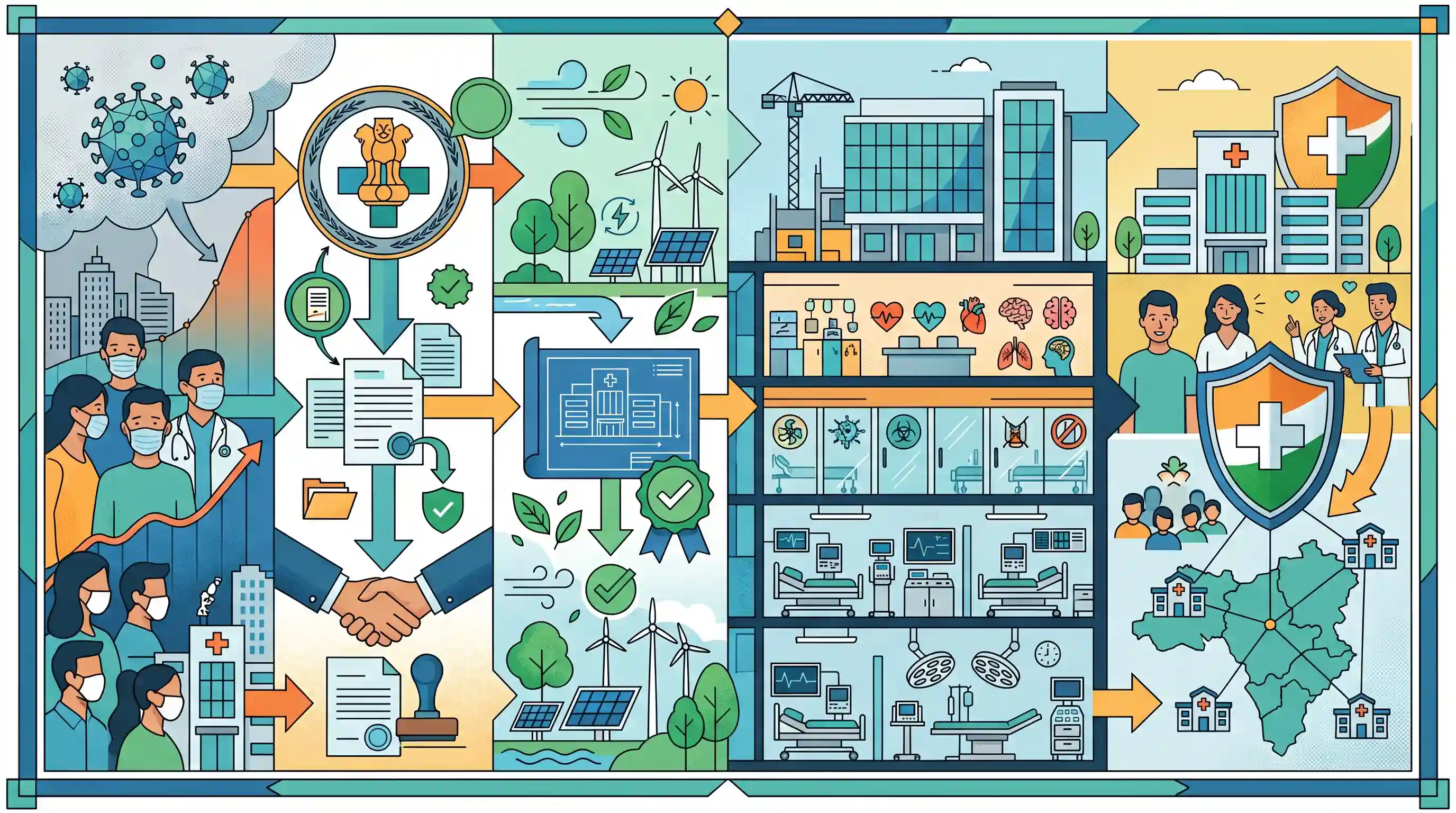
Demonstrates the on-ground implementation of national health schemes (PM-ABHIM) to build resilient public health infrastructure, while also highlighting how administrative bottlenecks like environmental clearances can delay critical capacity-building projects.
Summary
The Post Graduate Institute of Medical Education & Research (PGIMER) in Chandigarh is set to commence construction of a 150-bed Critical Care Block after securing long-awaited environmental clearance. Approved by the Centre under the PM-ABHIM scheme, the facility was conceptualised in the wake of the Covid-19 pandemic to enhance preparedness for infectious disease outbreaks and public health emergencies. The multi-speciality centre will house intensive care units, isolation wards, and surgical units, significantly upgrading the region's public healthcare infrastructure.
Key Points
- PGIMER Chandigarh has received environmental clearance to begin construction on a new 150-bed Critical Care Block, a project delayed by administrative hurdles.
- The critical care facility was conceptualised during the Covid-19 pandemic to bolster emergency response capacity for infectious disease outbreaks.
- The project is funded and approved by the Centre under the Pradhan Mantri Ayushman Bharat Health Infrastructure Mission (PM-ABHIM).
- Once operational, it will function as a multispeciality centre with ICUs, isolation wards, and surgical units, easing the burden on other clinical areas during public health emergencies.
Important Terms
PM-ABHIM (Pradhan Mantri Ayushman Bharat Health Infrastructure Mission)

A pan-India scheme launched in 2021 to strengthen healthcare infrastructure and surveillance at primary, secondary, and tertiary levels, ensuring pandemic preparedness and self-reliance in health crises.
UPSC context
GS Paper II: Government Schemes; tests knowledge of social sector initiatives and health infrastructure development.
Environmental Clearance
Mandatory administrative procedure under the Environment Impact Assessment (EIA) Notification, 2006, requiring developmental projects to evaluate and mitigate their impact on the environment before starting construction.
UPSC context
GS Paper III: Environmental Impact Assessment; tests understanding of regulatory frameworks for sustainable development.
PGIMER (Post Graduate Institute of Medical Education & Research)
A premier medical and research "Institute of National Importance" in Chandigarh. Established as an autonomous body under an Act of Parliament to provide high-quality tertiary healthcare and medical education.
UPSC context
GS Paper II: Health Infrastructure; tests familiarity with statutory bodies and premier public health institutions.
Critical Care Hospital Block (CCB)
Specialized tertiary-care units established under PM-ABHIM to manage infectious diseases and critical illnesses, enhancing hospital capacity for future outbreaks through isolated beds and ICUs.
UPSC context
GS Paper II: Health Sector; tests understanding of pandemic preparedness and specialized medical infrastructure.
HSCC (Hospital Services Consultancy Corporation Limited)
A Mini Ratna PSU and subsidiary of NBCC specializing in consultancy and project management for healthcare infrastructure projects in India and abroad.
UPSC context
GS Paper II: Role of Public Sector Undertakings; tests knowledge of agencies implementing major government infrastructure projects.
Prelims Trap
PM-ABHIM is a purely Centrally Sponsored Scheme focused exclusively on primary health centres.
PM-ABHIM includes both Centrally Sponsored and Central Sector components. Furthermore, it specifically targets tertiary infrastructure like 50-150 bed 'Critical Care Blocks', not just primary care.
Static Concepts Connected
What are the core components of PM-Ayushman Bharat Health Infrastructure Mission?
- Primary Care: Support for establishing rural and urban Health and Wellness Centres to strengthen primary care.
- Critical Care Blocks: Creating exclusive Critical Care Hospital Blocks (50-150 beds) in all districts with a population over 5 lakhs.
- Diagnostic Network: Setting up Integrated Public Health Labs (IPHLs) in all districts for comprehensive diagnostic services.
- Surveillance & Research: Establishing a national institution for One Health, regional NIVs, and strengthening the NCDC.
How does the EIA framework regulate large construction projects?
- Statutory Basis: The Environmental Impact Assessment (EIA) Notification is issued under the powers of the Environment (Protection) Act, 1986.
- Categorisation: Building and construction projects typically fall under Category B, which are appraised by State-level authorities (SEIAA) rather than the Centre.
- Area Threshold: Clearance is mandatory for construction projects with a built-up area exceeding 20,000 square meters.
Cross-Topic Patterns
Public Health vs. Green Clearances
The delay of critical public health projects due to EIA clearance highlights the recurring governance friction between rapid emergency infrastructure deployment and statutory environmental compliance.
Post-Covid Health Architecture
PM-ABHIM shifts focus from mere demand-side insurance (PM-JAY) to supply-side physical asset creation, directly addressing the systemic lack of ICUs and isolation wards exposed during the pandemic.

Expect a multi-statement Prelims question merging PM-ABHIM's funding structure (Central Sector + Sponsored) with EIA statutory backing.
Linked PYQs · 3
Linked PYQs · 3
- 2024MainsGS2
In a crucial domain like the public healthcare system the Indian State should play a vital role to contain the adverse impact of marketisation of the system. Suggest some measures through which the State can enhance the reach of public healthcare at the grassroots level.
- 2021MainsGS2
“Besides being a moral imperative of a Welfare State, primary health structure is a necessary precondition for sustainable development.” Analyze.
- 2014MainsGS3
Environmental Impact Assessment studies are increasingly undertaken before a project is cleared by the Government. Discuss the environmental impacts of coal-fired thermal plants located at coal pitheads.
