High tech manufacturing growth surges industrial water demand
Source:The Hindu ↗
ఇది ఎందుకు ముఖ్యం
It highlights an often-overlooked constraint in high-tech manufacturing: water intensity. As India pushes for semiconductor fabrication and solar manufacturing, sustainable industrial wastewater management and ultrapure water provision become critical infrastructure requirements.
సారాంశం
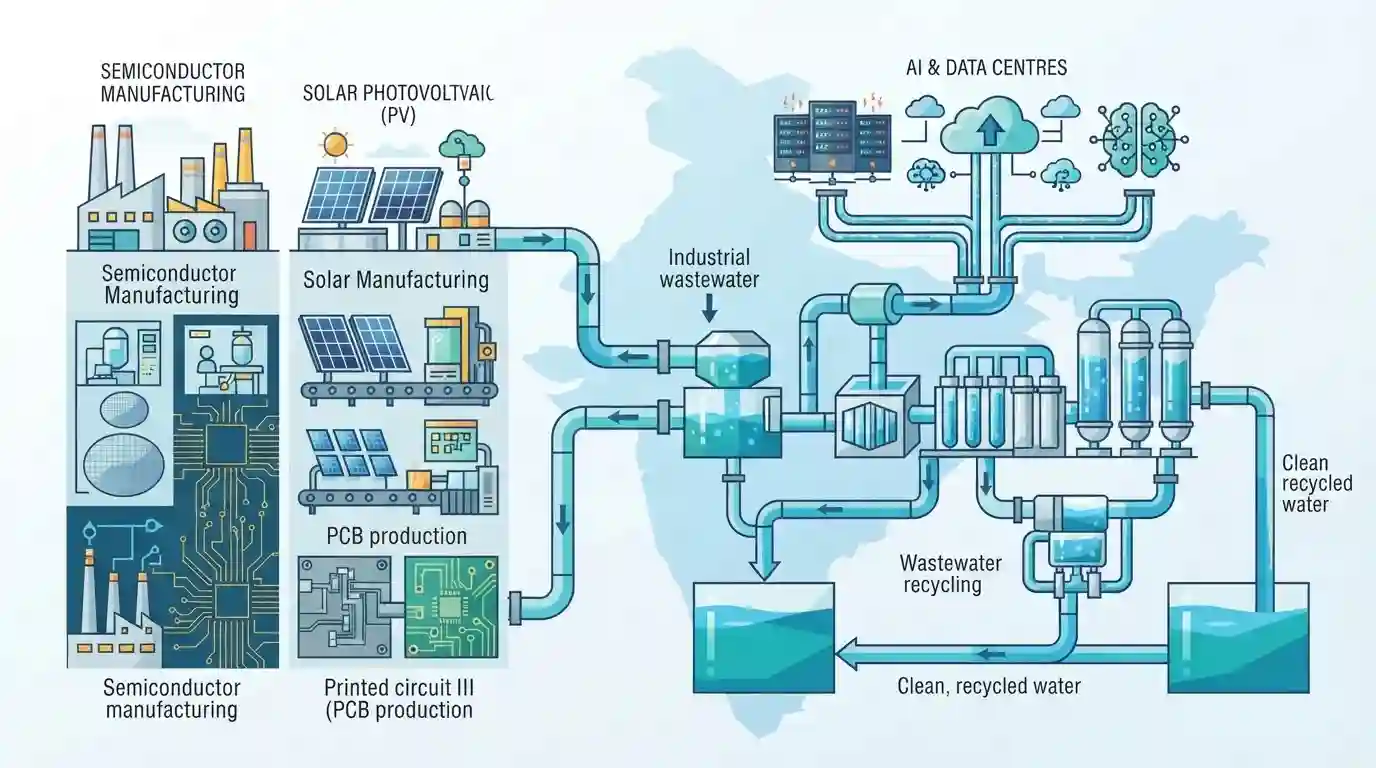
Industrial water technology company Gradiant anticipates its India business to double next year, fuelled by the expanding semiconductor, solar photovoltaic, and printed circuit board (PCB) manufacturing sectors. These high-tech industries, particularly semiconductor fabrication, are highly water-intensive, requiring massive volumes of ultrapure water and complex wastewater recycling systems. Additionally, the proliferation of AI-driven data centres is intensifying the demand for advanced water-cooling solutions. The trend underscores the critical intersection of sustainable water management and India's ambitions to become a global electronics manufacturing hub.
ముఖ్య అంశాలు
- Industrial water technology firm Gradiant expects its India business to double next year, driven by high-tech manufacturing growth.
- Semiconductor, printed circuit board (PCB), and solar photovoltaic manufacturing require significant amounts of ultrapure water and wastewater treatment systems.
- The rise of AI has increased the power density of data centres, driving demand for advanced water cooling solutions.
- Gradiant runs a 250-employee Global Engineering Centre from Chennai and Coimbatore.
- The expansion highlights the critical role of sustainable industrial water management in scaling India's electronics and semiconductor manufacturing ecosystems.
ముఖ్యమైన పదాలు
Gradiant

An industrial water technology company and unicorn, founded at MIT, specializing in advanced wastewater treatment, water recycling, ultrapure water systems, and zero liquid discharge solutions for high-tech industries.
UPSC context
GS Paper III (Economy/Industry); tests sustainable manufacturing practices and water infrastructure in advanced manufacturing.
Massachusetts Institute of Technology (MIT)
A premier global research university in the US, known for technology, engineering, and scientific research, acting as an incubator for cutting-edge climate-tech and clean-water academic spin-offs.
UPSC context
GS Paper III (Science and Technology); tests models of industry-academia collaboration and technology-led entrepreneurship.
Ultrapure Water (UPW)
Water purified to extreme standards (resistivity >18.2 MΩ·cm) with near-zero organic and particulate contaminants, essential for cleaning silicon wafers and ensuring high yields in semiconductor fabrication.
UPSC context
GS Paper III (Science & Tech/Infrastructure); tests understanding of key manufacturing constraints and ecological strains of semiconductor fabs.
Zero Liquid Discharge (ZLD)
An industrial wastewater management system that treats and recycles all wastewater within a facility, converting contaminants to solid waste and completely preventing liquid effluent discharge.
UPSC context
GS Paper III (Environment/Industrial Policy); tests knowledge of industrial pollution standards, water conservation, and circular economy principles.
India Semiconductor Mission (ISM)
A specialized division under MeitY launched to build a sustainable and globally competitive semiconductor and display manufacturing ecosystem in India through robust financial and policy incentives.
UPSC context
GS Paper III (Industrial Policy); tests understanding of strategic schemes targeting domestic high-tech manufacturing and electronic import substitution.
ప్రిలిమ్స్ ఉచ్చు
A higher Water Usage Effectiveness (WUE) ratio in a data center indicates superior water conservation and environmental efficiency.
WUE measures water consumed per kWh of IT energy. A lower ratio (approaching 1.0) indicates high efficiency; a higher ratio means excessive water waste.
అనుసంధానమైన స్థిర భావనలు
What is Zero Liquid Discharge (ZLD)?
- Process objective: Recycles all industrial wastewater, leaving only solid waste and producing zero liquid effluent.
- Primary technologies: Combines membrane filtration (Reverse Osmosis) with thermal evaporation and crystallization to recover clean water.
- Regulatory application: Mandated by CPCB for water-intensive and highly polluting industrial sectors to prevent freshwater resource degradation.
What is Ultrapure Water (UPW)?
- Extreme purification: Purified to high resistivity (18.2 MΩ·cm) to remove all dissolved gases, minerals, and micro-particles.
- Semiconductor cleaning: Serves as a microscopic solvent in chip fabs to clean wafers without depositing ionic contaminants.
- Consumption hazard: Highly unsafe for human drinking as its extreme mineral-deficit state actively leaches essential electrolytes from the body.
అంతర-అంశ నమూనాలు
Tech Manufacturing vs Hydrological Footprint
Connects GS-3 Electronics Manufacturing with GS-1 Resource Distribution. Semiconductor fabs require millions of gallons of water daily, intensifying competition over stressed urban aquifers.
Data Governance vs Ecological Capacity
Links GS-2 federalism with GS-3 environmental conservation. State incentives granting data centers priority water access risk bypassing local groundwater sustainability guidelines.

Tech manufacturing's water-intensity (semiconductors/AI data centers) vs regional water stress is highly ripe for GS-3 critical analysis.
అనుసంధాన PYQలు · 3
అనుసంధాన PYQలు · 3
- 2024MainsGS3
Industrial pollution of river water is a significant environmental issue in India. Discuss the various mitigation measures to deal with this problem and also the government's initiatives in this regard.
- 2025MainsGS3
India aims to become a semiconductor manufacturing hub. What are the challenges faced by the semiconductor industry in India? Mention the salient features of the India Semiconductor Mission.
- 2020MainsGS3
Describe the benefits of deriving electric energy from sunlight in contrast to the conventional energy generation. What are the initiatives offered by our Government for this purpose?
