India EU FTA defends against opposition concerns over trade terms
Source:The Hindu ↗
Why It Matters
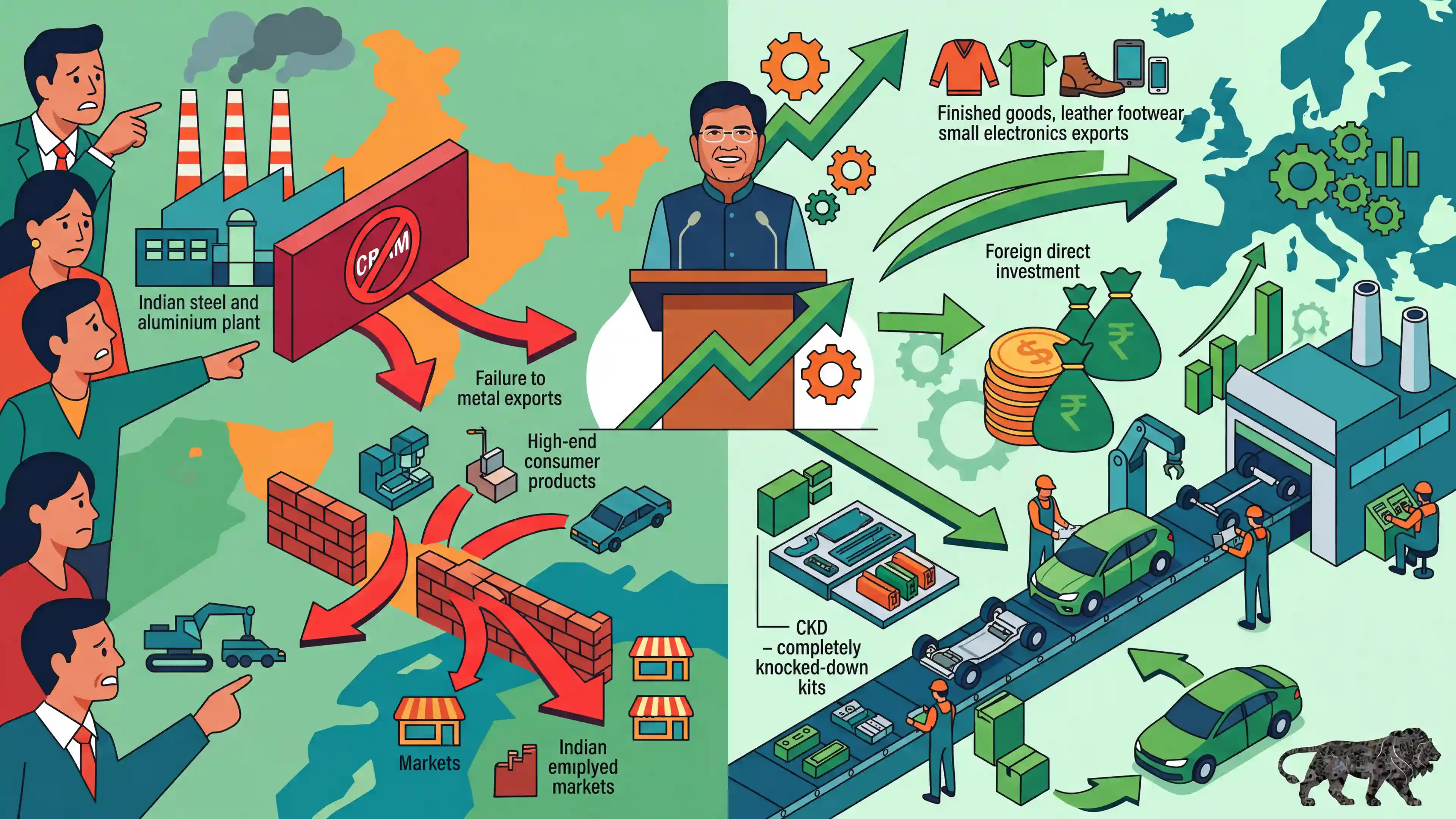
The India-EU FTA represents a monumental shift in India's trade policy, opening up massive markets for Indian exports while requiring careful management of domestic manufacturing (especially in autos) and emerging non-tariff environmental barriers like CBAM.
Summary
Commerce and Industry Minister Piyush Goyal has strongly defended the newly negotiated India-EU Free Trade Agreement against criticisms from the Congress party. While the opposition raised concerns over the failure to secure exemptions from the EU's Carbon Border Adjustment Mechanism (CBAM) for Indian steel and aluminium, as well as sweeping tariff reductions for EU goods, Goyal framed the deal as a 'win-win' economic milestone. He emphasized that $33 billion of India’s labour-intensive exports will enjoy zero-duty access immediately. Additionally, Goyal detailed how strategic tariff reductions on completely knocked-down (CKD) vehicle imports and phased electric vehicle provisions will incentivize European automakers to set up local assembly lines, ultimately boosting domestic manufacturing and the 'Make in India' initiative.
Key Points
- Commerce Minister Piyush Goyal defended the India-EU FTA against Congress criticisms regarding tariffs, market access, and the EU's Carbon Border Adjustment Mechanism (CBAM).
- The deal eliminates duties on day one for $33 billion worth of India's labour-intensive exports, leveraging complementary economies with a combined GDP of $25 trillion.
- The Congress flagged concerns that India failed to secure exemptions from the EU's CBAM for Indian aluminium and steel makers.
- Goyal highlighted that the FTA addresses the auto sector strategically: by liberalizing imports on a quota basis and significantly dropping duties on completely knocked down (CKD) units, it incentivizes EU automakers to transition from exporting to localizing assembly in India under the 'Make in India' initiative.
- The FTA features a phased approach to EV imports, with a 5-year lag, giving domestic industries time to mature while ensuring technology transfer and higher manufacturing standards.
Important Terms
Carbon Border Adjustment Mechanism (CBAM)

A trade-linked climate policy imposing carbon taxes on carbon-intensive imports like steel and aluminum. It prevents 'carbon leakage' by aligning import prices with the EU’s domestic carbon costs.
UPSC context
GS Paper 3 (Environment/Economy); tests understanding of non-tariff barriers and climate justice (CBDR).
India-EU Free Trade Agreement (FTA)
A comprehensive economic agreement concluded in 2026 to eliminate tariffs on over 90% of trade lines. It covers goods, services, and investments, aiming to double bilateral trade.
UPSC context
GS Paper 2 (International Relations); focuses on bilateral agreements and strategic global partnerships.
Make in India
A flagship industrial policy launched in 2014 to transform India into a global manufacturing hub. It targets 27 sectors to increase manufacturing's GDP share to 25%.
UPSC context
GS Paper 3 (Industrial Policy); assesses strategies for FDI, job creation, and manufacturing growth.
Completely Knocked-Down (CKD)
An assembly process where vehicles are imported as fully disassembled kits for local reassembly. This attracts lower customs duties compared to Completely Built Units (CBUs), promoting domestic industrialization.
UPSC context
GS Paper 3 (Economy/Manufacturing); tests knowledge of trade classifications and manufacturing incentives.
European Union (EU)
A political and economic union of 27 member states and India’s second-largest trading partner. It collaborates with India on climate, technology, and a rules-based international order.
UPSC context
GS Paper 2 (International Relations); evaluates India’s engagement with major regional blocs and global trade.
Labour-Intensive Exports
Export sectors requiring high human labor relative to capital, such as textiles and leather. These are prioritized in trade deals to drive mass employment.
UPSC context
GS Paper 3 (Economy); important for employment-led growth and inclusive export strategies.
Prelims Trap
The India-EU FTA provides Indian steel and aluminium exporters a complete exemption from the EU's Carbon Border Adjustment Mechanism (CBAM).
India actively sought but failed to secure CBAM exemptions in these negotiations. The EU's carbon tax will still apply to Indian metals.
Static Concepts Connected
What is the EU's Carbon Border Adjustment Mechanism (CBAM)?
- Carbon tax: A tariff on carbon-intensive products (e.g., steel, aluminium, cement, fertilizer) imported into the EU, to equalize the carbon price paid by domestic vs. foreign producers.
- Anti-Carbon Leakage: It aims to prevent companies from moving production to countries with weaker climate rules to avoid EU carbon costs.
- Impact on India: It deeply impacts India's export-oriented metal sectors, which rely on coal-heavy energy grids, reducing their price competitiveness in Europe.
How do CKD vs CBU tariffs drive the 'Make in India' initiative?
- CBU Tariffs: Completely Built Units (fully assembled imported vehicles) attract peak customs duties to discourage direct imports and protect domestic players.
- CKD Tariffs: Completely Knocked Down kits (unassembled parts) face lower tariffs, directly incentivizing foreign original equipment manufacturers (OEMs) to set up local assembly lines.
- Spillover benefits: Local assembly mandates lead to technology transfers, ancillary auto-component ecosystem growth, and job creation in manufacturing hubs.
Cross-Topic Patterns
CBAM vs. Climate Equity (CBDR)
India often argues that the EU's unilateral CBAM violates the UN climate convention's core principle of Common But Differentiated Responsibilities (CBDR) by taxing developing nations at developed-world carbon prices.
EV Phase-ins & Infant Industry Protection
The 5-year lag for EV tariff reductions acts as a modern "infant industry" protection measure, allowing domestic capacity and the PLI-backed component ecosystem to scale before facing direct EU competition.
Export Tariffs & Demographic Dividend
Zero-duty access for sectors like textiles and leather is vital for absorbing India's semi-skilled workforce, making FTAs a primary vehicle for realizing the demographic dividend.

Expect a multi-statement Prelims question comparing the WTO-compatibility of EU's CBAM with India's defense using UNFCCC's CBDR principle.
Linked PYQs · 3
Linked PYQs · 3
- 2017PrelimsGS1
'Broad-based Trade and Investment Agreement (BTIA)' is sometimes seen in the news in the context of negotiations held between India and
- 2023MainsGS3
Faster economic growth requires increased share of the manufacturing sector in GDP, particularly of MSMEs. Comment on the present policies of the Government in this regard.
- 2023PrelimsGS1
Consider the following statements: Statement-I: Recently, the United States of America (USA) and the European Union (EU) have launched the 'Trade and Technology Council'. Statement-II: The USA and the EU claim that through this they are trying to bring technological progress and physical productivity under their control. Which one of the following is correct in respect of the above statements?
