Atomic Energy Act amendment to open nuclear sector to private players
Source:Indian Express ↗
Why It Matters
It marks a historic paradigm shift in India's energy policy by opening the highly sensitive nuclear sector to private capital. This is highly relevant for GS-3 discussions on overcoming energy deficits, transitioning to clean baseload power, funding infrastructure (SMRs), and meeting India's Net-Zero 2070 commitments.
Summary
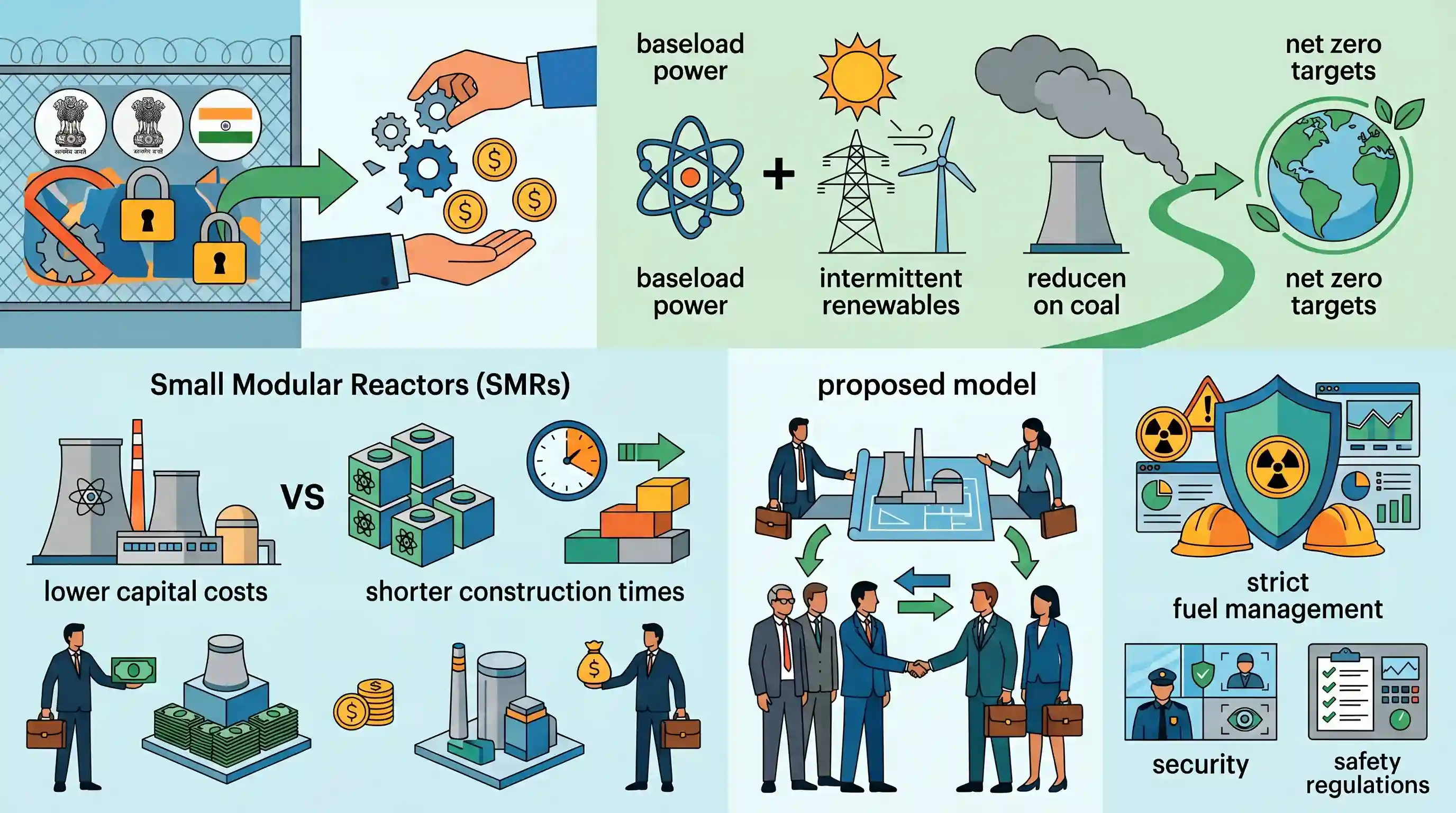
The Union Cabinet has cleared a crucial amendment to the Atomic Energy Act, 1962, aiming to open India’s historically state-controlled nuclear power sector to private investment. This reform is seen as vital for scaling up nuclear capacity to secure clean "baseload power"—a reliable, round-the-clock energy source needed to complement intermittent renewables (like solar and wind) and reduce dependence on coal. The move is particularly focused on facilitating the deployment of Small Modular Reactors (SMRs), which involve lower capital costs and shorter construction times, making them attractive for private capital. Under the proposed model, private players will be able to form joint ventures with state entities (such as NPCIL) to fund and build reactors, while the government continues to strictly manage nuclear fuel, security, and safety regulations.
Key Points
- The Union Cabinet has cleared a pivotal amendment to the Atomic Energy Act, 1962, to permit private sector investment and participation in nuclear power generation.
- Nuclear power provides essential 'baseload energy'—steady, 24/7 power—necessary to complement intermittent renewable sources like solar and wind and replace coal in the grid.
- A major driver for this policy shift is the deployment of Small Modular Reactors (SMRs), which are compact, scalable, and require less upfront capital, making them highly suitable for private partnerships.
- The amendment aims to mobilize vast private capital to scale up India's nuclear capacity, a critical requirement for achieving the Net-Zero emissions target by 2070.
- Private companies will likely partner with public sector entities (like NPCIL), while the government will retain strict control over nuclear fuel handling, security, and overall regulatory oversight via AERB.
Important Terms
Atomic Energy Act, 1962

The principal legislation governing nuclear energy in India, historically mandating exclusive state control over nuclear fuel, plant operations, and radioactive waste management. Recent reforms seek to amend it for private sector participation.
UPSC context
GS-III (Energy) and GS-II (Statutory Framework); tests understanding of strategic sector reforms and legislative barriers to energy security.
Small Modular Reactors (SMRs)
Advanced nuclear reactors with power capacities up to 300 MW, characterized by modular designs, shorter construction times, and enhanced safety features. They are ideal for private investment and decentralized energy needs.
UPSC context
GS-III (Science & Technology/Environment); relevant for net-zero targets and technological innovation in clean energy.
Nuclear Power Corporation of India Limited (NPCIL)
A central Public Sector Undertaking (PSU) under the Department of Atomic Energy (DAE) responsible for the design, construction, and operation of India's commercial nuclear power plants.
UPSC context
GS-III (Infrastructure); tests knowledge of institutional roles in managing India’s strategic energy assets.
Atomic Energy Regulatory Board (AERB)
India’s national nuclear regulator constituted under the Atomic Energy Act. It enforces safety and regulatory standards for nuclear and radiation installations to protect public health and the environment.
UPSC context
GS-II (Statutory/Regulatory Bodies) and GS-III (Disaster Management); tests knowledge of nuclear safety governance.
Baseload Power
The continuous, minimum level of electricity demand on a power grid. Nuclear energy is considered a vital clean baseload source because it provides steady, 24/7 power unlike intermittent renewables.
UPSC context
GS-III (Infrastructure/Energy); essential for understanding grid stability and the energy transition mix.
SHANTI Bill, 2025
Reported 2025 legislation aimed at consolidating nuclear laws, granting statutory status to the AERB, and allowing private/foreign participation in nuclear plant operations and power generation.
UPSC context
GS-II (Government Policies) and GS-III (Economic Reforms); tests knowledge of current legislative shifts in strategic sectors.
Prelims Trap
The amendment permits private entities to handle nuclear fuel and independently manage nuclear reactor operations.
Private players will only fund and build reactors (often via JVs with PSUs). The government retains an absolute monopoly over nuclear fuel management, safety regulations, and physical security.
Static Concepts Connected
What are Small Modular Reactors (SMRs) and their advantages over conventional nuclear reactors?
- Size & Cost: Up to 300 MW(e) capacity per unit, physically a fraction of the size of conventional nuclear power reactors, requiring less upfront capital.
- Modularity: Systems and components can be factory-assembled and easily transported as a single unit to a location for installation, reducing construction delays.
- Passive Safety: Often rely on passive safety systems that operate via natural circulation and gravity, requiring no human intervention or external power to shut down.
What is the difference between 'baseload' and 'intermittent' power in electricity grid management?
- Baseload Power: Energy sources that provide continuous, reliable, 24/7 electricity to meet the minimum demand of the grid (e.g., Coal, Nuclear).
- Intermittent Power: Energy sources whose output fluctuates based on environmental and weather conditions, creating variable supply (e.g., Solar, Wind).
- Grid Stability: Baseload power acts as a steady anchor, preventing grid collapse and frequency mismatches when renewable generation suddenly drops.
Cross-Topic Patterns
SMRs as the bridge to Net-Zero 2070
India's Panchamrit targets require phasing down coal. Since renewables are intermittent, nuclear SMRs provide the essential clean baseload needed to maintain grid stability without greenhouse gas emissions.
Privatization of core strategic sectors
Like recent space sector reforms (IN-SPACe), this marks a policy shift where the state moves from monopoly operator to enabler, retaining core sovereign functions like security and fuel control.

Expect a 2026 Prelims multi-statement question contrasting SMRs with conventional reactors, focusing on passive safety and ownership limits.
Linked PYQs · 5
Linked PYQs · 5
- 2020PrelimsGS1
In India, why are some nuclear reactors kept under "IAEA Safeguards" while others are not?
- 2018MainsGS3
“Access to affordable, reliable, sustainable and modern energy is the sine qua non to achieve Sustainable Development Goals (SDGs).” Comment on the progress made in India in this regard.
- 2017MainsGS3
Give an account of the growth and development of nuclear science and technology in India. What is the advantage of fast breeder reactor programme in India?
- 2013MainsGS1
With growing scarcity of fossil fuels, the atomic energy is gaining more and more significance in India. Discuss the availability of raw material required for the generation of atomic energy in India and in the world.
- 2021MainsGS3
“Investment in infrastructure is essential for more rapid and inclusive economic growth.” Discuss in the light of India's experience.
