Selective construction bans spark debates on hill town planning rules
Source:himachalscape ↗
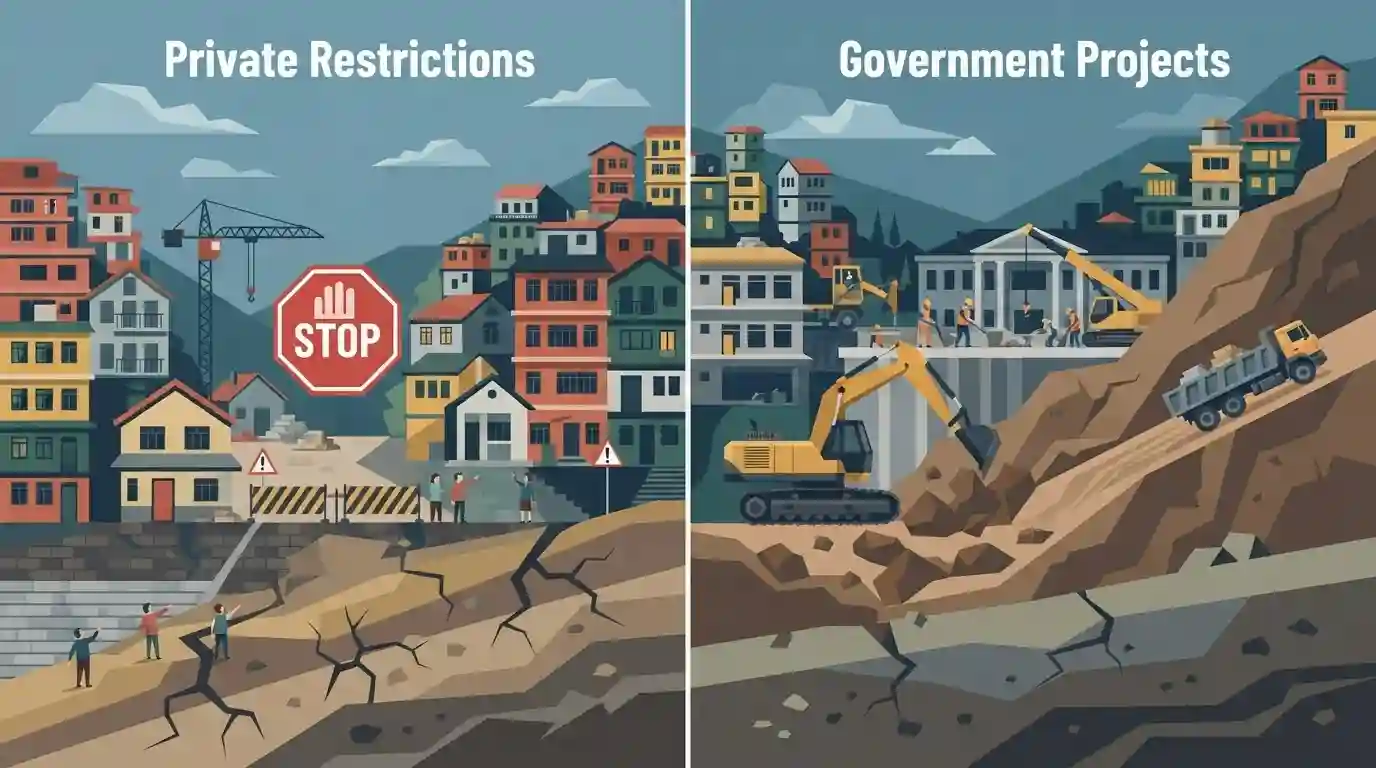
Why It Matters
The contradiction in implementing environmental regulations in hill stations is a pressing issue for sustainable urban development and disaster management in Himachal Pradesh. It serves as a prime case study for the challenges of enforcing Town and Country Planning policies while dealing with fragile Himalayan ecology and natural disaster vulnerability.
Summary
The Himachal Pradesh Town and Country Planning Department's proposal to declare heavily congested parts of Shimla as 'no-construction zones' for private citizens has faced criticism due to selective enforcement. While private construction is restricted citing ecological fragility and the threat of subsidence, government agencies continue large-scale excavations and infrastructure projects in the same vulnerable areas, exacerbating landslide risks and undermining environmental safety.
Key Points
- The HP Town and Country Planning Department has proposed to declare congested core areas of Shimla as 'no-construction zones' for private citizens to prevent ecological degradation.
- Despite these regulations citing ecological fragility, government agencies continue large-scale excavations, hill cutting, and infrastructure projects in the same vulnerable areas (e.g., duct construction between Chhota Shimla and Mall Road).
- Such unchecked governmental construction activities in subsidence-prone areas, especially during monsoons, have heightened the risk of landslides and slope instability, undermining the region's environmental safety.
- The selective enforcement of rules highlights the need for a unified, strictly enforced urban planning and disaster management policy that applies uniformly to both private individuals and government entities to safeguard Shimla's fragile Himalayan ecology.
Important Terms
Himachal Pradesh Town and Country Planning Act, 1977

A state legislation regulating land use, regional planning, and development. It establishes planning areas and development authorities but typically exempts state and central government operational construction from seeking standard planning permissions.
UPSC context
GS-2 (State Legislation) & GS-3 (Urban Planning). Tests understanding of regulatory gaps and the legal frameworks governing Himalayan urbanization.
Himachal Pradesh Town and Country Planning Department
The state nodal agency responsible for drafting urban development plans, regulating land-use, and notifying eco-sensitive 'no-construction zones' to prevent haphazard urbanization in Himachal Pradesh.
UPSC context
GS-2 (State Agencies). Relevant for evaluating the administrative capacity and policy contradictions of urban planning bodies in disaster-prone hill states.
Shimla Development Plan-2041
A GIS-based spatial plan aiming to regulate construction, expand green belts, and sustainably manage Shimla’s population growth till 2041, recently approved by the Supreme Court over previous NGT bans.
UPSC context
GS-3 (Urbanization, Environment). Acts as a vital case study for balancing infrastructure growth with ecological conservation in fragile Himalayan ecosystems.
No-construction Zones
Environmentally sensitive or heavily congested urban areas where new private construction is legally prohibited to preserve green cover, natural drainage, and prevent geological disasters like landslides.
UPSC context
GS-3 (Disaster Management, Environment). Tests knowledge of spatial planning tools used to mitigate urban vulnerability to natural hazards.
Land Subsidence
The gradual settling or sudden sinking of the Earth's surface due to subsurface movement. In Himalayan towns, it is heavily exacerbated by unplanned excavations, disrupted natural drainage, and heavy rainfall.
UPSC context
GS-1 (Geophysics) & GS-3 (Disaster Management). Essential concept for understanding geological hazards affecting structurally fragile hill stations.
Prelims Trap
"The NGT's 2017 blanket ban on construction in Shimla's core and green belts was upheld by the Supreme Court."
The Supreme Court actually set aside the NGT’s blanket ban in 2024, approving the state's Shimla Development Plan 2041 under its statutory powers.
Static Concepts Connected
What is 'Carrying Capacity' in the context of Himalayan urban ecology?
- Definition: The maximum population size and infrastructure footprint a specific environment can sustainably support without undergoing permanent ecological degradation.
- Himalayan Context: Crucial for hill towns to assess limits on slope stability, groundwater extraction, and waste disposal to prevent events like land subsidence.
- Judicial Mandate: The Supreme Court has recently pushed for evaluating the carrying capacity of all 13 states/UTs in the Indian Himalayan Region (IHR).
What are the core NDMA guidelines for landslide risk mitigation?
- Hazard Zonation: Mandates micro-zonation and landslide hazard mapping at a 1:10,000 scale to guide safe urban planning and zoning.
- Slope Modification: Restricts unchecked hill-cutting; mandates scientific retaining walls and proper surface drainage to prevent water seepage into fractured rock strata.
- Uniform Enforcement: Building codes, load-bearing assessments, and land-use regulations must be applied uniformly across both private buildings and public infrastructure projects.
Cross-Topic Patterns
Carrying Capacity vs Statutory Powers
The SC overturning the NGT's blanket ban highlights the tension between strict ecological preservation mandates and the statutory powers of states to draft and execute their own town planning policies.
Public vs Private Hazard Paradox
Exempting large government infrastructure from 'no-construction' bans contradicts NDMA mandates, showcasing how selective urban governance can directly exacerbate land subsidence and slope destabilization risks.

Carrying capacity of Himalayan towns combined with NDMA landslide guidelines and NGT vs SC town planning powers is a high-prob GS-3 theme.
Linked PYQs · 3
Linked PYQs · 3
- 2020HPAS_PRELIMSGS1
Consider the given four statements and choose the correct answer from the given options. Select the true statements from the following: 1. Chamba, Kullu and Kinnaur are considered the most susceptible of landslide threat. 2. Una, Bilaspur, Sirmaur, Shimla and Solan are considered as low vulnerable of disaster threats. 3. Hum valley of Una district has hardly any natural drinking water source. 4. As per the study of central water board, Kala Amb valley in Sirmaur district has exploited the least underground water.
- 2020HPAS_PRELIMSGS1
Which of the following is / are correct about the Himachal Pradesh Town | Country Planning Act-1977? 1. It has been enforced in 55 Planning areas. 2. Planning area constitutes to 1.60 % of the total geographical area of the state. 3. The above act is enforced in 35 special areas of Himachal Pradesh. 4. 2.06% area of the total geographical area of the state comes under special area.
- 2018HPAS_PRELIMSGS1
The impacts caused by construction of dams and reservoirs include all, except :
