Carbon Capture Utilization and Storage Funding for Decarbonization
Source:Indian Express ↗
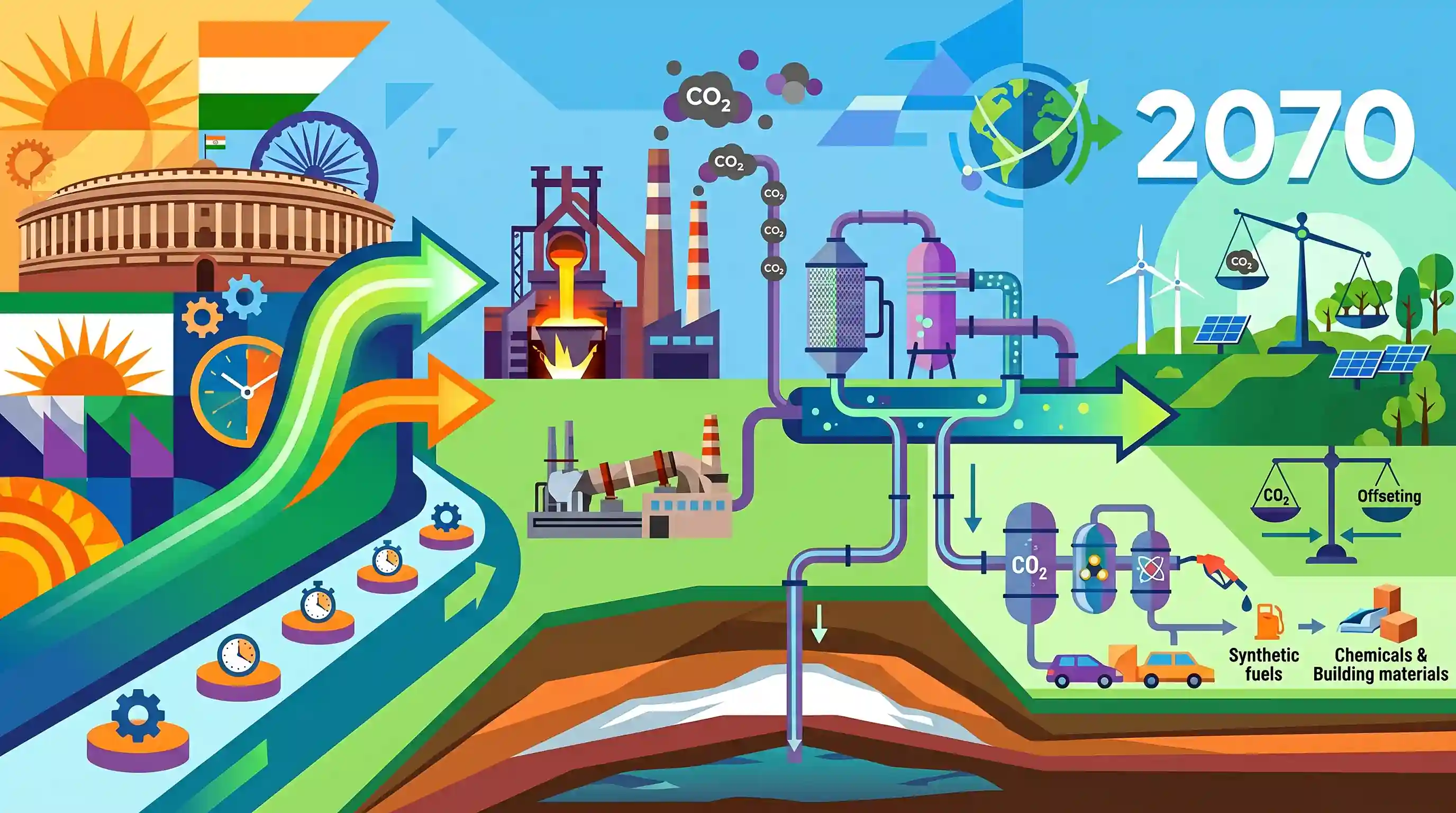
Why It Matters
CCUS is increasingly recognized as an essential technology for global decarbonization, specifically for heavy industries. Government funding addresses the high capital costs associated with CCUS, making its development a crucial topic for GS3 Environment and Science & Technology.
Summary
The Government of India is set to invest Rs 20,000 crore over the next five years to advance Carbon Capture, Utilization, and Storage (CCUS) technologies. This substantial financial backing aims to significantly reduce carbon emissions from hard-to-abate sectors like steel and cement, making it a cornerstone of India's strategy to meet its net-zero emissions target by 2070.
Key Points
- The Indian government plans to invest Rs 20,000 crore over five years to promote Carbon Capture, Utilization, and Storage (CCUS) technologies.
- CCUS is vital for decarbonizing "hard-to-abate" industrial sectors such as steel, cement, and thermal power, where direct electrification is currently difficult.
- The technology involves capturing CO2 emissions at the source and either utilizing them in industrial processes or storing them permanently underground.
- This financial commitment is a strategic step towards fulfilling India's climate goals, particularly the target of achieving net-zero emissions by 2070.
Important Terms
Carbon Capture, Utilization, and Storage (CCUS)

Technologies that capture CO2 from industrial or power sources to be reused in products (like chemicals) or permanently stored underground in geological formations to prevent atmospheric release.
UPSC context
GS3: Environment & Science and Technology. Tests knowledge of emerging mitigation technologies and industrial emission reduction strategies.
Hard-to-abate sectors
Industries like steel, cement, and chemicals where emissions result from chemical reactions or high-temperature heat requirements, making them technically and economically difficult to decarbonize through electrification alone.
UPSC context
GS3: Economy & Environment. Focuses on industrial policy and challenges in achieving net-zero targets.
Net Zero 2070
India's commitment, announced at COP26, to reach carbon neutrality by 2070, ensuring all greenhouse gas emissions are balanced by removal through carbon sinks or technology.
UPSC context
GS3: Environment. A cornerstone of India's climate change policy and international commitments under the Paris Agreement.
Panchamrita
The five-fold climate action strategy announced by India at COP26, including targets for non-fossil energy capacity, renewable energy share, emission reductions, and carbon intensity.
UPSC context
GS3: Environment. Tests awareness of India's official climate roadmap and Nationally Determined Contributions (NDCs).
Decarbonization
The systematic process of reducing or eliminating carbon dioxide emissions from a country's economy, particularly in the energy, transportation, and industrial manufacturing sectors.
UPSC context
GS3: Environment & Economy. Fundamental strategy for sustainable development and energy transition.
Prelims Trap
"CCUS technologies primarily capture historical CO2 directly from the atmosphere to reverse global warming."
Standard CCUS captures emissions at the source (industrial smokestacks) before release. Capturing ambient air is Direct Air Capture (DAC), a distinct and costlier technology.
Static Concepts Connected
Why are industries like cement and steel termed 'hard-to-abate'?
- Chemical Process emissions: In cement manufacturing, the calcination of limestone intrinsically releases CO2 as a byproduct, independent of the fuel source used.
- High Heat demand: These industries require extremely high temperatures historically achieved only through fossil fuels, making direct renewable electrification highly difficult.
- Long-term lock-in: Capital-heavy industrial plants have multi-decade lifespans, causing infrastructure 'carbon lock-in' unless retrofitted with CCUS.
Where is captured carbon permanently stored geologically under CCUS?
- Saline Aquifers: Deep underground porous rock formations filled with unpotable brine, offering the largest potential carbon storage capacity globally.
- Depleted Oil/Gas Fields: Old fossil-fuel reservoirs where injected CO2 can be securely trapped, sometimes simultaneously aiding in Enhanced Oil Recovery (EOR).
- Unmineable Coal Seams: Deep coal seams where CO2 is adsorbed, which is sometimes utilized for Enhanced Coal Bed Methane (ECBM) recovery.
Cross-Topic Patterns
CCUS & Circular Carbon Economy
The 'U' in CCUS links directly to circular economy frameworks by converting captured industrial CO2 into value-added products like green urea, methanol, and sustainable building materials.
Green Hydrogen + CCUS synergies
Decarbonizing heavy industry uses a dual approach: Green Hydrogen as a clean reducing agent to replace coking coal, and CCUS to capture unavoidable chemical emissions from legacy plants.

Expect a 2026 question contrasting industrial point-source CCUS with Direct Air Capture, emphasizing its role in hard-to-abate sectors.
Linked PYQs · 2
Linked PYQs · 2
- 2025MainsGS3
What is Carbon Capture, Utilization and Storage (CCUS)? What is the potential role of CCUS in tackling climate change?
- 2025PrelimsGS1
With reference to 'Direct Air Capture', an emerging technology, which of the following statements is/are correct? I. It can be used as a way of carbon sequestration. II. It can be a valuable approach for plastic production and in food processing. III. In aviation, it can be a source of carbon for combining with hydrogen to create synthetic low-carbon fuel. Select the correct answer using the code given below.
