Andhra Pradesh Government to Hold Talks with Tribal Organizations
Source:The Hindu ↗
ఇది ఎందుకు ముఖ్యం
Issues concerning Scheduled Areas, such as the 1/70 Land Transfer Regulation and 100% tribal reservations (G.O. 3), frequently appear in APPSC exams. They highlight the constitutional mechanisms (like the Fifth Schedule) designed to protect vulnerable communities against exploitation, as well as the judicial limits on reservation policies.
సారాంశం
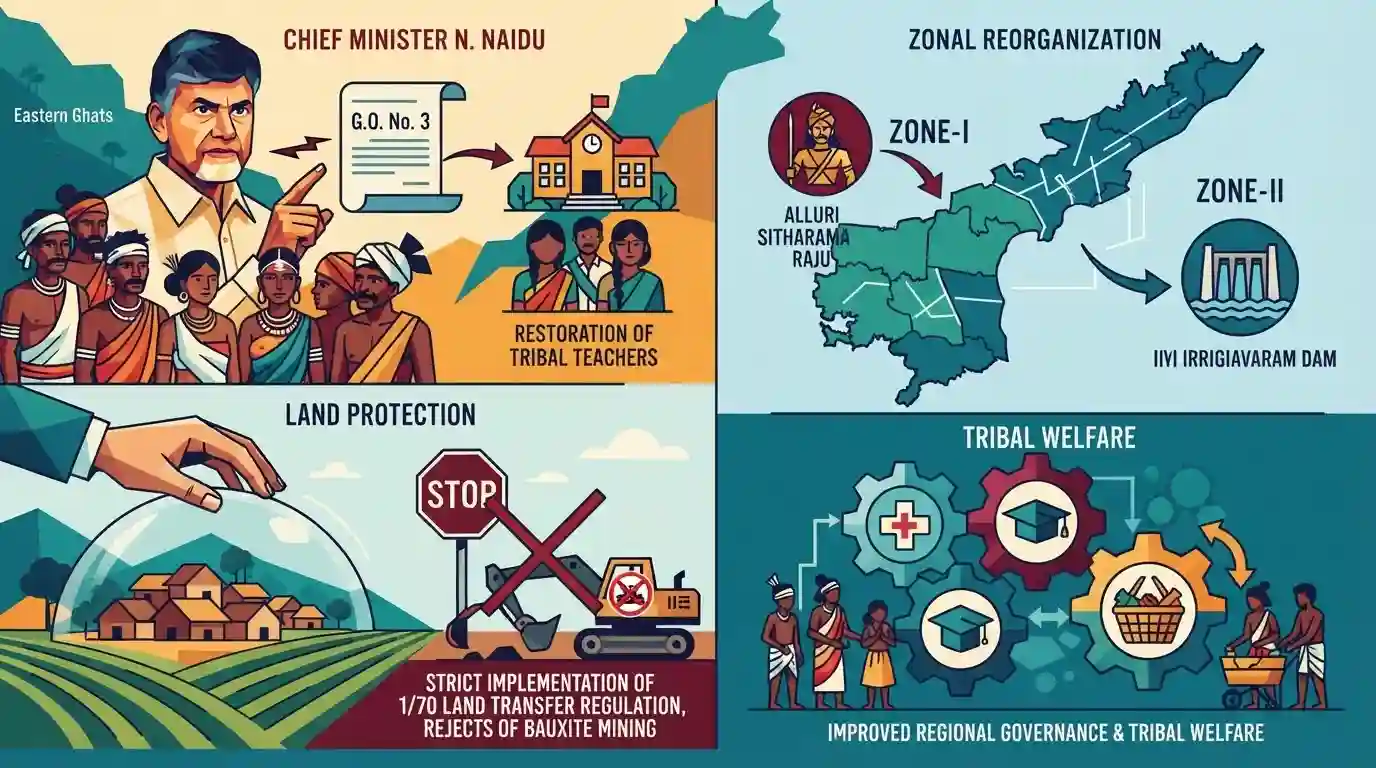
Andhra Pradesh Chief Minister N. Chandrababu Naidu has assured tribal organizations that the state is exploring legal avenues to restore the benefits of G.O. No. 3, which historically provided 100% reservation for tribal teachers in Scheduled Areas before being invalidated by the Supreme Court. The Chief Minister also committed to strictly implementing the 1/70 Land Transfer Regulation to protect tribal lands and promised that bauxite mining policies would respect tribal sentiments. Additionally, the administration plans to reorganize zones by placing Alluri Sitharama Raju district in Zone-I and Polavaram district in Zone-II to improve regional governance and tribal welfare.
ముఖ్య అంశాలు
- Andhra Pradesh CM N. Chandrababu Naidu assured tribal organizations that the government is seeking legal alternatives to G.O. No. 3, which granted 100% reservation for local tribal teachers but was struck down by the Supreme Court in 2020.
- The government reaffirmed its commitment to protecting tribal land ownership rights as enshrined in the 1/70 Land Transfer Regulation.
- Assurances were given that decisions regarding bauxite mining in Scheduled Areas would not undermine tribal rights or sentiments.
- Officials were directed to expedite administrative restructuring by moving Alluri Sitharama Raju district to Zone-I and Polavaram district to Zone-II.
ముఖ్యమైన పదాలు
G.O. No. 3

An Andhra Pradesh government order from 2000 that provided 100% reservation for Scheduled Tribe candidates in teacher posts within Scheduled Areas. The Supreme Court quashed it in 2020 for exceeding the 50% reservation ceiling.
UPSC context
Important for GS-II (Polity) under reservation policies, constitutional limits (Articles 14, 16), and the Indra Sawhney judgment's 50% cap.
1/70 Land Transfer Regulation
An amendment to the Andhra Pradesh Scheduled Areas Land Transfer Regulation. Popularly called the 1/70 Act, it absolutely prohibits the transfer of land in Scheduled Areas from tribals or the government to non-tribals.
UPSC context
Highly relevant for GS-II (Social Justice) and GS-III (Land Reforms) regarding the Fifth Schedule and the protection of tribal land rights.
Scheduled Areas
Regions with significant tribal populations designated under the Fifth Schedule of the Indian Constitution. They are subjected to special administrative provisions to protect the land, culture, and socioeconomic rights of indigenous communities.
UPSC context
Crucial for GS-II (Constitutional Provisions) testing knowledge of the Fifth Schedule, tribal administration, and the discretionary powers of the Governor.
Samatha Judgment
A landmark 1997 Supreme Court ruling holding that government, tribal, or forest land in Scheduled Areas cannot be leased to non-tribals or private companies for mining, reserving such operations only for state instrumentalities or tribal cooperatives.
UPSC context
Key for GS-II (Polity) and GS-III (Environment) to understand the judicial protection of the Fifth Schedule and sustainable development policies.
ప్రిలిమ్స్ ఉచ్చు
Governors possess absolute power under the Fifth Schedule to enact new laws guaranteeing 100% ST reservation.
The SC ruled in 2020 that Governor powers under Para 5(1) only allow applying/modifying existing laws and cannot violate Fundamental Rights or breach the 50% quota ceiling.
అనుసంధానమైన స్థిర భావనలు
What are the Governor's legislative powers under the Fifth Schedule?
- Modify existing laws: The Governor can direct that any Act of Parliament or the State Legislature shall not apply, or apply with specific modifications, to a Scheduled Area.
- Make regulations: Can frame regulations for 'peace and good government' (e.g., regulating land transfer and money lending) but only after consulting the Tribes Advisory Council.
- Constitutional limits: These powers cannot supersede Fundamental Rights, nor can the Governor independently enact entirely new legislative frameworks.
What is the significance of the Samatha Judgement (1997) for Scheduled Areas?
- State as a 'person': Declared the State Government is a 'person' under land transfer regulations, thus restricting it from leasing tribal lands to non-tribals or private companies.
- Mining restriction: Ruled that mining in Scheduled Areas can only be undertaken by state instrumentalities or recognized tribal cooperatives to prevent tribal alienation.
అంతర-అంశ నమూనాలు
Fifth Schedule vs. Part III Rights
The clash between affirmative tribal protections (G.O. No. 3) and fundamental equality (Articles 14, 16). UPSC frequently tests scenarios where special constitutional provisions yield to basic fundamental rights.
Bauxite Mining & Tribal Land Rights
Andhra's bauxite reserves heavily overlap with Fifth Schedule areas. Economic geography (aluminum industry locations) directly intersects with tribal protections, the Samatha Judgement, and the Forest Rights Act.

Expect a 2026 multi-statement question interlinking Governor's 5th Schedule powers, the Samatha ruling on mining, and Fundamental Rights.
అనుసంధాన PYQలు · 4
అనుసంధాన PYQలు · 4
- 2023APPSC_PRELIMSGS1
Which of the following Amendment(s) provide(s) for reservation in jobs and admissions ?
- 2023APPSC_PRELIMSGS1
According to the Indian Forest Act, 1927, which of the following is the most appropriate sequence which shows the degree of protection between different forest types ?
- 2023APPSC_PRELIMSGS1
Andhra Pradesh is the sole producer of
- 2023APPSC_PRELIMSGS1
How many Schedules are there in the Andhra Pradesh Reorganisation Act?
