Andhra Pradesh Plans Biodiversity Parks and Village Forests
Source:The Hindu ↗
Why It Matters
It showcases concrete state-level environmental governance initiatives. The article touches upon several high-yield UPSC topics, including the ecological significance of mangroves, the threat of invasive exotic species, and the conservation of specific, highly-tested biodiversity hotspots like the Seshachalam forests and red sanders.
Summary
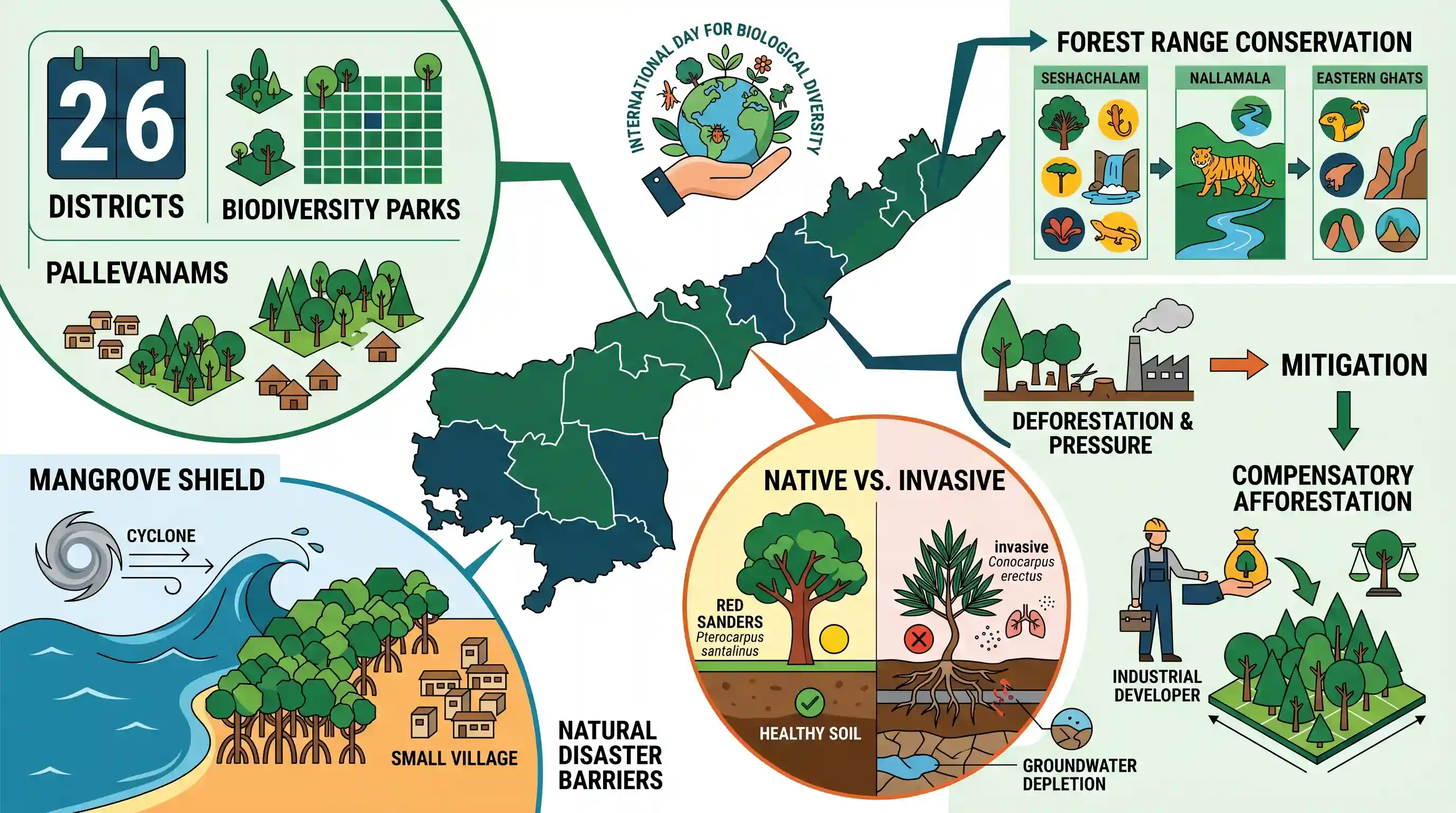
The Andhra Pradesh government, spearheaded by Deputy Chief Minister Pawan Kalyan, has announced the development of biodiversity parks in all 26 districts and 'Pallevanams' (village forests) across the state. Announced on the International Day for Biological Diversity, the initiative aims to combat deforestation and mitigate anthropogenic pressure on the environment. Key priorities include enforcing compensatory afforestation, protecting mangroves as natural disaster barriers, and conserving crucial forest ranges like Seshachalam, Nallamala, and the Eastern Ghats. The government also emphasized planting native tree species over exotic, potentially invasive plants like Conocarpus erectus.
Key Points
- The Andhra Pradesh government announced plans to establish biodiversity parks across all 26 districts and 'Pallevanams' (village forests) in villages to counter deforestation.
- Emphasis was placed on compensatory afforestation and the critical role of mangroves in acting as natural barriers against disasters like tsunamis.
- There is a strong focus on protecting regional biodiversity hotspots, including the Eastern Ghats, Papikondalu, Nallamala, and Seshachalam forests, particularly against the illegal felling of red sanders.
- The government advised against planting exotic species like Conocarpus erectus, advocating instead for native flora such as Neem, Peepal (Raavi), and Banyan (Marri) to preserve ecological balance.
Important Terms
Pallevanams

Small-scale village forests developed in Andhra Pradesh to enhance rural green cover, promote native biodiversity, and raise environmental awareness at the grassroots level.
UPSC context
GS III: Biodiversity & Environment. Represents community-based conservation and decentralized afforestation models often asked in Mains.
Conocarpus erectus
An exotic, invasive tree species native to Africa and the Americas, recently restricted in several Indian states due to its groundwater depletion and respiratory health hazards.
UPSC context
GS III: Invasive Alien Species. Tests knowledge of ecological threats and environmental management policies.
Seshachalam Biosphere Reserve
A protected area in the Eastern Ghats of Andhra Pradesh, famous for being the world's only natural habitat for the endemic and endangered Red Sanders (Pterocarpus santalinus).
UPSC context
GS I: Geography & GS III: Biodiversity. Focuses on endemic flora, conservation threats like smuggling, and physical geography.
Andhra Pradesh State Biodiversity Board (APSBB)
A statutory body established under the Biological Diversity Act, 2002, to advise the state on conservation and ensure equitable sharing of benefits from biological resources.
UPSC context
GS II: Statutory Bodies. Tests the institutional framework for environmental governance and decentralized conservation in India.
Compensatory Afforestation (CAMPA)
A legal mechanism under the CAMPA Act, 2016, requiring developers to pay for planting forests elsewhere to offset the diversion of forest land for non-forest purposes.
UPSC context
GS III: Environmental Impact Assessment. Crucial policy tool for sustainable development and balancing industrial growth with forest cover.
Mangroves
Coastal salt-tolerant vegetation that serves as a critical natural barrier against storm surges, tsunamis, and coastal erosion, particularly along Andhra Pradesh's coastline.
UPSC context
GS III: Disaster Management & Environment. Relevant for coastal ecology and ecosystem-based disaster risk reduction strategies.
Prelims Trap
Conocarpus erectus is a protected native mangrove species.
UPSC mixes native flora with harmful invasives. Conocarpus erectus is actually an exotic invasive shrub planted for urban greening that damages groundwater, not a native mangrove.
Static Concepts Connected
How are funds distributed and utilized under the CAMPA Act, 2016?
- Fund split: 90% of the funds go to the State Compensatory Afforestation Fund, while 10% is retained by the National Fund.
- Core purpose: Compensates for forest land diverted for non-forest purposes (like mining) by mandating equivalent afforestation.
- Restricted usage: Funds cannot be used for administrative overheads, salary payments, travel allowances, or building infrastructure.
What are the core ecological features of the Seshachalam Biosphere Reserve?
- Forest type: The region is predominantly characterized by tropical dry deciduous forests.
- Endemic flora: It serves as the strict endemic habitat for the endangered Red Sanders (Pterocarpus santalinus) tree.
- Tribal groups: The reserve is historically home to indigenous tribal populations such as the Yanadis.
Cross-Topic Patterns
Urban greening schemes & invasive species
State-led afforestation programs often clash with ecological balance when fast-growing exotics like Conocarpus are used, linking urban forestry initiatives directly to biodiversity loss.
State micro-forestry & national targets
Andhra's 'Pallevanams' decentralize forest creation to the village level, mirroring and supplementing national urban and rural forestry schemes like the Nagar Van Yojana.

Expect a 2026 Prelims question testing the ecological hazards of specific exotic species used in urban greening, like Conocarpus erectus.
Linked PYQs · 3
Linked PYQs · 3
- 2024PrelimsGS1
Consider the following : 1. Cashew 2. Papaya 3. Red sanders How many of the above trees are actually native to India?
- 2014PrelimsGS1
The most important strategy for the conservation of biodiversity together with traditional human life is the establishment of
- 2013PrelimsGS1
Which one of the following is the correct sequence of ecosystems in the order of decreasing productivity?
