Prahaar National Counter Terrorism Policy Framework
Source:Indian Express ↗
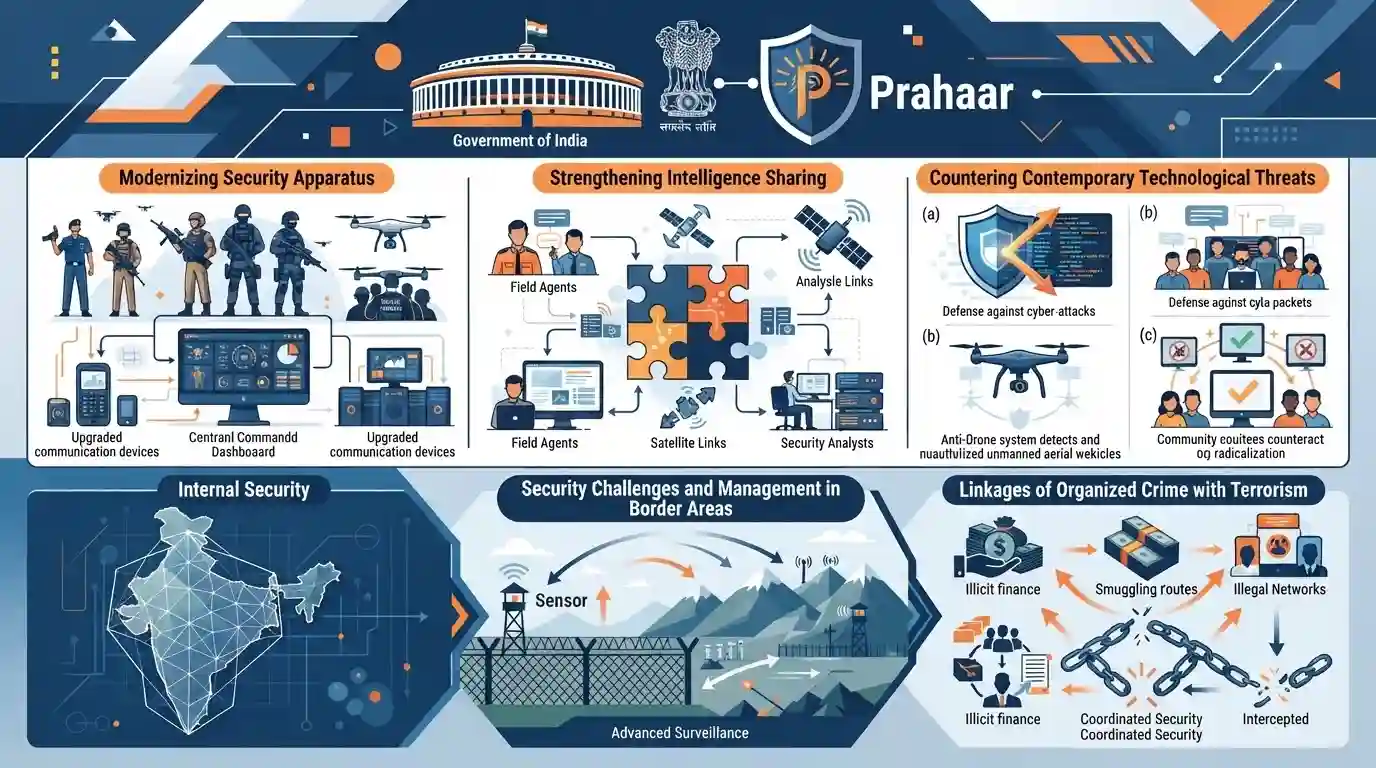
આ શા માટે મહત્વનું છે
As India's first dedicated national counter-terrorism policy, 'Prahaar' represents a watershed moment in the country's internal security architecture, establishing a unified strategic blueprint to tackle tech-driven and transnational terror threats.
સારાંશ
The Government of India has unveiled 'Prahaar', the country's first comprehensive counter-terrorism policy designed to modernize the security apparatus, strengthen intelligence sharing, and counter contemporary technological threats such as cyber-attacks, drones, and radicalisation.
મુખ્ય મુદ્દા
- India unveiled its first comprehensive counter-terrorism policy named 'Prahaar'.
- The policy aims to systematically address emerging threats like radicalisation, cyber-terrorism, use of drones, and darknet financing.
- It seeks to synergize intelligence, law enforcement agencies, and international cooperation to combat state and non-state terror actors.
મહત્વપૂર્ણ શબ્દો
Prahaar

India's first comprehensive national counter-terrorism policy and strategy, designed to shift from a reactive to a proactive, intelligence-led approach to counter modern security threats like cyber-attacks, drones, and radicalisation.
UPSC context
Important for GS Paper III (Internal Security - Security challenges and management in border areas, linkages of organized crime with terrorism).
Ministry of Home Affairs
The central government ministry responsible for the internal security of the country, border management, formulation of internal security policies, and overseeing central armed police forces.
UPSC context
Important for GS Paper II & III (Government Policies & Interventions, Internal Security governance and institutional framework).
પ્રિલિમ્સ ટ્રેપ
India had previously codified a comprehensive counter-terrorism policy under the 2008 National Security Act framework.
Aspirants often assume India had a unified statutory counter-terrorism policy prior to Prahaar, whereas past approaches relied on piecemeal legislative amendments (UAPA, NIA Act) and agency notifications rather than an integrated doctrine.
સંલગ્ન સ્થિર ખ્યાલો
What are the key institutional mechanisms and legal frameworks governing counter-terrorism in India?
- UAPA (1967): Acts as the primary anti-terrorism law in India, empowering the central government to designate individuals and groups as terrorists.
- NIA Act (2008): Established post-2008 Mumbai attacks as the central agency to investigate and prosecute terror offenses across state boundaries without separate state permission.
- NATGRID & Multi-Agency Centre (MAC): Multi-agency center operating under the Intelligence Bureau to ensure real-time intelligence sharing among security and law enforcement agencies.
આંતર-વિષય પેટર્ન
Counter-Terrorism Policy + Emerging Tech Governance
Combines national counter-terrorism doctrine (Internal Security) with emerging disruptive tech governance like drone rules and darknet monitoring (Science & Tech).
Internal Security + Intelligence Architecture Reform
Reflects the evolution from reactive anti-terror responses to proactive intelligence synergy and institutional border-to-interior security frameworks.

First comprehensive counter-terrorism policies like Prahaar are high-probability match-ups for multi-statement prelims or Mains GS-3 security questions.
સંલગ્ન PYQ · 2
સંલગ્ન PYQ · 2
- 2023MainsGS3
What are the internal security challenges being faced by India? Give out the role of Central Intelligence and Investigative Agencies tasked to counter such threats.
- 2021MainsGS3
Analyse the multidimensional challenges posed by external state and non-state actors, to the internal security of India. Also discuss measures required to be taken to combat these threats.
